Jack Whyte - The Lance Thrower
Здесь есть возможность читать онлайн «Jack Whyte - The Lance Thrower» весь текст электронной книги совершенно бесплатно (целиком полную версию без сокращений). В некоторых случаях можно слушать аудио, скачать через торрент в формате fb2 и присутствует краткое содержание. Жанр: Старинная литература, на английском языке. Описание произведения, (предисловие) а так же отзывы посетителей доступны на портале библиотеки ЛибКат.
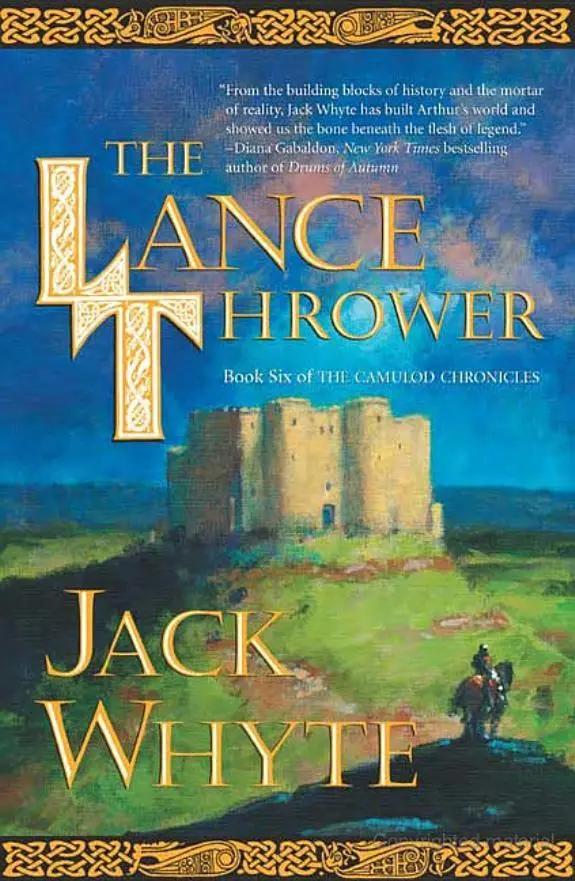
- Название:The Lance Thrower
- Автор:
- Жанр:
- Год:неизвестен
- ISBN:нет данных
- Рейтинг книги:5 / 5. Голосов: 1
-
Избранное:Добавить в избранное
- Отзывы:
-
Ваша оценка:
The Lance Thrower: краткое содержание, описание и аннотация
Предлагаем к чтению аннотацию, описание, краткое содержание или предисловие (зависит от того, что написал сам автор книги «The Lance Thrower»). Если вы не нашли необходимую информацию о книге — напишите в комментариях, мы постараемся отыскать её.
Clothar is a young man of promise. He has been sent from the wreckage of Gaul to one of the few schools remaining, where logic and rhetoric are taught along with battle techniques that will allow him to survive in the cruel new world where the veneer of civilization is held together by barbarism. He is sent by his mentor on a journey to aid another young man: Arthur Pendragon. He is a man who wants to replace barbarism with law, and keep those who work only for destruction at bay. He is seen, as the last great hope for all that is good.
Clothar is drawn to this man, and together they build a dream too perfect to last--and, with a special woman, they share a love that will nearly destroy them all...
The name of Clothar may be unknown to modern readers, for tales change in the telling through centuries. But any reader will surely know this heroic young man as well as they know the man who became his king. Hundreds of years later, chronicles call Clothar, the Lance Thrower, by a much more common name.
That of Lancelot.
The Lance Thrower — читать онлайн бесплатно полную книгу (весь текст) целиком
Ниже представлен текст книги, разбитый по страницам. Система сохранения места последней прочитанной страницы, позволяет с удобством читать онлайн бесплатно книгу «The Lance Thrower», без необходимости каждый раз заново искать на чём Вы остановились. Поставьте закладку, и сможете в любой момент перейти на страницу, на которой закончили чтение.
Интервал:
Закладка:
On the last dash for home I decided to leave the flat valley bottom and cut off some distance by riding higher, taking a straighter route along the gently sloping shoulder of the hillside that stretched above me on the right. But just as my mount breasted the last angled line of hillside that lay between me and the finishing line, I suddenly saw Balbus coming down at me from above, on my right. He, too, had chosen to climb, but had gone even higher than I had, gambling that he would be able to cut my lead and beat me on the downhill dash into the last turn. I saw him just in time and kneed my mount to the left, sending him downhill, not steeply but sufficiently to stay ahead of Balbus. My horse, a surefooted animal that I had ridden many times, lost his footing somehow on the slick, rain-wet shale of the hillside and went sprawling, hurling me over his head like a living boulder. Neither my horse nor I was seriously injured, but we were nonetheless effectively out of the race. By the time I had collected myself and clambered back up onto the bay’s back after checking him for injuries, five riders had galloped past us and we were unable to catch any of them thereafter.
I arrived back in the stable yards glowering blackly and biting down on my self-disgust, but I could not even have the satisfaction of being angry at Balbus. He had done nothing wrong, apart from inducing me to make an error of judgment and then going on to win the race.
Less than an hour later, my earlier disappointment forgotten, I was in the middle of what we called the battle, the most chaotic but also the most enjoyable part of the competition. It was a remnant of the truly ancient gladiatorial contests in which, as the climax of a set of games, there would be a general fight in which it was every man for himself and the last man left standing could win his freedom. Our version of the event was nowhere near so bloodthirsty, but it was our tradition that the last man standing would be declared the day’s victor, which meant that even an underdog who had fared badly in the individual contests of strength and skill had a theoretical chance to emerge victorious over all others. There were almost as many umpires on our battlefield as there were combatants, too, their object being to identify and remove participants who were clearly beaten before they could suffer any real physical damage. The combatants all wore heavily padded protective leather helmets and fought in armor built of boiled and hammered layered leather; solid metal was too cumbersome and heavy for most boys. The weapons were standard shields and wooden practice swords of heavy ash or oaken dowel.
The combat began with every contestant mounted on horseback, and the theory was that the man who remained mounted for the longest time ought to emerge as the easy victor. Theory, however, seldom survives for any length of time against reality and human ingenuity. It had quickly become standard activity in our school battles for those who were first unhorsed to join forces on the ground and unseat everyone who remained on horseback. Then, when the last man had been unhorsed, the battle began on foot and in earnest.
The ground-level battlefield was not a pleasant spot for those who took no joy in passages of arms, because the danger of serious injury was very real. There were always students—usually the younger, smaller boys—who would take part gleefully in the early portion of the battle, milling around in the crush until they were unhorsed and then joining forces to bring down their elders and betters. They would then defect soon thereafter, citing self-declared and self-determined wounds during the confusion of the first few moments of the main fighting. The majority of the larger boys, particularly at the outset of each battle, had high hopes of winning the contest by themselves, and laid about them enthusiastically, slashing at everyone who came within reach. Reality asserted itself quickly, however, as arms and wind began to tire after but a few moments of savage, energy-sapping swings that missed their targets but nonetheless took their toll on the swingers.
In the end, the contest invariably boiled down to a struggle between the same eight or ten boys who had been predicted as final-stage fighters long before the event began, and this occasion proved no exception. By the time the initial frenzy began to dissipate and I had an opportunity to take a wary step back and look quickly about me while I snatched a breath of air, I found I was now sharing the arena with five opponents. Even as I counted them, however, one of them, a classmate called Serdec, took a thrust in the gut that dropped him to his knees. His shield fell away, leaving him open to a crushing blow that might have cracked his skull had it not been struck aside by a vigilant umpire.
Serdec was out, leaving five of us, and even then, as I counted, the number shrank to four as another fighter, Balbus this time, was hit savagely between the shoulders and then again on the back of the helmet as he went to his knees, head down. I didn’t wait to see him fall forward but swung away, my own shield up in anticipation of being attacked simply because I had stopped moving to look, but there was no one near me and I was in no danger. I was alone in that part of the field and I took immediate advantage of the respite, dropping the tip of my wooden sword to earth to rest my arm muscles as I looked about me for the best spot from which to defend myself against whoever would eventually come against me.
For hundreds of years the legions of Rome had trained with practice swords that were double the weight of the real swords they would use in battle, and the reasons for that were simple, admirable, and perfectly understandable: after having trained for years with heavy practice weapons of oak or ash doweling, a real sword, wielded in battle, felt practically weightless to the soldier using it. For our battle we were similarly encumbered with the brutally heavy practice swords. These often became too heavy even to hold after a period of prolonged use, and so I stood there gratefully, my arms dangling, feeling the deadweight of the weapons I was holding but enjoying the sensation of exhilaration as new strength came flooding back into my tired muscles.
The fighter who had finished off Balbus was a large boy from Germania whose real name had been unpronounceable to anyone when he first came to the school. Because of that, he had quickly been nicknamed Lupus, because someone had said he looked just like a big German wolf, and nowadays no one in the school knew what his real name was. This fellow was now moving quickly toward Lorco, his gait a combination of trotting and sidling as he maneuvered to come in behind Lorco’s opponent, another Spartan called Borus. Borus saw him coming, however, and shifted his stance warily, circling away from Lupus and trying to assess whether the newcomer would tackle him or join him in attacking Lorco. Apparently none of them had noticed me, still on my feet and armed, less than thirty paces from them. Borus had done his own calculations, however, and with a wave of the hand he invited Lorco to join him in a combined assault on Ursus, the largest of the three. They closed on him together, from right and left, and he did not last long at all against their combined assault. He lost his wooden sword to a smashing blow from Lorco so that he had only his shield for defense and no offensive weapon at all. The umpires declared him dead immediately, and he slumped and lowered his shield, hanging his head dejectedly as his two erstwhile opponents turned their heads to look at me.
I had taken advantage of the time accorded me to choose my own fighting ground and prepare myself to meet them, and I stood crouched on the only spot in the entire arena that might be described as high ground, a tiny knoll that afforded me a very slight advantage over them in height. I was half convinced that Lorco would take sides with me against Borus if I invited him to join me, but the other half of me argued that even if he did join me, I would then be forced to abandon my position on the little knoll, and then I would have to fight Lorco on equal terms, once we had beaten Borus. I held my ground, facing them both blank-faced and keeping my wrist cocked threateningly, my sword’s point up and ready to swing in any direction. They shuffled their feet, hesitating, doubtless reviewing their own plans should the next few moments bring them both against me. The next move, and the decision that would precipitate it, would be momentous, and at the instant when the die was cast, all three of us knew, the one of us left to fight alone against the other two would be out of the contest, which would then be settled between the pair who remained.
Читать дальшеИнтервал:
Закладка:
Похожие книги на «The Lance Thrower»
Представляем Вашему вниманию похожие книги на «The Lance Thrower» списком для выбора. Мы отобрали схожую по названию и смыслу литературу в надежде предоставить читателям больше вариантов отыскать новые, интересные, ещё непрочитанные произведения.







Обсуждение, отзывы о книге «The Lance Thrower» и просто собственные мнения читателей. Оставьте ваши комментарии, напишите, что Вы думаете о произведении, его смысле или главных героях. Укажите что конкретно понравилось, а что нет, и почему Вы так считаете.