Jack Whyte - The Lance Thrower
Здесь есть возможность читать онлайн «Jack Whyte - The Lance Thrower» весь текст электронной книги совершенно бесплатно (целиком полную версию без сокращений). В некоторых случаях можно слушать аудио, скачать через торрент в формате fb2 и присутствует краткое содержание. Жанр: Старинная литература, на английском языке. Описание произведения, (предисловие) а так же отзывы посетителей доступны на портале библиотеки ЛибКат.
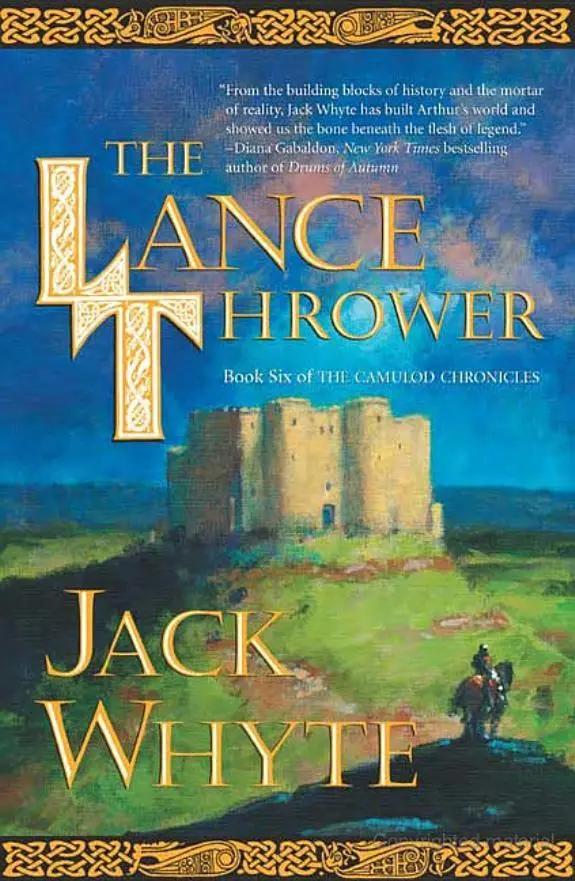
- Название:The Lance Thrower
- Автор:
- Жанр:
- Год:неизвестен
- ISBN:нет данных
- Рейтинг книги:5 / 5. Голосов: 1
-
Избранное:Добавить в избранное
- Отзывы:
-
Ваша оценка:
The Lance Thrower: краткое содержание, описание и аннотация
Предлагаем к чтению аннотацию, описание, краткое содержание или предисловие (зависит от того, что написал сам автор книги «The Lance Thrower»). Если вы не нашли необходимую информацию о книге — напишите в комментариях, мы постараемся отыскать её.
Clothar is a young man of promise. He has been sent from the wreckage of Gaul to one of the few schools remaining, where logic and rhetoric are taught along with battle techniques that will allow him to survive in the cruel new world where the veneer of civilization is held together by barbarism. He is sent by his mentor on a journey to aid another young man: Arthur Pendragon. He is a man who wants to replace barbarism with law, and keep those who work only for destruction at bay. He is seen, as the last great hope for all that is good.
Clothar is drawn to this man, and together they build a dream too perfect to last--and, with a special woman, they share a love that will nearly destroy them all...
The name of Clothar may be unknown to modern readers, for tales change in the telling through centuries. But any reader will surely know this heroic young man as well as they know the man who became his king. Hundreds of years later, chronicles call Clothar, the Lance Thrower, by a much more common name.
That of Lancelot.
The Lance Thrower — читать онлайн бесплатно полную книгу (весь текст) целиком
Ниже представлен текст книги, разбитый по страницам. Система сохранения места последней прочитанной страницы, позволяет с удобством читать онлайн бесплатно книгу «The Lance Thrower», без необходимости каждый раз заново искать на чём Вы остановились. Поставьте закладку, и сможете в любой момент перейти на страницу, на которой закончили чтение.
Интервал:
Закладка:
I heard voices from the bishop’s day room as I passed along the passageway that ran between Germanus’s private quarters and his working, public rooms, and was quietly relieved to know that the meeting of the senior clerics, whatever it concerned, was still in progress and I had not, therefore, kept the bishop waiting. I knocked nonetheless before entering his private rooms and was unsurprised when one of the lay brethren opened the door and, waving me forward with the broom he was clutching, ushered me into the familiar anteroom, where a wood fire burned briskly in an iron basket set in an ornate fireplace in the wall near the entrance. I thanked the man courteously and took the chair he indicated, beside the fireplace, and settled in to wait for the bishop. The lay brother, who had not spoken a word and whose name I did not know, nodded to me and then quietly withdrew into what I knew was the bishop’s bedchamber, where he was obviously doing some kind of cleaning chore. A pocket of resin in one of the logs on the fire ignited and spat loudly, making me jump, and I gazed into the burning mass, trying to detect where the explosion had occurred.
I had seen stone fireplaces indoors before—life in King Ban’s great stone castle, with its thick walls, tiny windows, and perpetually darkened rooms would have been intolerable without huge fireplaces, and logs that were large enough to be considered tree trunks were kept burning in them night and day, to banish the shadows and generate much-needed heat. Until I came to Auxerre, however, I had never seen a smaller version, in a smaller, brighter, better-lit household—and having said that, I must add that until then I had never even imagined the existence of smaller, brighter, better-lit households. I knew of only two kinds of dwellings: the stone huts that ordinary people lived in where I came from, which varied in size but never in design, being either round or square and consisting only of one common room, usually windowless; and the massive fortresses in which the rulers lived. The presence of light indoors, in an unfortified dwelling place, and the feelings of spacious airiness created by that light, had been the single most telling difference I found between life in Auxerre and the Bishop’s School and life in the land in which I had grown up with King Ban and Queen Vivienne. Here, in the civilized fastnesses of north-central Gaul, where peace had reigned virtually uninterrupted for hundreds of years, people had learned how to live elegantly, in wondrous houses built with pleasure and entertainment in mind.
Indoor fireplaces were yet uncommon here. I knew of only six others in addition to the one here in the anteroom to Germanus’s sleeping chamber. He had worked and soldiered too long under a hot sun, the bishop said, to permit him to be warm away from the sun’s direct rays, and so he kept a fire near him at all times, even going to the extreme lengths of building one into his house. I found it amusing but thought-provoking that every one of the other five similar fireplaces I had seen were in the homes of retired soldiers, men who, like Germanus, had spent years and even decades on campaign beneath desert suns.
“Ah, Clothar, you are here. I hope you have not been waiting long?”
I leaped to my feet, not having heard Germanus enter the room, but he was already waving me back into my seat.
“Stay, stay where you are.” He crossed the room to the long table beneath the glazed window opposite the fireplace and carefully placed the parchment scrolls he had been carrying so that they would not roll off and tumble to the floor, moving a heavy inkwell against one side of the pile to ensure that they would stay. That done, he turned back to gaze at me in silence for some time. I gazed back, but although he was looking at me, I knew he was not really seeing me, for it was clear that his mind was elsewhere. His lower lip was thrust forward, covering the line of his upper one completely, and I knew that this indicated deep thought prior to some momentous announcement, for that expression, known throughout the school as the Bishop’s Pout, appeared only in times of extreme deliberation and deep concern, and everyone who knew Germanus recognized it immediately.
“Is something wrong, Father Germanus?” I asked, daring to interrupt his thoughts. He blinked, then seemed to shake himself although he made no visible move.
“No.” I could tell from his voice that that was true. “No, there is nothing wrong, nothing at all. It’s simply that—” He broke off and frowned slightly. “It seems like an unconscionable time since last we spoke. When was it?”
“Eight weeks ago, Father. The day before you left to go to Britain.”
“Aye, right, eight weeks ago … Dear Lord, the time is flying nowadays. Eight weeks, gone in a blink, and it seems but yesterday since I was talking to Ludovic about our plans for traveling, and that in itself must have been nigh on half a year ago.” He paused, and then asked, “Did you really believe it necessary for your friend Lorco to win this afternoon?”
I gaped at him, caught off balance yet again by the sudden emergence of this question when I had not expected it, but this time, having been through the exercise of discussing the matter with Tiberias Cato, I responded more quickly and more easily.
“Yes, Father. I did.”
“Hmm. Why? Do you object to my asking?”
“No, Father, of course not, but Tiberias Cato and you both noticed what happened. Do you think anyone else saw?”
Father Germanus shook his head tersely. “No, I doubt it. Cato and I noticed it because we both know you as well as we do, and we saw … shall we say, a certain lack of fire and energy in your attack? Duke Lorco took great pleasure in his son’s prowess. You intended that to be the case, did you not?” I nodded. “I thought so. Why?”
I shrugged. “Lorco is my friend, sir, and his father’s esteem is important to him. I saw that today, and I first noticed it yesterday, when word came of his father’s visit. It was good that he should win and make his father proud.”
The bishop smiled a tiny smile and raised his right hand to bless me. “Peace be upon you, then. I shall beseech God in my prayers to furnish you with friends worthy of such loyalty and trust.”
I smiled and nodded. “Thank you, Father.”
“Do not thank me, boy. Friendship is God’s gift for fortunate men to share. It is a wonderful phenomenon and it exists according to its own rules and regulations. Its criteria are unique unto itself and it is restrained by none of the usual demands that people place upon other people’s behavior.”
Once launched upon a favorite topic—and I knew by this time that the bishop loved to talk about the criteria governing friendship—Germanus could be virtually unstoppable. I sat back and listened for a long time as he held forth on all that he believed about friendship, and much of what he told me that afternoon is still as alive in me today, and as fresh and credible, as it was when I first heard it that day.
He talked about the nature of friendship and about its durability; about how it could, and often did, spring out of nowhere, fully formed to take both members of the relationship by surprise, and then he went on to describe how, at other times and in other circumstances, it might grow slowly and almost unnoticeably, unsuspected by either participant. He pointed out to me, too, that friendship is untrammeled and unconstrained in its acceptance in a friend of appearances and personality quirks that would be unacceptable in anyone else; and from there he progressed to a discussion—albeit one-sided—of the nature of friendship and its relationship to love.
I listened, fascinated, to everything he had to say, hanging on his every word and feeling no urge to speak or to intrude upon what he was unfolding to me.
Читать дальшеИнтервал:
Закладка:
Похожие книги на «The Lance Thrower»
Представляем Вашему вниманию похожие книги на «The Lance Thrower» списком для выбора. Мы отобрали схожую по названию и смыслу литературу в надежде предоставить читателям больше вариантов отыскать новые, интересные, ещё непрочитанные произведения.








Обсуждение, отзывы о книге «The Lance Thrower» и просто собственные мнения читателей. Оставьте ваши комментарии, напишите, что Вы думаете о произведении, его смысле или главных героях. Укажите что конкретно понравилось, а что нет, и почему Вы так считаете.