Jack Whyte - The Lance Thrower
Здесь есть возможность читать онлайн «Jack Whyte - The Lance Thrower» весь текст электронной книги совершенно бесплатно (целиком полную версию без сокращений). В некоторых случаях можно слушать аудио, скачать через торрент в формате fb2 и присутствует краткое содержание. Жанр: Старинная литература, на английском языке. Описание произведения, (предисловие) а так же отзывы посетителей доступны на портале библиотеки ЛибКат.
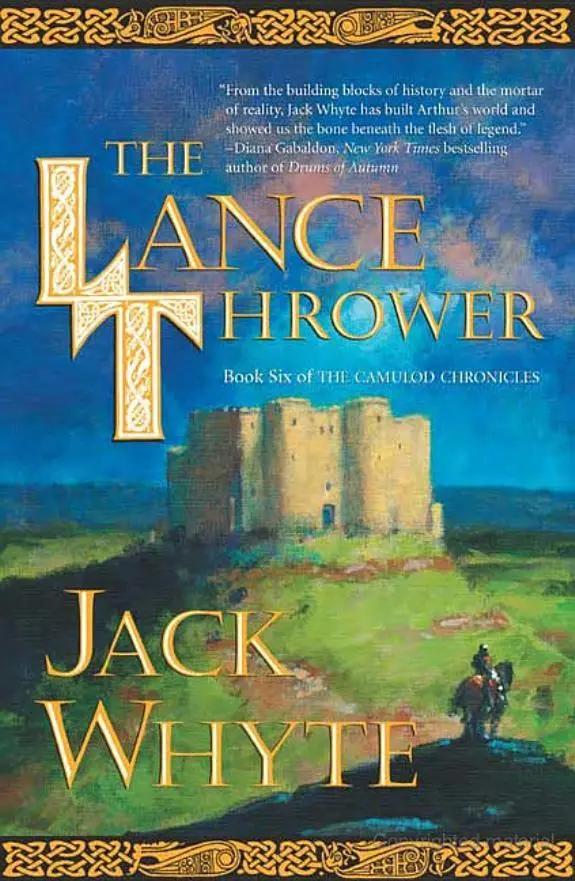
- Название:The Lance Thrower
- Автор:
- Жанр:
- Год:неизвестен
- ISBN:нет данных
- Рейтинг книги:5 / 5. Голосов: 1
-
Избранное:Добавить в избранное
- Отзывы:
-
Ваша оценка:
The Lance Thrower: краткое содержание, описание и аннотация
Предлагаем к чтению аннотацию, описание, краткое содержание или предисловие (зависит от того, что написал сам автор книги «The Lance Thrower»). Если вы не нашли необходимую информацию о книге — напишите в комментариях, мы постараемся отыскать её.
Clothar is a young man of promise. He has been sent from the wreckage of Gaul to one of the few schools remaining, where logic and rhetoric are taught along with battle techniques that will allow him to survive in the cruel new world where the veneer of civilization is held together by barbarism. He is sent by his mentor on a journey to aid another young man: Arthur Pendragon. He is a man who wants to replace barbarism with law, and keep those who work only for destruction at bay. He is seen, as the last great hope for all that is good.
Clothar is drawn to this man, and together they build a dream too perfect to last--and, with a special woman, they share a love that will nearly destroy them all...
The name of Clothar may be unknown to modern readers, for tales change in the telling through centuries. But any reader will surely know this heroic young man as well as they know the man who became his king. Hundreds of years later, chronicles call Clothar, the Lance Thrower, by a much more common name.
That of Lancelot.
The Lance Thrower — читать онлайн бесплатно полную книгу (весь текст) целиком
Ниже представлен текст книги, разбитый по страницам. Система сохранения места последней прочитанной страницы, позволяет с удобством читать онлайн бесплатно книгу «The Lance Thrower», без необходимости каждый раз заново искать на чём Вы остановились. Поставьте закладку, и сможете в любой момент перейти на страницу, на которой закончили чтение.
Интервал:
Закладка:
Love, he maintained, is an essential part of friendship, although it might be seldom mentioned by the friends themselves, but friendship may not necessarily be a part of love. Physical love—sexual love—and the state of being in love he explained as being conditions that completely enfold two individual people, fusing them emotionally and inexorably into a single unit of awareness and rendering them generally oblivious to everything else that is taking place in the world about them. They are a pair, but in the fiery singularity of their love for each other they exist as a single entity that shuts out the rest of the world.
Friendship, on the other hand, while also confined to two people, involved each of the two less exclusively and far less selfishly. Lovers demanded closeness— propinquity was the word he used—but friends could remain friends at opposite ends of the world and their friendship was undeterred by years of separation. Each friend in a pair might have many other friends, and those friends might like or dislike any of their friend’s other friends, but the initial pair’s friendship was a thing unique to the two of them, and though they might choose to extend the privilege of their friendship to others, their own friendship remained strictly and at all times a private matter between the two of them. I blinked, I recall, when he said that, but I managed to follow it without difficulty.
True friendship, he asserted in summing up, was a unique and divinely privileged phenomenon, and in consequence it was a condition that occurred only rarely in the life of any single person. If a man could name five close, lifetime friends before he died, Germanus said, then that man’s life had truly been blessed.
I clearly remember that as I listened to him say that I felt uncomfortable, skeptical, and even slightly embarrassed by what I perceived as his naivety, for I was fifteen years old and had a wealth of friends—scores of them, I thought. I was prepared to accept everything else that Germanus had had to say on the subject of friends and friendship, and in fact I had been delighted to hear him endorse some of the ideas that had occurred to me in thinking about my friends, but I really did believe that he was being ingenuous in insisting upon this scarcity of true friendship. Alas, two decades were to pass before I came to appreciate what he had meant.
“Now, I have a task for you, should you be willing to accept it.”
I straightened with a jerk, aware that I had been woolgathering.
“Anything, Father,” I said. “Anything, and gladly.”
“Hmm. Enthusiasm, without knowing what is involved? Thank you.” Smiling at his own observation, he crossed to the armchair on the other side of the fire and sat down, tugging at the voluminous folds of his outer garment and shifting in his seat until he had adjusted everything and could sit in comfort. “I want you to go home,” he said, and then, before I could react, he held up his palm to forestall me. “I have just returned from Britain, as you know, and much has happened while I was over there—happened here, I mean, in Gaul, not merely in Britain.”
I nodded, silently, and waited.
“I was supposed to spend last night in Lutetia, for no other reason originally than the fact that it lies on the direct route here from the coast. But it is also a central point for irregular gatherings of bishops, and one of those was convened while I was in Britain, in response to several urgent matters that arose unexpectedly and could not safely be postponed. It was known that I would be returning shortly from Britain, but couriers were dispatched to find me sooner and to summon me to the gathering in Lutetia as quickly as I could travel. They missed me on their first pass because I had made a detour for reasons of my own, and by the time they found me I was preparing to leave for home, so they only gained a single day on my planned schedule. Thus I arrived in Lutetia one day earlier than I had intended, and spent not one but two nights there, conferring there with my pastoral brethren.”
His face clouded, and he sat staring for a space of moments into the flames in the fire basket, but then he collected himself again and straightened slightly, looking me in the eye. “You may or may not have heard mutterings of what is going on in the world outside our school, but there is widespread unrest, and troublesome events are shaping up here in Gaul … very real threats of another war, which is the last thing any of us needs. These threats are arising from several sources. Most particularly, however, they are emanating from the lands of the Burgundian tribes, to the south and west of where we sit today. The imperial military intelligence people have been warning us for years now that the Burgundians are poised to spill out of their present holdings in an attempt to conquer all of central and southern Gaul, and first and foremost, from my perspective, those are not good tidings for the Church. The Burgundians, as you know, are not Christian and are, in fact, violently opposed to us and to our faith. They seem to delight in killing priests and bishops and in persecuting the faithful wherever they find them, and so we—my brother bishops and our clergy—will be using all the influence at our disposal, marshaling and channeling our combined resources to deflect and disarm the rebels’ initiatives however and wherever we can—working in conjunction, of course, with the legions.” Again he paused, considering his next words.
“It was forewarnings of a Burgundian revolt that caused the Imperial Administration in Treves to summon Duke Lorco here from his base in Carcasso, but I have received forewarnings, too, from my own sources, concerning another aspect of the same revolt, and that is why I require your assistance—not because you are a doughty fighter and a champion of God’s work, although you show all the signs of growing into such strengths, but because you are Ban’s nephew and adopted son and Ban is my friend. And so I would have you leave here in four days’ time, bearing messages from me to your kinsman Ban and traveling with your friend Stephan Lorco and his father the Duke when they leave to return to their own lands in the south. Their journey home to Carcasso will take them within sixty miles of where you live, and I have asked the Duke to provide you with an escort from his group for that short portion of the journey that will remain to bring you to Genava. He assures me that he will see you safely delivered home. Will you do this for me?”
“Of course, Father,” I said, attempting to mask my disappointment at being sent home from school before my just time had elapsed. Even as I voiced my consent, however, I saw that he had told me nothing other than that he was sending me away. Because King Ban, my uncle, was his friend, he had said, Germanus wanted me to leave his school and go home. For what purpose? And if it were only to bear messages, why would he send me and not a fast-riding courier? Beginning to grow increasingly confused, I bit down upon my rising panic and forced myself to try to speak what was on my mind. “You want me to carry a message to King Ban … from you and in person … but what do you wish me to tell him, Father?”
He seemed completely unaware of my discomfiture and merely smiled, shaking his head very slightly in dismissal of any concerns I might have. “Nothing that you need lose sleep about. I will put everything into words on paper in the next few days, because it is of extreme importance that I say what must be said properly, with no possibility of being misunderstood. I shall therefore write, and rewrite, and write yet again. It will be sufficient for you to carry the missives that I write to your uncle the King, thereby assuring him that they come directly from me to him, as a friend. That done, and having spent some pleasant and restful times with your aunt, the Lady Vivienne, you will hie yourself back here as soon as may be, for this is merely the first such task I have assigned to you and by the time you return I will have great need of you … .” He broke off, arching one eyebrow. “You wish to say something.”
Читать дальшеИнтервал:
Закладка:
Похожие книги на «The Lance Thrower»
Представляем Вашему вниманию похожие книги на «The Lance Thrower» списком для выбора. Мы отобрали схожую по названию и смыслу литературу в надежде предоставить читателям больше вариантов отыскать новые, интересные, ещё непрочитанные произведения.








Обсуждение, отзывы о книге «The Lance Thrower» и просто собственные мнения читателей. Оставьте ваши комментарии, напишите, что Вы думаете о произведении, его смысле или главных героях. Укажите что конкретно понравилось, а что нет, и почему Вы так считаете.