Jack Whyte - The Lance Thrower
Здесь есть возможность читать онлайн «Jack Whyte - The Lance Thrower» весь текст электронной книги совершенно бесплатно (целиком полную версию без сокращений). В некоторых случаях можно слушать аудио, скачать через торрент в формате fb2 и присутствует краткое содержание. Жанр: Старинная литература, на английском языке. Описание произведения, (предисловие) а так же отзывы посетителей доступны на портале библиотеки ЛибКат.
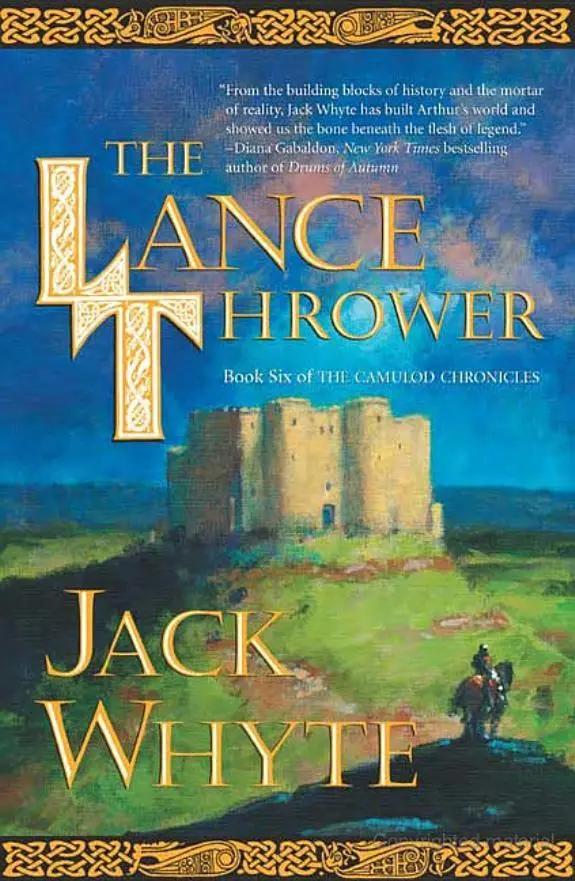
- Название:The Lance Thrower
- Автор:
- Жанр:
- Год:неизвестен
- ISBN:нет данных
- Рейтинг книги:5 / 5. Голосов: 1
-
Избранное:Добавить в избранное
- Отзывы:
-
Ваша оценка:
The Lance Thrower: краткое содержание, описание и аннотация
Предлагаем к чтению аннотацию, описание, краткое содержание или предисловие (зависит от того, что написал сам автор книги «The Lance Thrower»). Если вы не нашли необходимую информацию о книге — напишите в комментариях, мы постараемся отыскать её.
Clothar is a young man of promise. He has been sent from the wreckage of Gaul to one of the few schools remaining, where logic and rhetoric are taught along with battle techniques that will allow him to survive in the cruel new world where the veneer of civilization is held together by barbarism. He is sent by his mentor on a journey to aid another young man: Arthur Pendragon. He is a man who wants to replace barbarism with law, and keep those who work only for destruction at bay. He is seen, as the last great hope for all that is good.
Clothar is drawn to this man, and together they build a dream too perfect to last--and, with a special woman, they share a love that will nearly destroy them all...
The name of Clothar may be unknown to modern readers, for tales change in the telling through centuries. But any reader will surely know this heroic young man as well as they know the man who became his king. Hundreds of years later, chronicles call Clothar, the Lance Thrower, by a much more common name.
That of Lancelot.
The Lance Thrower — читать онлайн бесплатно полную книгу (весь текст) целиком
Ниже представлен текст книги, разбитый по страницам. Система сохранения места последней прочитанной страницы, позволяет с удобством читать онлайн бесплатно книгу «The Lance Thrower», без необходимости каждый раз заново искать на чём Вы остановились. Поставьте закладку, и сможете в любой момент перейти на страницу, на которой закончили чтение.
Интервал:
Закладка:
“I … I am to return, then, Magister? I thought you were sending me away for good.”
“I am sending you away for good, boy—for good reason and to even better purpose. I am sending you upon a mission for the well-being of God’s Church and her faithful servants, which means, in effect, that I am sending you upon God’s own work. But I am far from being finished with your education, if that is what you really meant to suggest. I have much in mind for you, and hone of it entails sending you back to Genava permanently as a punishment for having reached the age of sixteen.” He smiled. “In truth, I see little of Genava in your future, my young friend, at least for several years. That is, at least in part, why I am sending you home on this mission. It will give you an opportunity to take your leave of your family again before moving on to the next level of your endeavors.”
As his words washed over me I felt relieved, elated, and exalted. I would be called upon to do a man’s work here in central Gaul, it seemed. I felt the merest twitching of guilt in acknowledging then that I had been dreading my eventual return to Genava, fearing that the life I had known there previously would suffer gravely now by comparison to all that I had known here in Auxerre. Now, however, with the blessing bestowed by these new duties, I could return gratefully to the lakeside to revisit and embrace all my old friends and loved ones before taking off yet again on expanded adventures.
I had yet another cause for relief and exultation in my breast on that occasion, although I would have been loath to mention it to my august mentor. When it first occurred to me that I was being sent away, never to return to the school, my chest had filled up with the unanticipated and panic-stricken fear of being unable to fulfill my vengeance—that long-standing promise to myself that I would one day pursue, confront, and cut down the usurper Clodas of Ganis as just punishment for the murder of my parents and my grandfather, his own true king, Garth of Ganis. Were I to be sent home now, I had realized, dismissed from the school before officially achieving manhood, I might never have the opportunity to fulfill my dreams in that regard. Still a mere boy, I would have no voice in Benwick when I went back and that, allied with my reluctance to go back and live in what I now perceived to be a backward and inferior region, might easily combine to make it impossible for me to escape from the humdrum of daily life by the lakeside.
It was an unjust thought and one that was already causing me to feel guilty and ungrateful by the time I realized that I was wrong and Germanus was not banishing me permanently. As soon as that awareness dawned, however, I lost all feelings of fear and guilt in the burst of elation that flooded over me. I would return to Auxerre, and I would finish my schooling and my training, and I would leave the Bishop’s School as a warrior with all the skills, all the abilities, and all the weight of years that would enable me to claim King Ban’s promised assistance in my quest to regain my own rightful kingdom.
When I left the bishop’s quarters that afternoon, I was bubbling inside with excitement, and every philosophical thought that had simmered in my mind earlier had been obliterated by the import of what I could now look forward to doing and being. I had four days left as a schoolboy; four days to wrap up the raiment of my time as a student; after that, like a chrysalis shedding its outer skin, I would be reborn as an entirely new being: a man and a warrior dedicated to the greater glory of God.
IV
URSUS
 IDO NOT KNOW where I was on the day my boyhood came to an end, but I remember the occasion very well because the horror of it never left me and still has the power today to stir the hairs on the nape of my neck and make me shudder with dread. I can recall every aspect of the countryside that surrounded me that day, and most particularly I can remember with absolute clarity the last scene I saw before my world was suddenly changed for all time.
I never have known, however, exactly where we were that day. It was our fourth day out of Auxerre, heading south at a leisurely pace. We were riding two abreast, twelve of us and one two-horse wagon. Our party was strung out along a surprisingly hard-packed path that followed the osier-lined left bank of a broad, muddy-brown river that eddied sluggishly, its waters looking thick and viscous beneath a sun that was too bright and too hot for the time of the year, even in southern Gaul. It had been raining heavily to the north and east of us for two entire days; although we ourselves had not seen as much as a storm cloud in the skies around us, there was no mistaking the signs in the river. We had watched the water level rise alarmingly these past two days, swelling and filling up the channel until the banks had entirely vanished and the sullen waters spilled over in several low-lying places to flood the fields on either side. We had managed to remain on slightly higher ground at all times, however, and nothing untoward had happened to us. The river was swollen to the point of threat, but yet the ground around us and ahead of us was firm and almost drought-dry.
Paralleling our path on the left, some distance away but easily discernible, was the wide, dusty swath carved by the small army of Duke Phillipus Lorco as it passed by earlier that morning. We were a hunting party, dispatched the previous afternoon to harvest fresh meat for the troopers, and we had done well that morning, so that now, approaching midday, we were riding to rejoin the main body of our party, avoiding the dusty track stirred up by the earlier troops and staying on the narrow, hard-packed riverside path. The light four-wheeled wagon we had with us was loaded with six large deer carcasses—enough meat to keep everyone in the one-hundred-and-twenty-strong main force smiling and well fed for several days.
Lorco and I were riding together at the very rear of the loose column, close behind the wagon with the butchered deer, and although it was an unpleasant place to be, what with the swarming flies and the thick stink of the fresh, congealing blood that attracted them, it was nonetheless a spot that kept us safely out of sight of our two current nemeses, Harga, the Sergeant-at-Arms, and Dirk the Huntsman, both of whom had been charged by Lorco’s father to watch us closely and keep us out of mischief. They were an ill-matched and foul-tempered pair, and neither of them even tried to like us or to tolerate us. To them we were nothing more than an imposition, an accursed nuisance to be frowned upon, shouted at, and generally held in subjection. And so we naturally set about immediately finding ways of thwarting them and doing as we wished. To that end, we were hiding from them at the rear of the meat wagon as we plotted our escape from their supervision.
Harga and Dirk lent themselves easily, albeit unknowingly, to our mischief. No one with eyes to see would ever describe either one of them as comely, and so we had named them Castor and Pollux, the heavenly twins, thinking ourselves extremely witty. We were now out of their direct line of sight, safe behind the tailgate of the wagon as we enjoyed a laugh at their expense. For their part, the two jailers rode on side by side, unaware of us or of our disdain.
Disturbed by our passage, an enormous flock of crows rose up with a clatter of flapping wings from a recently plowed field to our left and then wheeled away from us, cawing and screaming raucously as only crows know how. Mildly surprised at their number, I watched them go, following the dense cloud of them easily with my eyes until they disappeared into the leafy masses of a trio of huge old conical trees that stood like tapered, towering candles in the distance, close by a distant stretch of river that caught the afternoon sun’s light in a silvery dazzle of reflected brightness.
Читать дальшеИнтервал:
Закладка:
Похожие книги на «The Lance Thrower»
Представляем Вашему вниманию похожие книги на «The Lance Thrower» списком для выбора. Мы отобрали схожую по названию и смыслу литературу в надежде предоставить читателям больше вариантов отыскать новые, интересные, ещё непрочитанные произведения.







Обсуждение, отзывы о книге «The Lance Thrower» и просто собственные мнения читателей. Оставьте ваши комментарии, напишите, что Вы думаете о произведении, его смысле или главных героях. Укажите что конкретно понравилось, а что нет, и почему Вы так считаете.