Jack Whyte - The Lance Thrower
Здесь есть возможность читать онлайн «Jack Whyte - The Lance Thrower» весь текст электронной книги совершенно бесплатно (целиком полную версию без сокращений). В некоторых случаях можно слушать аудио, скачать через торрент в формате fb2 и присутствует краткое содержание. Жанр: Старинная литература, на английском языке. Описание произведения, (предисловие) а так же отзывы посетителей доступны на портале библиотеки ЛибКат.
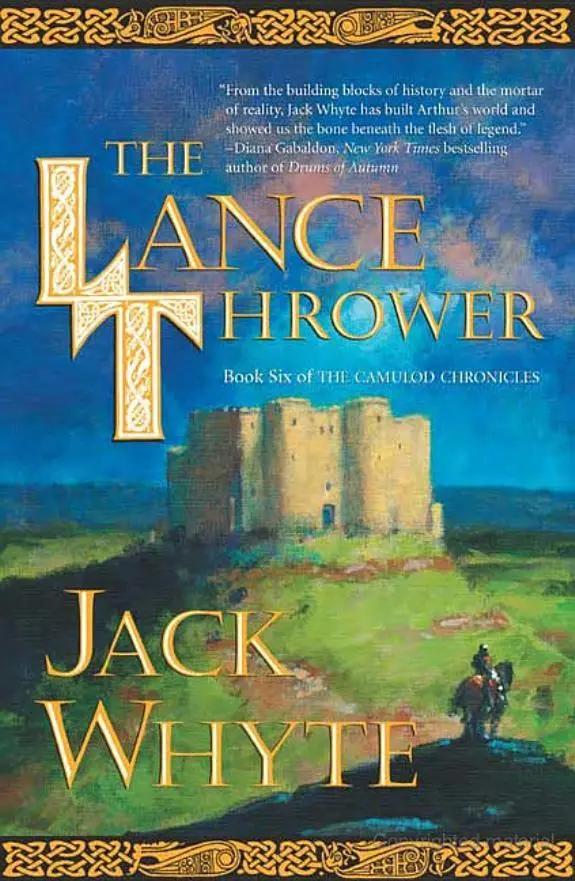
- Название:The Lance Thrower
- Автор:
- Жанр:
- Год:неизвестен
- ISBN:нет данных
- Рейтинг книги:5 / 5. Голосов: 1
-
Избранное:Добавить в избранное
- Отзывы:
-
Ваша оценка:
The Lance Thrower: краткое содержание, описание и аннотация
Предлагаем к чтению аннотацию, описание, краткое содержание или предисловие (зависит от того, что написал сам автор книги «The Lance Thrower»). Если вы не нашли необходимую информацию о книге — напишите в комментариях, мы постараемся отыскать её.
Clothar is a young man of promise. He has been sent from the wreckage of Gaul to one of the few schools remaining, where logic and rhetoric are taught along with battle techniques that will allow him to survive in the cruel new world where the veneer of civilization is held together by barbarism. He is sent by his mentor on a journey to aid another young man: Arthur Pendragon. He is a man who wants to replace barbarism with law, and keep those who work only for destruction at bay. He is seen, as the last great hope for all that is good.
Clothar is drawn to this man, and together they build a dream too perfect to last--and, with a special woman, they share a love that will nearly destroy them all...
The name of Clothar may be unknown to modern readers, for tales change in the telling through centuries. But any reader will surely know this heroic young man as well as they know the man who became his king. Hundreds of years later, chronicles call Clothar, the Lance Thrower, by a much more common name.
That of Lancelot.
The Lance Thrower — читать онлайн бесплатно полную книгу (весь текст) целиком
Ниже представлен текст книги, разбитый по страницам. Система сохранения места последней прочитанной страницы, позволяет с удобством читать онлайн бесплатно книгу «The Lance Thrower», без необходимости каждый раз заново искать на чём Вы остановились. Поставьте закладку, и сможете в любой момент перейти на страницу, на которой закончили чтение.
Интервал:
Закладка:
As soon as the animal began to move, my body adjusted to its motion and my thoughts became cogent and cohesive. I glanced up at the sky and saw the sun low in the west, its glare trapped behind all but the edges of a swollen cloud. The attack, I knew, had occurred before noon, so I must have been lying by the stream in the woods for several hours. By this time, I knew, the enemy, whoever they had been, must have collected their booty and moved on long since. But what they might have done with the bodies of my companions was an unknown that I had to address. Bad enough that I had run away from the killing field in the first place, but if I were to return to the Duke as the sole survivor of this debacle, I would have to bring information on the aftermath of the slaughter, verifying and reporting the names of the others dead … besides his son. My jaws began to ache with the strain of gritting my teeth together as I made my way back to the scene by the riverside, following the deeply gouged tracks of my earlier, headlong flight without difficulty and growing increasingly aware that if anyone had chosen to follow me they would have had no trouble finding me and killing me.
I saw the wagon first, standing abandoned near the river, among grass that grew as high as its axles. The horses were gone, as were the butchered deer carcasses; clearly our attackers had had no wish to encumber themselves with a wheeled vehicle. As I approached, I thought at first that I could see a body hunched on the ground beside one of the rear wheels, but on closer inspection it proved to be the broken, boxy shape of one of the chests that had been on the wagon. There were articles of clothing all over the surrounding ground, scattered to the winds as though they had been pulled from their chests and flung straight up into the air, but whether they had been mine or Lorco’s I had no idea and less concern. They were garments, clothing, things of less than no value. I moved on.
The first body I found was that of Borg, the cheerful young man who had driven the wagon and had been the friendliest of the group toward me and Lorco. His throat had been slashed open, almost severing his head, and he had been stripped naked. My stomach heaved as I looked down for the first few moments at what remained of him, but then I swallowed hard and tugged on my reins, turning my mount, and my eyes, away in search of others.
I could see most of the others now, their lifeless bodies strewn haphazardly over a surprisingly wide expanse of ground, and I guessed that some of them must have fought hard and long before being cut down so far from the path, irrespective of whether their horses had carried them there alive or dead. There were no dead horses, however, although it did not occur to me to look for any at first. Only when I saw the distance at which some of the bodies lay from the river path did I think to look about me for dead animals, and at that point another element of the enigma of what had happened clicked into place. I remembered waiting for the thump of an arrow hammering into my mount’s side as I hid behind its bulk from the aiming bowman, and I recalled being surprised that the killing shot had not come. Now, however, that was no longer so surprising. These men, whoever they had been, had attacked us for our horses and perhaps our weapons, no more than that. They had not been interested in simple plunder.
As soon as I saw the truth of that I tried to recall the attackers. Hazy, confused images came to me at first, of open, screaming mouths and wild, staring eyes; of madly running men brandishing fearsome weapons and intent upon my death; of flashing, naked, dirty limbs, long, bony legs and knobby knees and, in some instances, bare, muddy feet. And then my mind fastened upon an image of one particular man, the man who had flanked the bowman whom I dodged by hiding behind my horse’s barrel. He had been facing me, too, crouched and tense, ready to kill should I approach him closely enough, but the fearsome weapon he had clutched in one hand, upraised and ready to strike, had been misshapen and clumsy looking, a club of some kind—a plain, heavy-looking wooden cudgel that looked nowhere near as menacing as the ash wood practice swords I had been using for years at the Bishop’s School. This killer had not even had a blade to brandish. From that recollection sprang others, and I rapidly began to revise my opinion of our opponents.
They had been stronger in numbers than we were, but they had not been as well armed, and the impressions I had had of heavily armed and armored men had been born more from frightened panic than from observation. Many of them had been bowmen, true, but I could recall now, looking back less fearfully, that more than half of them had not. The essence of their victory had lain in the success of the trap they laid; in their numbers and the speed and surprise of their onslaught. More than anything else, however, their victory had been our fault, attributable to the slovenly, incompetent leadership of the Sergeant-at-Arms, Harga.
Chilled by that assessment, I sucked in a deep breath and set about my self-imposed task of cataloguing the dead. We had been thirteen, including myself, Lorco, and Borg the wagon driver, but I found fifteen corpses scattered about the field, and four of those were strangers to me. That meant that there was a body missing, and someone else from our group had survived the attack, unless—and the idea came to me quickly, surprising me with my own pessimism—the missing man had tried to escape by the river and had been killed in the water. I pulled my horse’s head around and turned to look toward the river, and as I did so I thought I saw a flicker of movement off to my right, among the osier willows that lined the riverbank.
I froze, afraid to turn my head again and look more closely, but then, accepting that I had a choice of fleeing yet again or staying where I was, perhaps to die this time, I acknowledged to myself with great bitterness that I would never be able to live with the shame of running away again, and so I gritted my teeth, unsheathed my spatha, and turned to face directly toward the place where I had seen the movement, seeing the spot slide into clear focus in the gap between the side flaps of my helmet.
I stared and waited, silently defying whoever was there to step forth, but no one appeared and nothing moved, and eventually I began to feel foolish, sitting there on my horse like a living statue and facing an uninhabited stretch of treed riverbank. I nudged my heels into my horse’s flanks and it began to walk forward slowly, its ears pricked in the direction we were taking. And then, in a burst of movement that brought my heart into my mouth, Lorco’s horse lurched out from among the distant willows and came trotting toward us, whinnying a welcome. The sight of it almost unmanned me yet again, for I had assumed that the raiders had taken it with all the others, but seeing it trotting toward me, with Lorco’s silver helmet dangling from its saddle hook, I realized that it must have run away right at the start of the attack, when Lorco fell from its back, and not stopped until it entered the river willows, presumably to find water. It had obviously managed to remain unseen by the enemy, who must still have been fighting at the time.
The magnificent animal, one of Tiberias Cato’s finest blacks and bred from the same sire and dam as my own mount, came directly to us and made no move to avoid me as I sheathed my sword and leaned forward to take hold of its reins. As I straightened up again with the reins safely in my hand I saw something that I had never expected to see again. The magnificent long-bladed spatha that Lorco had won in the school arena weeks earlier, Tiberias Cato’s own spatha, hung in its belted, hand-tooled sheath from the hook on the other side of the saddlebow from Lorco’s helmet. Slowly, reverently, I reached across and collected it, then removed my own sword and replaced it with Lorco’s, hanging mine from the hook on my saddlebow. Then, once again, I unsheathed the sword, and the difference between it and my own was immediately apparent. It settled into my grasp, filling my fist completely and satisfyingly, and in the pleasure of simply holding it and feeling the heft of it, it took several moments for me to remember that I was a coward and undeserving of such a weapon. Grimly then, I sheathed it and returned to the task of recording the dead.
Читать дальшеИнтервал:
Закладка:
Похожие книги на «The Lance Thrower»
Представляем Вашему вниманию похожие книги на «The Lance Thrower» списком для выбора. Мы отобрали схожую по названию и смыслу литературу в надежде предоставить читателям больше вариантов отыскать новые, интересные, ещё непрочитанные произведения.






Обсуждение, отзывы о книге «The Lance Thrower» и просто собственные мнения читателей. Оставьте ваши комментарии, напишите, что Вы думаете о произведении, его смысле или главных героях. Укажите что конкретно понравилось, а что нет, и почему Вы так считаете.