Jack Whyte - The Lance Thrower
Здесь есть возможность читать онлайн «Jack Whyte - The Lance Thrower» весь текст электронной книги совершенно бесплатно (целиком полную версию без сокращений). В некоторых случаях можно слушать аудио, скачать через торрент в формате fb2 и присутствует краткое содержание. Жанр: Старинная литература, на английском языке. Описание произведения, (предисловие) а так же отзывы посетителей доступны на портале библиотеки ЛибКат.
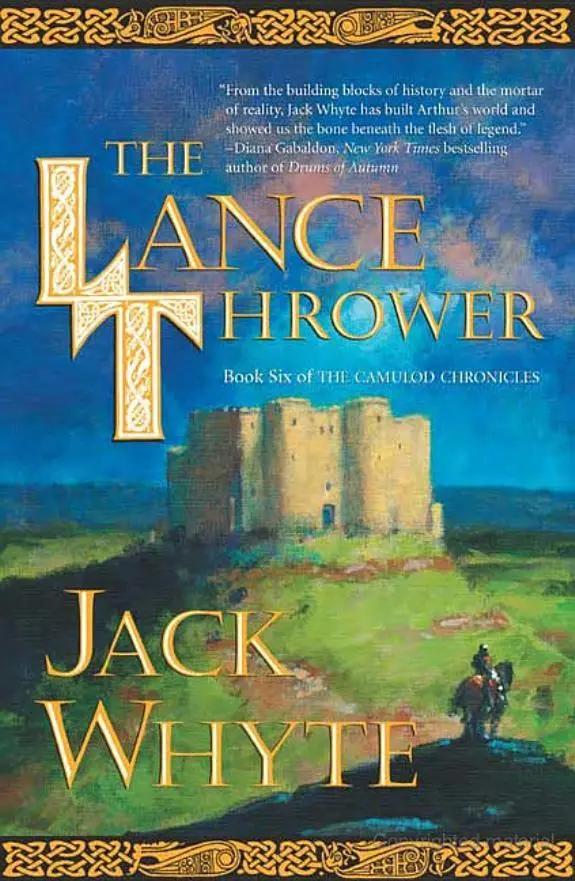
- Название:The Lance Thrower
- Автор:
- Жанр:
- Год:неизвестен
- ISBN:нет данных
- Рейтинг книги:5 / 5. Голосов: 1
-
Избранное:Добавить в избранное
- Отзывы:
-
Ваша оценка:
The Lance Thrower: краткое содержание, описание и аннотация
Предлагаем к чтению аннотацию, описание, краткое содержание или предисловие (зависит от того, что написал сам автор книги «The Lance Thrower»). Если вы не нашли необходимую информацию о книге — напишите в комментариях, мы постараемся отыскать её.
Clothar is a young man of promise. He has been sent from the wreckage of Gaul to one of the few schools remaining, where logic and rhetoric are taught along with battle techniques that will allow him to survive in the cruel new world where the veneer of civilization is held together by barbarism. He is sent by his mentor on a journey to aid another young man: Arthur Pendragon. He is a man who wants to replace barbarism with law, and keep those who work only for destruction at bay. He is seen, as the last great hope for all that is good.
Clothar is drawn to this man, and together they build a dream too perfect to last--and, with a special woman, they share a love that will nearly destroy them all...
The name of Clothar may be unknown to modern readers, for tales change in the telling through centuries. But any reader will surely know this heroic young man as well as they know the man who became his king. Hundreds of years later, chronicles call Clothar, the Lance Thrower, by a much more common name.
That of Lancelot.
The Lance Thrower — читать онлайн бесплатно полную книгу (весь текст) целиком
Ниже представлен текст книги, разбитый по страницам. Система сохранения места последней прочитанной страницы, позволяет с удобством читать онлайн бесплатно книгу «The Lance Thrower», без необходимости каждый раз заново искать на чём Вы остановились. Поставьте закладку, и сможете в любой момент перейти на страницу, на которой закончили чтение.
Интервал:
Закладка:
Fortunately for me, for I was still wearing my heavy helmet, I landed without either breaking my neck or knocking the wind out of myself. My helmet was jarred forward over my eyes in the fall, cutting off my vision, but I managed to push it up and back in time to see, between my horse’s legs, the strangers starting toward me, separating widely to come at me from different directions. The bowman with the silver greaves remained in front, weaving slightly as he tried to find an angle from which to shoot me, but the other two were moving quickly now, circling to each side of me.
I had no time even to think of being afraid, although I knew beyond a doubt that if I tried to run away this time I would be dead within moments. Their encircling move, however, forcing me to fight in two directions, was one with which I was more than familiar—I had had the moves and countermoves of that attack and defense drummed into me since I was old enough to swing a practice sword. I looked down at the ground beneath my feet and saw that it was sloping downward to my right, and then I took two long paces backward, distancing myself from the two horses ahead of me yet keeping their bulk between me and the bowman in the ring-mail shirt.
Both of the men moving to attack me from right and left carried swords, the one a broad, heavy-bladed thing that looked as though it might be a one-edged blade, the other a long, slender, spathalike weapon that look well cared for and well used. The man approaching on my left had the heavier, ugly weapon and he was farther away from me than his companion was. He was also slightly above me, beginning to move down toward me. The fellow on my right was below me and closer, just starting to crouch and raise his sword as he came at me in a sidling shuffle. I took three running steps toward him, which he had not expected. He hesitated, wavering, and I almost beheaded him with my first slash. He barely managed to get his sword up quickly enough to save himself and my blade smashed his aside, by which time I was beside him, pivoting with my whole body and dropping into a crouch as I aimed a hacking slash at the unprotected back of his knees. It was a blow I had been taught by Tiberias Cato himself, years earlier, and when successfully delivered it was crippling. He screamed as my blade severed his hamstrings, and he dropped immediately, first to his knees and then forward onto his face, but I knew he was finished as a fighter and did not wait for him to fall.
I spun on one foot and sprang up and back to face the other attacker from my left, but he had seen how I handled his friend and he was more cautious, crouching defensively and waiting for me to come to him. I knew I could beat him—there was no trace of a doubt in my mind about that—but by that time my flesh was crawling in anticipation, waiting for the impact of the arrow I knew must be coming for me at any moment because I was out in the open now, clear of the horses and vulnerable to the bowman, who had all the time he needed to sight on me. Nothing came, and finally I risked looking over to see what he was doing. It was the quickest of glances, no more than a flick of the head, but it showed me what I least expected to see, and I could not resist looking again, even although I knew the risk I was taking by looking away from the sword-wielder on my left.
The bowman was dead, flat on his face on the ground and motionless, with an arrow through his ring-mail tunic and buried almost to the feathers between his shoulder blades. And as I saw that, my opponent attacked. He had seen me look away, then look again, and on the second look he lunged, swinging a mighty overhand chop that would have cleft me in two had it landed. Of course it did not land, because I had Cato’s magnificent spatha with which to deflect it. I swept it aside easily and leaped backward, only to land awkwardly on a round section of stick that rolled beneath my foot and sent me crashing to my back on a bed of the previous year’s oak leaves.
My opponent was above me almost before I had landed. Spread-legged and dark-faced, he rose on his toes to gain the maximum impetus from his ungainly weapon. I tried to whip my sword across in front of me to stab him in the groin, but my blade had slipped beneath a branch or a root when I fell, and as soon as I felt the resistance in my arm I knew I would not be able to dislodge it quickly enough to save myself. Then, for the second time in the space of two mornings, I watched a life snuffed out abruptly by a hard-shot arrow. This one caught my opponent in the hollow of the neck, just above the metal rim of his cuirass, and drove him backward, off his feet and into instant death.
I rolled hard to my left, dragging my sword behind me and feeling the moment when it sprang free of whatever had been holding it. As soon as I did, I spun on my left elbow, kicking my legs around, and lunged to my feet quickly, if far from gracefully, facing the direction from which the second arrow had come. I told myself that whoever had shot my enemy must be my friend, although I did not dare to trust myself sufficiently to believe it. As soon as I was safely upright, I set my feet squarely and hunched into a fighting crouch, glaring around me to see who and where the marksman was, but he remained unseen. Slightly to the right of where I now stood, the man I had hamstrung lay dead, too, pinned to the ground by yet another arrow. Directly ahead of me now was the massive oak tree that had stood between me and my three erstwhile attackers, and I guessed that the fourth man, whoever he was, must be behind its huge bole. I glared at the tree, willing him to come out and face me.
Moments later, just as I was beginning to feel foolish, a voice spoke from behind my back.
“That tree is not going to attack you, boy.”
Appalled at how easily I had been duped, I spun as quickly as I could move, raising my sword as I did so and preparing to throw myself to the attack, although I was once again expecting to die, shot down before I could really move forward. But then I stopped in midstep, astonished. The man facing me was Ursus. He held his arms folded across his chest as he leaned back against the trunk of a tree, his legs crossed at the ankles and his entire weight on his left foot. His bow, still strung, hung from his right shoulder. I was stunned to see him and was incapable of finding a single word of greeting or of gratitude or anything else. I simply stood and gaped at him.
“You handled yourself well, for a youngster. Who taught you to fight like that?”
I had never heard this man speak before, and now I found the sound of him to be more pleasant than I would have expected, based purely upon the things I had heard the others in the hunting party say about him. His voice was deep and sonorous, warm and mellifluous and somehow suggestive of humor. I cleared my throat and tried to answer him coherently.
“Teachers … I had many … at the Bishop’s School, in Auxerre.”
“They taught you to fight? I thought they were churchmen, priests.”
“They are, but the bishop there is Germanus. He used to be an imperial legatus, commander-in-chief of all imperial forces in central and northern Gaul. He was Duke Lorco’s first legatus.”
“Shit … I knew that, but I never made the connection between Germanus the legate and Germanus the bishop.”
“You mean the Duke didn’t tell you?”
He straightened up from the tree and uncrossed his arms, leaning forward slightly to peer at me, a strange expression on his face. “Are you twitting me?” Before I could react to that, however, he nodded and the expression on his face changed. “I’m a mercenary, lad, a sword for hire. I don’t even have a rank that earns me any more than basic pay, whereas Phillipus Lorco is the governor of an entire imperial region. We don’t have much in common, Duke Lorco and I. You understand?”
Читать дальшеИнтервал:
Закладка:
Похожие книги на «The Lance Thrower»
Представляем Вашему вниманию похожие книги на «The Lance Thrower» списком для выбора. Мы отобрали схожую по названию и смыслу литературу в надежде предоставить читателям больше вариантов отыскать новые, интересные, ещё непрочитанные произведения.







Обсуждение, отзывы о книге «The Lance Thrower» и просто собственные мнения читателей. Оставьте ваши комментарии, напишите, что Вы думаете о произведении, его смысле или главных героях. Укажите что конкретно понравилось, а что нет, и почему Вы так считаете.