Jack Whyte - The Lance Thrower
Здесь есть возможность читать онлайн «Jack Whyte - The Lance Thrower» весь текст электронной книги совершенно бесплатно (целиком полную версию без сокращений). В некоторых случаях можно слушать аудио, скачать через торрент в формате fb2 и присутствует краткое содержание. Жанр: Старинная литература, на английском языке. Описание произведения, (предисловие) а так же отзывы посетителей доступны на портале библиотеки ЛибКат.
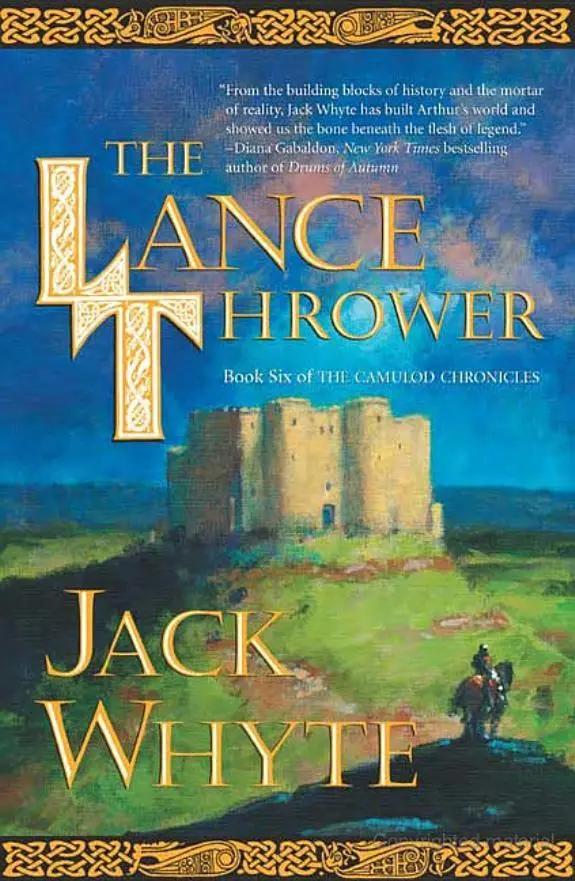
- Название:The Lance Thrower
- Автор:
- Жанр:
- Год:неизвестен
- ISBN:нет данных
- Рейтинг книги:5 / 5. Голосов: 1
-
Избранное:Добавить в избранное
- Отзывы:
-
Ваша оценка:
The Lance Thrower: краткое содержание, описание и аннотация
Предлагаем к чтению аннотацию, описание, краткое содержание или предисловие (зависит от того, что написал сам автор книги «The Lance Thrower»). Если вы не нашли необходимую информацию о книге — напишите в комментариях, мы постараемся отыскать её.
Clothar is a young man of promise. He has been sent from the wreckage of Gaul to one of the few schools remaining, where logic and rhetoric are taught along with battle techniques that will allow him to survive in the cruel new world where the veneer of civilization is held together by barbarism. He is sent by his mentor on a journey to aid another young man: Arthur Pendragon. He is a man who wants to replace barbarism with law, and keep those who work only for destruction at bay. He is seen, as the last great hope for all that is good.
Clothar is drawn to this man, and together they build a dream too perfect to last--and, with a special woman, they share a love that will nearly destroy them all...
The name of Clothar may be unknown to modern readers, for tales change in the telling through centuries. But any reader will surely know this heroic young man as well as they know the man who became his king. Hundreds of years later, chronicles call Clothar, the Lance Thrower, by a much more common name.
That of Lancelot.
The Lance Thrower — читать онлайн бесплатно полную книгу (весь текст) целиком
Ниже представлен текст книги, разбитый по страницам. Система сохранения места последней прочитанной страницы, позволяет с удобством читать онлайн бесплатно книгу «The Lance Thrower», без необходимости каждый раз заново искать на чём Вы остановились. Поставьте закладку, и сможете в любой момент перейти на страницу, на которой закончили чтение.
Интервал:
Закладка:
Ursus sighed, finally, and stretched where he sat, grimacing as he did so.
“I don’t know,” he growled. “We’ll live now, for a while, at least long enough to get ourselves killed if we run into any more of those Burgundians. But where’s Duke Lorco? That’s the question you and I have to answer. We’ll have to find him by the shortest route, for our own safety—” He broke off, frowning at the expression on my face. “What’s wrong with you?”
I shrugged, trying to make light of what I had been thinking and to dismiss the grim vision that had sprung into my mind. “Nothing, not really. I was just thinking about what you said about the hostiles … the Burgundians … . Thousands of them, you said. Is that true or were you exaggerating?”
Ursus made a face. “No, it was true.”
“Far more than Duke Lorco has with him.”
“Aye, but Lorco’s cavalry are worth ten men afoot, and he’s got three turmae.”
“True.” I nodded, but with no enthusiasm, for the calculation attached to that was not a difficult one. “That’s more than a hundred troopers … . But a single thousand men would match them at ten-to-one odds, and you said there were several thousands of Burgundians. That could make odds of twenty, thirty to one.”
“If it came to a fight, aye, it could. But who’s to say it would? Lorco’s smart enough to keep away from an army of that size.”
“What if he has no choice?”
“What do you mean? Of course he’ll have a choice. There’s always a choice.”
I dismissed that, seeing the fallacy behind his bluster. “No, not always. Look at what happened to me with these three. I came around the big tree and there they were, right in front of me, looking at me. I had no choice but to fight. Same thing might easily happen to Duke Lorco.”
Ursus pulled his mouth down into a scowl of doubt. “Nah, I don’t think so. Lorco would have scouts out. He’d never be stupid enough to ride without scouts.”
“Granted, but these Burgundians would have scouts out, too—that’s what these three were doing here, scouting. But they ran into us, and now they’ll never get the word back that we’re here. Couldn’t the same thing have happened to Duke Lorco’s scouts?”
Now the scowl on Ursus’s face had deepened to a glower. “By the Christ, boy, you have a knack for seeing the blackest side of things, haven’t you?” He glanced around us, looking at the forest growth that sheltered us. “Well, we can’t sit here forever, so let’s go and try to find our own before the enemy finds us. I warn you, though, they’ll be swarming like bees to the north of us, and if we can’t pass through them—which is almost certain to be the way of it—we’ll have to ride around them. God alone knows how long that might take. However it turns out, you make sure to stick close behind me, keep your head down, and do whatever I tell you to do right now , with no arguments and no questions. If you ever live to be as old as I am, then I’ll take orders from you. In the meantime, I’m the Magister , understand?”
I nodded, and we moved directly to mount up and head northward in search of our friends.
We never did discover what befell Duke Lorco and his three turmae. They simply vanished from the ken of men. Ursus and I searched for them for three entire days, and not once in that time did we find as much as a trace of them, although we might have had cause for thanks in that, since the entire countryside was overrun by the force that Ursus had described, and his estimation of their numbers as being in the thousands turned out to be very conservative. We were surprised, too, to see that they had large numbers of horsemen among them, because Ursus had seen no riders among the troops that moved steadily past him on that first afternoon when he had hidden among the pond reeds, and we were forced to assume that they had ridden separately to join the foot soldiers.
We watched these riders closely, after our initial surprise wore off, and although their mounts were healthy and well equipped, it soon became obvious that the riders themselves had had no intensive training in coordination. They were warriors, but not cavalry troopers. That realization, reinforced by our observations of the casual, informal way the riders moved about the countryside, encouraged us to step out of hiding and venture among them as though we had every right to be there doing what we were doing. We moved openly but took care nonetheless to avoid coming too close to any particular group, and we managed to avoid detection, although there were times during those days when we passed within spitting distance of some of the invaders.
Notwithstanding all our caution, however, we were twice involved in skirmishes with small groups whom we met in places where we had no reason for being present, other than trying to slip past the carefully guarded strong points that had been built on high elevations overlooking those places where enemies like us might be expected to try to pass by undetected. We were fortunate enough on both occasions to see these people before they saw us. There were three foot soldiers in the first group and two horsemen in the second, and I take no shame in saying that it was Ursus who dispatched four of them, including both horsemen, each of them driven off his horse’s back by a single deadly hard shot. I captured the fifth and last of the men by running him down, smashing my horse directly into him and bowling him over, then leaping on him and disarming him before he could regain his breath, after which I held him at the point of my sword until Ursus could tie his arms securely behind his back.
It was in questioning this captive—Ursus, it turned out, could speak a version of his language—that we discovered the enemy were in fact Burgundians from the southwest. A federation of their tribes, our prisoner told us, six in all and numbering close to ten thousand warriors, had left the lands they had settled almost a hundred years earlier and struck east in search of more living space. So far, he said, they had been on the march and victorious on all fronts for half a month. They had encountered no serious opposition and had annexed everything between their home territories and the spot where we had captured him, and it was plain to see from his attitude that even although he, personally, had erred and fallen into our hands, he did not expect to be our prisoner for long. He told us that we would be discovered and killed within the very near future.
Simply by falling into our hands, our prisoner had presented us with a problem, because we could not take him with us when we moved on, and we could not simply set him free. We knew we ought to kill him, but because of the teachings I had absorbed in the Bishop’s School, I was incapable of doing that and equally incapable of permitting Ursus to. “Thou shalt not kill” is an unequivocal Commandment. Not that I would have hesitated to kill the man in the heat of battle—or so I told myself, blithely disregarding the fact that I had never yet come close to contemplating killing any man. I knew well that killing in self-defense is permissible at any time, and that in time of war, when the cause is just, killing as the result of armed aggression is justifiable. Killing in cold blood, however, was murder, unacceptable under any conditions, and so we were trapped, becoming, in effect, prisoners to our prisoner.
Fortunately, he absolved us of our quandary by freeing himself in the middle of the night and then foolishly awakening us with the noise he made in escaping. Ursus felled him with a single arrow from a distance of thirty paces, which, at night and against a running target, was a bowshot verging on the miraculous. We scrambled out to where the fellow lay and dragged him back into the cave where we were sheltering. We left him there in the morning, after we had scouted the area and identified a reasonable opportunity to move out of hiding and escape unobserved.
Читать дальшеИнтервал:
Закладка:
Похожие книги на «The Lance Thrower»
Представляем Вашему вниманию похожие книги на «The Lance Thrower» списком для выбора. Мы отобрали схожую по названию и смыслу литературу в надежде предоставить читателям больше вариантов отыскать новые, интересные, ещё непрочитанные произведения.







Обсуждение, отзывы о книге «The Lance Thrower» и просто собственные мнения читателей. Оставьте ваши комментарии, напишите, что Вы думаете о произведении, его смысле или главных героях. Укажите что конкретно понравилось, а что нет, и почему Вы так считаете.