Jack Whyte - The Lance Thrower
Здесь есть возможность читать онлайн «Jack Whyte - The Lance Thrower» весь текст электронной книги совершенно бесплатно (целиком полную версию без сокращений). В некоторых случаях можно слушать аудио, скачать через торрент в формате fb2 и присутствует краткое содержание. Жанр: Старинная литература, на английском языке. Описание произведения, (предисловие) а так же отзывы посетителей доступны на портале библиотеки ЛибКат.
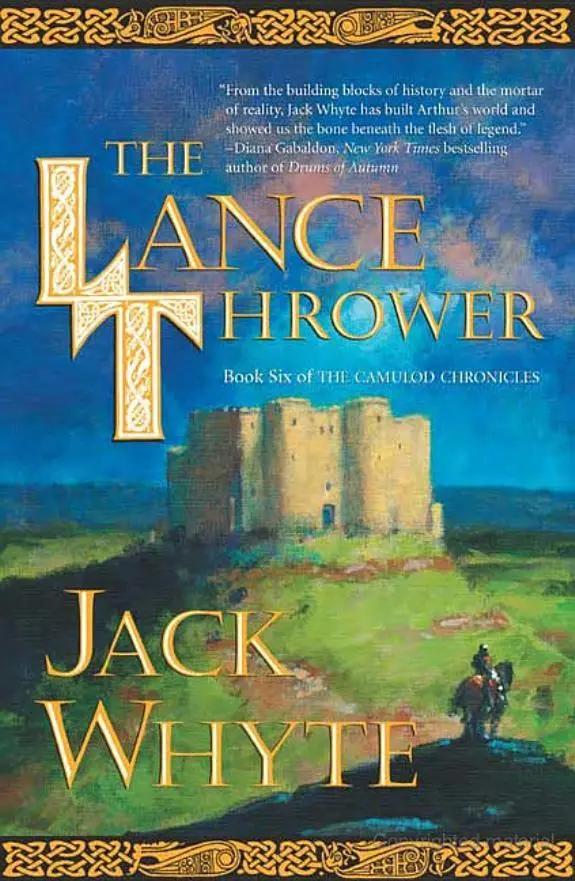
- Название:The Lance Thrower
- Автор:
- Жанр:
- Год:неизвестен
- ISBN:нет данных
- Рейтинг книги:5 / 5. Голосов: 1
-
Избранное:Добавить в избранное
- Отзывы:
-
Ваша оценка:
The Lance Thrower: краткое содержание, описание и аннотация
Предлагаем к чтению аннотацию, описание, краткое содержание или предисловие (зависит от того, что написал сам автор книги «The Lance Thrower»). Если вы не нашли необходимую информацию о книге — напишите в комментариях, мы постараемся отыскать её.
Clothar is a young man of promise. He has been sent from the wreckage of Gaul to one of the few schools remaining, where logic and rhetoric are taught along with battle techniques that will allow him to survive in the cruel new world where the veneer of civilization is held together by barbarism. He is sent by his mentor on a journey to aid another young man: Arthur Pendragon. He is a man who wants to replace barbarism with law, and keep those who work only for destruction at bay. He is seen, as the last great hope for all that is good.
Clothar is drawn to this man, and together they build a dream too perfect to last--and, with a special woman, they share a love that will nearly destroy them all...
The name of Clothar may be unknown to modern readers, for tales change in the telling through centuries. But any reader will surely know this heroic young man as well as they know the man who became his king. Hundreds of years later, chronicles call Clothar, the Lance Thrower, by a much more common name.
That of Lancelot.
The Lance Thrower — читать онлайн бесплатно полную книгу (весь текст) целиком
Ниже представлен текст книги, разбитый по страницам. Система сохранения места последней прочитанной страницы, позволяет с удобством читать онлайн бесплатно книгу «The Lance Thrower», без необходимости каждый раз заново искать на чём Вы остановились. Поставьте закладку, и сможете в любой момент перейти на страницу, на которой закончили чтение.
Интервал:
Закладка:
With a snarl of fury, one of the four gave up his puzzling and launched himself toward Ursus. I let him go, knowing that Ursus had his measure. No sooner had this fellow started moving, however, than his accomplices joined him, all three of them lunging forward to assist the first man. None of them had seen me yet, and so I sighted on the leading runner of the three, a huge, gaunt man with long black hair and stiltlike legs that carried him out in front of the other two. I sucked a deep breath and then released it steadily as I followed his rush, obeying every lesson I had ever learned on sighting and shooting with a bow, and as the first clash of striking blades reached my ears I released and watched my arrow hiss across the space between me and the running target to hit him brutally hard in the neck, just behind the point of his jaw, and hurl him bodily off his feet and head over heels to roll and sprawl in a huddled mass just beyond the kneeling body of his friend, who had already been dispatched without ceremony by Ursus.
The behavior of the remaining two men, after seeing their companion so suddenly and unexpectedly destroyed, might have been laughable under any other circumstances. I saw them hesitate in midcharge, then break off their attack, spinning away from each other and from the perceived direction of the new threat they had found in me. One of them spun completely around and came running straight for me, covering ground at an enormous rate, while the other ran back the way he had come, pursued by Ursus. My attention, however, remained focused on the shapeless huddle of drab rags that marked the first man I had ever killed. There was no doubt in my mind that he was dead. I had seen my arrow hit, and it had reminded me exactly of what had happened to my friend Lorco when a similar arrow hit him in approximately the same place. But this death was one that I had inflicted, personally. I had taken this man’s life. He was now dead, finished, ended. He would never move or smile or laugh or eat or weep again, because I had killed him.
The fellow running at me now—and I could see him with utter clarity—was wide-eyed with terror, plainly expecting me to raise my bow again and shoot him down before he could reach me. But filled as I was with the thought of what I had done to his companion, the thought of rearming my bow had not even occurred to me, and as I watched him come hurtling toward me I saw the white knuckles of the hand that held his upraised sword and accepted, somewhere at the back of my mind, that I was going to die there. Even as he began to straighten up for the deathblow and his eyes showed dawning awareness that he was destined not to die before he could reach me, he stubbed his foot hard against something in his path and fell, sprawling forward and crashing heavily against me, grunting in my ear with the pain and with the effort of trying to recover his balance.
He was a big man, far taller than I and easily more than twice my weight, and the impact of our collision sent me flying and smashed the breath from me. Even as I crashed to the ground, however, I knew that the ancient goddess Fortuna had been watching over me. So complete had been his loss of balance that he had had no hope of swinging his sword, even although all his being had been focused upon cleaving me in two, and now we were both on the ground, both in one piece. I refused to yield to the urge to hunch over and hug my middle, which appeared to have been replaced by a ball of solid pain. Instead I bit down hard on my own cheek, focusing upon that pain, and forced my legs to swing up and over my head, rolling violently backward on tucked shoulders until I could push myself to my knees and see what my opponent was doing.
He, too, had landed badly and winded himself, but where I had fallen on hard ground, he had fallen or bounced sideways into the enormous clump of brambles that had flanked me. His entire face was ripped by the wicked thorns of the bramble briars, as was the palm of the hand he was holding up to his eyes. I could see him gasping for air, too, and hear the great whooping noises that were coming from his open mouth. I scrambled away from him, pushing at the ground in my panic before my common sense began to return to me. He was at as great a disadvantage as I was for the moment and could do me no harm. But that would change if he recovered more quickly than I did. And so I forced myself to sit still and breathe deeply and steadily, willing my body to behave itself and recover its functions before my enemy did.
With a scream of pain and anger that would have frightened me mere days before, the giant facing me dragged himself to his feet, snarling with rage and agony and hacking determinedly with his sword at the briars that surrounded him on all sides. I felt a stirring of awe at his strength and endurance, for I knew how viciously the thousands of long, hooked barbs on those green stems, some of them as thick as a boy’s wrist, were ripping at his muscled flesh. Even so, he made headway, gradually clearing a way out of the dragon’s nest that held him, and when it became plain to me that he would soon be free, I realized too late that I should have reclaimed my abandoned bow and shot him dead long since. I looked about me then and saw the quiver that had fallen from my shoulder when the big man knocked me down. I counted six arrows in one brief glance, but could see no signs of the bow I had been holding. And then it really was too late. The big man won free of his prison and reared up to his full height, raising his sword high above his head again and roaring something at me in a language I had never heard before. It was evident that he had no intention of missing his next swing at me.
Strangely enough, I felt not the slightest stirring of fear, though I had every reason to be afraid. I could not see a single patch of skin anywhere on my assailant’s body that was not covered in blood. I had never seen anyone so bloodied. He was huge and he was angry and he was covered in severed, trailing lengths of barbed briars and coming to smite me into oblivion for having dared to cross his path and I felt no animosity toward him.
As he lurched toward me, however, I moved easily away from him, circling smoothly to my right, unsurprised by the awareness that I was moving that way in order to take advantage of the fact that he was left handed, and as I moved, the spatha by my side, for so long the property of Tiberias Cato, seemed to spring into my hand by magic. I saw his eyes narrow at the sight of my unsheathed blade, and then he snarled again and raised his right hand to his forehead to wipe the blood from his eyes, and the contempt in his gesture was unmistakable. I hefted my weapon, feeling its balance, and moved again toward his sword arm, inhibiting him and forcing him to step back and away as he sought to raise his blade high for a clean swing at me. I heard Tiberias Cato’s voice again in my mind, explaining to us, as he had at least a hundred times each year, that the wooden practice swords we used every day had been used by Roman legion-naries for a thousand years, and that they had been designed in the earliest days of Rome to be twice the weight of a real sword, so that a man’s muscles, accustomed to dealing with the heavy practice swords, would rejoice in the apparent weightlessness of the real thing.
I reversed direction, moving left and away from him now and freeing him to use the full extent of his long, left-handed swing. I watched carefully, gauging my moment, then leaped away, a long jump that took me well clear of his clumsy, sweeping blade so that it hissed by me a good arm’s length from my right knee. I gave him sufficient time to rally and try for me again, and again I leaped nimbly beyond his reach.
By the time we had repeated the same moves a fourth time he was beginning to flag. His blade was heavy, as well as long, and the effort of swinging it and missing was, if anything, more damaging than anything else he might have done. His anger increasing visibly now with every heartbeat, he snarled something unintelligible at me, and I knew he was defying me to stand and fight, or more accurately to stand still and let him kill me. I grinned at him, drawing my lips back to show him all my teeth, and prepared to repeat the dance, even hesitating in preparation for leaping away, but this time he was determined that I would not skip away from him again, and as I began my spring to the left he threw himself after me, withholding his swing until he was sure of me.
Читать дальшеИнтервал:
Закладка:
Похожие книги на «The Lance Thrower»
Представляем Вашему вниманию похожие книги на «The Lance Thrower» списком для выбора. Мы отобрали схожую по названию и смыслу литературу в надежде предоставить читателям больше вариантов отыскать новые, интересные, ещё непрочитанные произведения.







Обсуждение, отзывы о книге «The Lance Thrower» и просто собственные мнения читателей. Оставьте ваши комментарии, напишите, что Вы думаете о произведении, его смысле или главных героях. Укажите что конкретно понравилось, а что нет, и почему Вы так считаете.