Jack Whyte - The Lance Thrower
Здесь есть возможность читать онлайн «Jack Whyte - The Lance Thrower» весь текст электронной книги совершенно бесплатно (целиком полную версию без сокращений). В некоторых случаях можно слушать аудио, скачать через торрент в формате fb2 и присутствует краткое содержание. Жанр: Старинная литература, на английском языке. Описание произведения, (предисловие) а так же отзывы посетителей доступны на портале библиотеки ЛибКат.
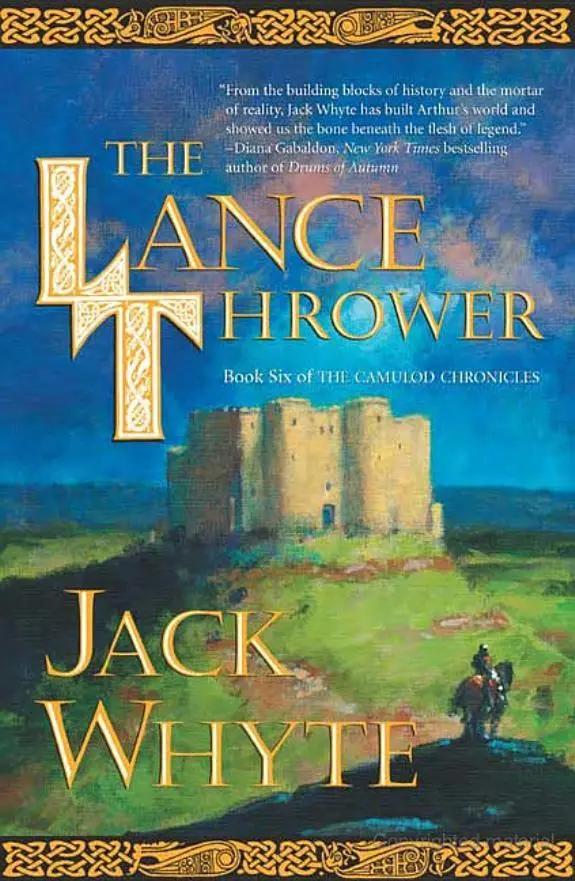
- Название:The Lance Thrower
- Автор:
- Жанр:
- Год:неизвестен
- ISBN:нет данных
- Рейтинг книги:5 / 5. Голосов: 1
-
Избранное:Добавить в избранное
- Отзывы:
-
Ваша оценка:
The Lance Thrower: краткое содержание, описание и аннотация
Предлагаем к чтению аннотацию, описание, краткое содержание или предисловие (зависит от того, что написал сам автор книги «The Lance Thrower»). Если вы не нашли необходимую информацию о книге — напишите в комментариях, мы постараемся отыскать её.
Clothar is a young man of promise. He has been sent from the wreckage of Gaul to one of the few schools remaining, where logic and rhetoric are taught along with battle techniques that will allow him to survive in the cruel new world where the veneer of civilization is held together by barbarism. He is sent by his mentor on a journey to aid another young man: Arthur Pendragon. He is a man who wants to replace barbarism with law, and keep those who work only for destruction at bay. He is seen, as the last great hope for all that is good.
Clothar is drawn to this man, and together they build a dream too perfect to last--and, with a special woman, they share a love that will nearly destroy them all...
The name of Clothar may be unknown to modern readers, for tales change in the telling through centuries. But any reader will surely know this heroic young man as well as they know the man who became his king. Hundreds of years later, chronicles call Clothar, the Lance Thrower, by a much more common name.
That of Lancelot.
The Lance Thrower — читать онлайн бесплатно полную книгу (весь текст) целиком
Ниже представлен текст книги, разбитый по страницам. Система сохранения места последней прочитанной страницы, позволяет с удобством читать онлайн бесплатно книгу «The Lance Thrower», без необходимости каждый раз заново искать на чём Вы остановились. Поставьте закладку, и сможете в любой момент перейти на страницу, на которой закончили чтение.
Интервал:
Закладка:
“So where are we now?”
“Seven days south of the gorge on the Liger River, headed southeast, this being the seventh day, and I’d say we’ve been covering less than a score of miles a day because we’ve been cautious, moving slow, keeping our heads down, covering our tracks, and taking care to stay out of people’s way. Seven more days at the same speed should bring us to Lugdunum. The locals call it Leeyon , but whichever way you say it, it’s the military administration’s headquarters for south-central Gaul.” He paused, waiting for my admiration, and when I admitted it he grinned. “What’s important about that, though, from your viewpoint, is that if we swing back to the northeast from there and follow the High Road, we can be bathing in Lake Genava in five more days, providing the water’s warm enough.”
This was momentous news, and I was pleasantly surprised at how close we were to my family home, for had he told me it would take us three times as long I would have accepted that without demur. I felt my face split into a wide grin.
“Well, whether the lake is cold or not, King Ban’s bathhouses are fine, I promise you. They were built for a Roman governor long ago and they lack nothing that his wealth could provide. Will you come with me, then, to Benwick?”
“Of course, how could I not? I have to see you safely home. We should find word of Duke Lorco in Lugdunum, but even if we are ahead of him and he hasn’t arrived yet, we’ll leave word there that I’ve escorted you home and I’ll follow him later to Carcasso. Does that sound like good sense? ’Course it does, so let’s get some sleep and be on the road again early tomorrow morning.”
The twelve days Ursus had estimated for our journey were more than sufficient. We found ourselves approaching Lugdunum at the end of the fifth of the seven days he had allowed us for that portion, and this was mainly because, within three days of setting out on that last lap, we had found ourselves in a heavily traveled area serviced by one of Rome’s great spear-straight roads and hence were able to discard all our former caution and proceed openly at more than twice our previous pace.
Lugdunum was a surprise to me. I knew I must have passed through it years earlier on my way north to Auxerre, but I had absolutely no memory of the place, and I found it to be very different, in almost every way that I could think of, from its counterpart city of Treves in the north. Each had a military fortress, and the imperial legions quartered there were the same in both places. Apart from that similarity, however, everything else was different from one town to the other, beginning most notably with the food but extending to the local people, the farmers and artisans who lived in the surrounding areas. The climate was warmer here, for one thing, since we were now in southern Gaul, but the very appearance of the local folk was completely dissimilar to that of the people who lived in the Treves region. These people here were darker skinned than their northern brethren, and they seemed plumper, somehow, sleeker, more content, and more self-satisfied. “Better fed” was the way Ursus expressed it, and in the utterance he made it sound like some kind of cause for shame.
The wine they drank was better, too, I learned, and even though I could not have told from tasting it I could see for myself that the white wine of this region was closer to yellow in appearance, so I was prepared to believe that it might be thicker and more fruity with the kinds of sugar that northern wines lacked notably. It was the local red wine that made this region famous, however, according to what Ursus told me, and I saw no reason to doubt him, although I had no desire to taste any of it. I had tasted my first cup of watered wine at twelve years old. Now, almost four years later, the blend of the two liquids I infrequently drank was barely stronger than that first anemic mixture of one part wine to three parts water. I still found the taste of it unpleasant and preferred the honest tastelessness of chilled, clear water.
We found no trace of Lorco’s turmae in Lugdunum. No one had heard of him or from him since he and his party passed through on the way north a month earlier. And so Ursus delivered a formal report to the military authorities, describing all that had happened, to the best of our limited knowledge, and left another written missive with the commander of the garrison for delivery to Duke Lorco when he arrived. That done, Ursus and I ate in the garrison refectory that night and slept soundly for eight hours in one of the barracks rooms before striking out again at dawn along the broad, straight highway that followed the Rhone river to the lake called Genava in the ancient territories of Cisalpine Gaul.
We rode with the river on our right, and at first we had no shortage of companions along the route, teamsters with laden wagons, and self-sufficient pedestrians, and an occasional string of laden mules led by handlers as taciturn as the creatures they led. But as we traveled farther and farther beyond the protection of the military headquarters, our traveling companions reached their various destinations in hamlets and small towns and villa farms and left us to travel on without them, until eventually we were alone again on the open road. We no longer had any need to hunt for food, which pleased us both, for once Ursus had established his identity and his membership in Duke Lorco’s squadrons, he had been able to draw some of his unpaid stipend from the offices of the military paymaster in Lugdunum. With those funds he had immediately gone looking for a commodious tent of hand-sewn leather panels to replace the one he had lost in the ambush by the river. I was most impressed with the workmanship I could see in the tent’s finish, but Ursus waved a hand dismissively, saying it was nowhere near as large or as fine as the one he had lost. Then, having bought the tent, he also bought a horse to carry it, for the thing was much too large to carry on the horse he had inherited from Lorco. I watched closely, but said nothing while he negotiated with the horse trader, but I was satisfied that he had acquitted himself well and had bought a fine, strong animal.
From the horse dealer’s premises, we next made our way to the armories, where he replenished his supply of arrows and purchased a bow and another quiver full of arrows for me before taking me on an expedition to purchase rations for the ensuing week, and now our saddlebags were filled with provisions: fresh crusty loaves of heavy, rich brown bread; several kinds of dried and salted meat and fish; four rounds of cheese, two soft and new, and two hard and dry; a flask of the garlic-enriched fish oil that had been beloved of Roman soldiers for countless hundreds of years, together with a vial of thick, aromatic black vinegar and even two earthen jars of salty, fat green olives preserved in their own oil. We were men of wealth on this portion of our journey, at least when it came to eating.
On the afternoon of our second day out of Lugdunum it threatened to rain heavily on us and we could see no signs of any rift in the thick-piled banks of cloud that had swept in upon us from the north, so we decided we would rather make camp early and sit warm and dry in our new leather tent than press on for no good reason and endure the deluge.
We picked a spot in the open, about a hundred paces from the roadside and close to the river, in the shelter of a huge dead tree that would provide us with all the firewood we might need. It took us almost an hour to pitch the tent to Ursus’s liking, since this was the first time we had tried it and every tent ever made has its own quirks and peculiarities. By the time we had it up and ready to use, my hands were sore and bruised from struggling with stiff new abrasive and unyielding ropes. As soon as that task was done, I went gathering ferns for our bedding, no great hardship compared to pitching the tent because, as close as we were to the water, ferns grew in lush profusion among the trees on the riverbank.
Читать дальшеИнтервал:
Закладка:
Похожие книги на «The Lance Thrower»
Представляем Вашему вниманию похожие книги на «The Lance Thrower» списком для выбора. Мы отобрали схожую по названию и смыслу литературу в надежде предоставить читателям больше вариантов отыскать новые, интересные, ещё непрочитанные произведения.








Обсуждение, отзывы о книге «The Lance Thrower» и просто собственные мнения читателей. Оставьте ваши комментарии, напишите, что Вы думаете о произведении, его смысле или главных героях. Укажите что конкретно понравилось, а что нет, и почему Вы так считаете.