Jack Whyte - The Lance Thrower
Здесь есть возможность читать онлайн «Jack Whyte - The Lance Thrower» весь текст электронной книги совершенно бесплатно (целиком полную версию без сокращений). В некоторых случаях можно слушать аудио, скачать через торрент в формате fb2 и присутствует краткое содержание. Жанр: Старинная литература, на английском языке. Описание произведения, (предисловие) а так же отзывы посетителей доступны на портале библиотеки ЛибКат.
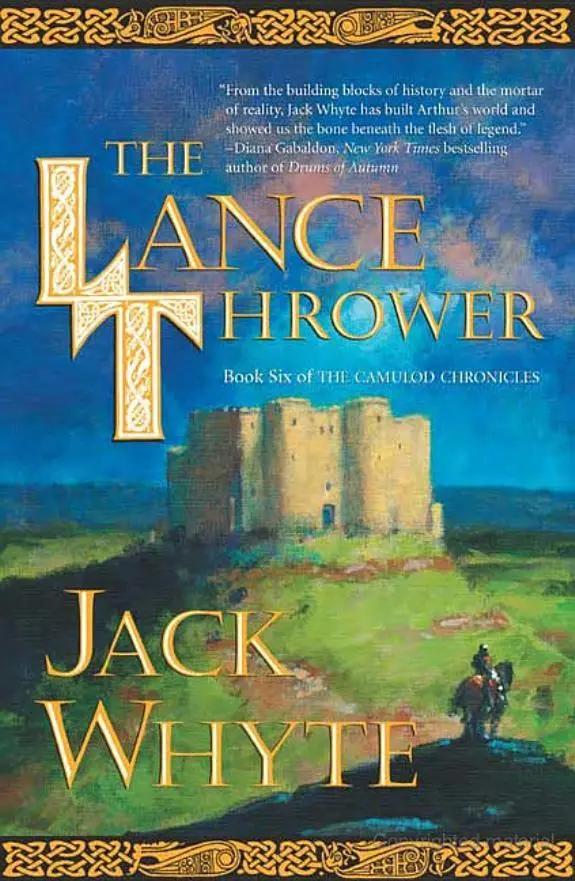
- Название:The Lance Thrower
- Автор:
- Жанр:
- Год:неизвестен
- ISBN:нет данных
- Рейтинг книги:5 / 5. Голосов: 1
-
Избранное:Добавить в избранное
- Отзывы:
-
Ваша оценка:
The Lance Thrower: краткое содержание, описание и аннотация
Предлагаем к чтению аннотацию, описание, краткое содержание или предисловие (зависит от того, что написал сам автор книги «The Lance Thrower»). Если вы не нашли необходимую информацию о книге — напишите в комментариях, мы постараемся отыскать её.
Clothar is a young man of promise. He has been sent from the wreckage of Gaul to one of the few schools remaining, where logic and rhetoric are taught along with battle techniques that will allow him to survive in the cruel new world where the veneer of civilization is held together by barbarism. He is sent by his mentor on a journey to aid another young man: Arthur Pendragon. He is a man who wants to replace barbarism with law, and keep those who work only for destruction at bay. He is seen, as the last great hope for all that is good.
Clothar is drawn to this man, and together they build a dream too perfect to last--and, with a special woman, they share a love that will nearly destroy them all...
The name of Clothar may be unknown to modern readers, for tales change in the telling through centuries. But any reader will surely know this heroic young man as well as they know the man who became his king. Hundreds of years later, chronicles call Clothar, the Lance Thrower, by a much more common name.
That of Lancelot.
The Lance Thrower — читать онлайн бесплатно полную книгу (весь текст) целиком
Ниже представлен текст книги, разбитый по страницам. Система сохранения места последней прочитанной страницы, позволяет с удобством читать онлайн бесплатно книгу «The Lance Thrower», без необходимости каждый раз заново искать на чём Вы остановились. Поставьте закладку, и сможете в любой момент перейти на страницу, на которой закончили чтение.
Интервал:
Закладка:
Even as he launched himself, however, I had already shifted my balance, and jumped this time to his right, landing behind him as he charged past me and crouching to sweep the end of my blade hard across the unprotected back of his knees. The double-edged tip of the blade missed the hamstrings this time, but sliced deeply into the thick muscles of his left calf.
With a bellow of rage the monstrous man swung around with impossible speed, slashing at my face as he came toward me. I threw my upper body sharply backward, almost falling over but avoiding the hissing slash of his blade and managing somehow to counter his attack with a blow of my own, blade against blade, my right-handed blow against his left, smashing his blade down and away from me so that his entire body followed the line of his swing and I ended up behind him again. I leaned forward, my weight on the balls of my feet, and closed with him quickly, stabbing hard, but my blade hit solid metal and its tip slid off the back of a cuirass I had not expected, worn beneath his tunic rather than over it.
Again he turned and came at me, but this time I detected a new respect in his approach. He paused, watching me, waiting for me to move, and when I did not, he changed his grip on his sword, holding it differently, more like a sword now than an ax, and began to circle me, moving now to my right, forcing me to move left against my natural inclination. The aversion I felt to moving so unnaturally reminded me of yet another lesson from my mentor Cato for dealing with a left-handed opponent. I shifted my weight and took two quick steps toward my assailant, leading off with my right foot and then stepping forward and to the left. The sudden move took me right inside his guard and put me in front of him, within smelling length of his unwashed body, my sword arm raised in expectation of his next blow. It was an awkward, ill-formed hack, as I knew it would be, useless from the start because I was all at once too close to him too suddenly. I caught his blade on my own with no effort and turned it aside, and as it fell away past me I dropped my right shoulder, pivoted to the left, and thrust my blade into the flesh below his navel, below his cuirass. It was a classic stroke, and I carried it out as I had been taught, twisting my wrist sharply to free the buried blade and jerking it straight back and away before the sundered flesh could clamp around it and before the dying man could drop his hands to grasp it.
He fell to his knees at my feet and gazed up into my eyes, his face twisted into a mask of consternation and terror as he realized what I had done to him. There was nothing worse than a belly wound, I knew. I had never seen one before, let alone dealt one, but I had heard all about what they meant: a slow, lingering, agonizing death.
“Finish him. You can’t leave the poor whoreson like that.”
I looked away from my assailant’s face to where Ursus stood close by, watching us, an arrow in his bow again, and I knew that even if I could do no more, Ursus would put the fellow out of his misery. But that, again, would be an avoidance that I would find difficult to live with. I looked back at my former opponent, who had fallen forward and now hung head down in front of me and moaning quietly, then I stepped to one side, gripped my spatha firmly in both hands and swung hard at his exposed neck, killing him instantly. Then I turned aside and vomited.
I have no idea how long it took me to recover from the sickness that swept over me, but when it was over and I picked myself up off the ground I found that Ursus had confiscated our assailants’ provisions and kindled a fire to cook some bannock to go with the cooked meat he had found in one of their packs. The smells were delicious, and I approached the fire slowly, feeling somewhat shamefaced about my latest pusillanimous behavior. Ursus, however, said nothing at all and contented himself with serving me some heated meat on a slab of thin, salty, freshly baked bannock. I accepted it gratefully and devoured it without saying a word. Ursus ate his more slowly, and when he was done he licked the blade of his knife carefully and pointed it at me.
“You did well, lad. First kill’s never easy to handle. But it’ll never be as difficult or as worrisome again, I promise.”
“He wasn’t the first.” I raised my head and looked Ursus directly in the eye. “The one I shot with your bow was the first.”
Ursus twisted his face into the semblance of a half grin and shook his head. “Nah,” he said. “That one didn’t count. That was no more than helping a friend in need. If you hadn’t taken that one down he would have been on top of me before I could handle his friend, and that might easily have been the end of me. Truth is, lad, your first real kill’s always the one whose blood gets on your hands and your clothes—the up-close, frantic one who’s trying just as hard to kill you as you are to kill him. He’s the one you’ll dream about for a while. But you’ll get over it, in time. We all do.”
He skewered the last piece of meat that lay simmering on the flat iron griddle he had laid on the coals of the fire—he must have found that, too, I realized, in his searching—and dropped it onto the last remaining piece of bannock in his hand, then closed his fist, squeezing the whole thing into a solid cylinder of bread and meat. He held it out to me. “Here, finish this, and then we’ll salvage those arrows and drag the bodies out of sight. Can’t bury them, but we can’t just leave them lying there, either.”
A long time later, after it grew dark, he spoke to me again across the dying fire. “Where exactly are you headed? Where are your people from?”
It was the first thing either of us had said for hours and it roused me from my semistupor of meditation. I realized that I couldn’t answer his question properly, simple though it was. I knew where I was going, but I had no notion of how to get there from where we were.
“Genava,” I told him. “It’s a lake, far to the southeast, I think, close to the Alps—part of the Frankish kingdom called Benwick. King Ban rules there. He is a Ripuarian Frank and my stepfather, wed to my mother’s sister—”
Ursus interrupted me with a scoffing laugh. “A Frank’s a Frank, lad, be he from north or south. Leave it at that.”
“No, that’s not true. The two are very different, no matter that they sound alike. King Ban is a Ripuarian Frank, but I’m not. I’m a Salian Frank, from the north, near the Rhine river. My father’s people lived and ruled along the Rhine. Ban rules along the Rhodanus, which is called the Rhone nowadays. Rhine, Rhone, almost the same, one in the north, one in the south. Are they the same river because of that? I think not.”
Ursus raised both eyebrows and pursed his lips, then nodded deeply, maintaining his wide-eyed look. “Prettily put,” he said. “A point well made, so I will say no more.”
I shrugged. “The fact remains, I know where I’m headed, but I don’t know how to set about going there from here. I don’t know where we are now.”
Ursus laughed, a sharp, deep bark. “Is that all? Well, lad, that’s easily taken care of since I know exactly where we are, and I also know the route from here to Benwick and Lake Genava.”
I blinked at him, astonished. “You do?”
“Of course I do, and you’d better learn to do the same, and the quicker the better.” He paused, gazing at me. “Knowing where you are is a matter of simple self-preservation. Look at me, a professional soldier, a mercenary. If I don’t know where I am at any time I could be killed, simply for wandering among the wrong people. And so I pay attention to where I go, always. I’m so used to doing it that I never think about it any more, but I always remember where I’ve been and I know where I am headed next—even if it’s only as far as I can see in a strange country.”
Читать дальшеИнтервал:
Закладка:
Похожие книги на «The Lance Thrower»
Представляем Вашему вниманию похожие книги на «The Lance Thrower» списком для выбора. Мы отобрали схожую по названию и смыслу литературу в надежде предоставить читателям больше вариантов отыскать новые, интересные, ещё непрочитанные произведения.







Обсуждение, отзывы о книге «The Lance Thrower» и просто собственные мнения читателей. Оставьте ваши комментарии, напишите, что Вы думаете о произведении, его смысле или главных героях. Укажите что конкретно понравилось, а что нет, и почему Вы так считаете.