Jack Whyte - The Lance Thrower
Здесь есть возможность читать онлайн «Jack Whyte - The Lance Thrower» весь текст электронной книги совершенно бесплатно (целиком полную версию без сокращений). В некоторых случаях можно слушать аудио, скачать через торрент в формате fb2 и присутствует краткое содержание. Жанр: Старинная литература, на английском языке. Описание произведения, (предисловие) а так же отзывы посетителей доступны на портале библиотеки ЛибКат.
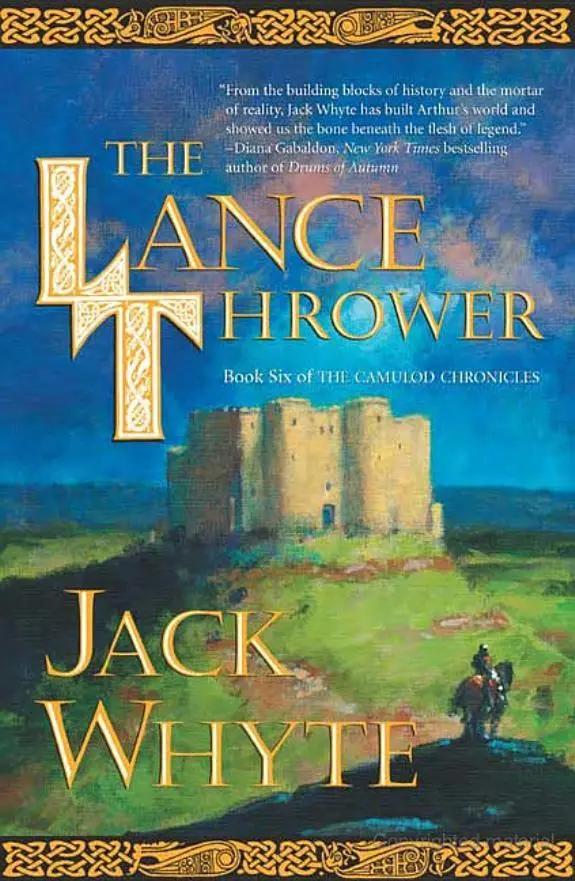
- Название:The Lance Thrower
- Автор:
- Жанр:
- Год:неизвестен
- ISBN:нет данных
- Рейтинг книги:5 / 5. Голосов: 1
-
Избранное:Добавить в избранное
- Отзывы:
-
Ваша оценка:
The Lance Thrower: краткое содержание, описание и аннотация
Предлагаем к чтению аннотацию, описание, краткое содержание или предисловие (зависит от того, что написал сам автор книги «The Lance Thrower»). Если вы не нашли необходимую информацию о книге — напишите в комментариях, мы постараемся отыскать её.
Clothar is a young man of promise. He has been sent from the wreckage of Gaul to one of the few schools remaining, where logic and rhetoric are taught along with battle techniques that will allow him to survive in the cruel new world where the veneer of civilization is held together by barbarism. He is sent by his mentor on a journey to aid another young man: Arthur Pendragon. He is a man who wants to replace barbarism with law, and keep those who work only for destruction at bay. He is seen, as the last great hope for all that is good.
Clothar is drawn to this man, and together they build a dream too perfect to last--and, with a special woman, they share a love that will nearly destroy them all...
The name of Clothar may be unknown to modern readers, for tales change in the telling through centuries. But any reader will surely know this heroic young man as well as they know the man who became his king. Hundreds of years later, chronicles call Clothar, the Lance Thrower, by a much more common name.
That of Lancelot.
The Lance Thrower — читать онлайн бесплатно полную книгу (весь текст) целиком
Ниже представлен текст книги, разбитый по страницам. Система сохранения места последней прочитанной страницы, позволяет с удобством читать онлайн бесплатно книгу «The Lance Thrower», без необходимости каждый раз заново искать на чём Вы остановились. Поставьте закладку, и сможете в любой момент перейти на страницу, на которой закончили чтение.
Интервал:
Закладка:
We traveled southeastward from the river gorge for six days without incident, avoiding all human contact, proceeding with the utmost caution and moving stealthily at all times, checking lines of sight and being careful never to move into any position from which we might become visible to anyone else. Within those short days, however, I learned much about woodcraft and the lore of tracking from my companion, who turned out to be far more pleasant company than I had been given to expect. He showed me, expending great patience and tolerance, how to watch for, and detect, the tiny, telltale signs that marked the passage taken by an animal on its way through the undergrowth, emphasizing that once I knew how to see the signs of passing animals I could not fail to see the damage done by humans in their passage. These were signs that I would never have seen had he not been there to point them out, and I knew well that he had spent the better part of his lifetime absorbing the lessons that enabled him to see them—a bent-back twig; a wrongly turned leaf that caught the light when none of its fellows did; a clump of hair caught on the thorns of a wild rosebush; a curled-up leaf that had filled with seepage after being crushed in the center and formed into a cup by a deer’s cloven hoof.
We were in a place that had been burned out in a massive fire, probably seven to ten years earlier, Ursus estimated. We had been afoot for some time after breaking camp before dawn and had made good headway until we reached this stretch of forest and were forced to dismount. The brush had quite suddenly become impenetrable, I remember—saplings and bushes that were simply too thickly packed to accord access to a mounted man—and neither of us had spoken for some time, our attention focused intently, for more than a mile, it seemed, upon finding the easiest possible route through a wilderness of springy, immature growth that had not yet begun to assert any order upon itself. We had just fought our way through what we hoped had been the very thickest growth and encountered the first signs that the brush was thinning—everything seemed much lighter and brighter ahead of us—and when I heard water running on my right, I felt a sharp stirring in my bowels that I knew I could not ignore. I muttered to Ursus and handed him my reins, telling him I would catch up to him, and he merely nodded and kept going, paying me no further attention as I made my way toward the sound of the running water to relieve myself in private.
When I had finished and cleansed myself, I made my way back to rejoin Ursus in no particular haste, following the signs of his passage easily beyond the spot where we had parted company. The growth around me was thinning with almost every step I took, and the oppressive feeling I had experienced earlier amid the thickets gave way to one of lightheartedness. There were birds singing everywhere, exulting in the perfection of a magnificent summer morning, and I responded to the music, forgetting for the first time in days to wonder what had happened to Duke Lorco and his party. I stepped around the bole of a respectably sized tree at one point and realized that not only was this the first mature, unburned tree I had seen in a long time but also that I was almost in open ground, standing upon a path of some kind, a game trail that ran straight ahead of me, unrestricted by undergrowth, so that had I so wished I could have spread my arms wide and spun around without hitting a single obstruction.
I started to do precisely that, raising my arms in the air like wings and preparing to spin around, but I froze instead, shocked into immobility by the sight of Ursus’s bow and quiver lying on the path less than twenty paces from where I stood.
They lay there, in the open, like dead things, the two most valuable weapons Ursus and I possessed, and even before the first flare of panic had subsided, I was thinking about the reasons for their being there. Clearly they had been left for me to find, a warning of some kind. For some reason unknown to me but evidently imperative, Ursus had decided that I could make better use of the weapons in this instance than he could. That all seemed self-evident at first glance, but I had no understanding at all of what it meant and even less understanding of what had happened to Ursus and the horses. And then I saw how the path, just beyond where the weapons lay, veered sharply to the left and disappeared, concealed beyond the bend by a towering clump of vibrant dark green growth that I recognized as an ancient and impenetrable thicket of bramble briars.
Ursus had gone around the bend in the path with both horses, but before doing so he had stopped and removed the weapons from about his shoulders, laying them there for me. He knew I would be close behind him, but he had no means of knowing how close, and if he were walking into danger beyond that bend in the path that knowledge might be crucial. I snatched up the quiver and slung it over my shoulder, then dropped to one knee and nocked an arrow to the bowstring. My intent was to listen, but even as I knelt I heard the sound of metal blades in contact, not ringing as they would in a fight but slithering along each other almost lazily as Ursus raised his voice.
“Come then, you ill-matched set of whoresons. Let’s see if four Burgundians—or whatever you call yourselves in the underworld that spawned you—let’s see if you can best one Roman Gaul. See, two blades I have, each one of them fit to kill a pair of you before you can puke your fear out. Come to me, then, and taste your deaths.”
I edged around the bush in front of me, the bowstring taut to my ear as my eyes sought the source of Ursus’s voice. He was facing me across a clearing, perhaps a score of paces from me, his back against a tree trunk that was wider than his shoulders. Safe there from attack from behind, he stood on the balls of his feet, leaning slightly forward and rubbing the two long blades of the weapons he held, one against the other. They were his own spatha and mine, the one I had left hanging from Lorco’s saddlebow when I took Tiberias Cato’s weapon in its place. His eyes were narrowed in concentration but he was smiling, too, the confident smile of a man who knows he is about to take much enjoyment from some imminent activity. He saw me as soon as I appeared around the bush, I know, but he gave no sign of it. His torso weaved slightly from side to side as his eyes moved constantly, watching all four of his attackers simultaneously.
Our two mounts stood close by him on his left side, slightly behind him and beyond the tree, their trailing reins anchoring the animals where Ursus had dropped them on the ground. I knew immediately that he had led the horses there, to place them safely out of his way, and had then darted back to the tree, putting it solidly at his back.
The four men ranged against him, all of whom had their backs to me, had made no move to attack him yet, and looking at their posture, observing the uneasy, anxious way they traded glances back and forth among themselves, I could tell they were bemused, to say the least, by his behavior. He should not have been smiling, not against odds of four to one. I could almost hear their minds working, worrying at the logic here, so much so, in fact, that my mind began framing antic thoughts about what they must be thinking: this fellow had two fine horses, both richly saddled and equipped, which meant that he was not alone. But he was alone and carrying two swords, one for each hand, which indicated that his companion, if he had one, must now be somewhere else without a weapon, and that made no sense at all, for no sane man would leave his sword behind him in strange territory. And that raised the possibility that this man had had a friend and lost him to death, burying him and continuing to journey with his possessions. Which meant, in turn, that this fellow—
Читать дальшеИнтервал:
Закладка:
Похожие книги на «The Lance Thrower»
Представляем Вашему вниманию похожие книги на «The Lance Thrower» списком для выбора. Мы отобрали схожую по названию и смыслу литературу в надежде предоставить читателям больше вариантов отыскать новые, интересные, ещё непрочитанные произведения.







Обсуждение, отзывы о книге «The Lance Thrower» и просто собственные мнения читателей. Оставьте ваши комментарии, напишите, что Вы думаете о произведении, его смысле или главных героях. Укажите что конкретно понравилось, а что нет, и почему Вы так считаете.