Jack Whyte - The Lance Thrower
Здесь есть возможность читать онлайн «Jack Whyte - The Lance Thrower» весь текст электронной книги совершенно бесплатно (целиком полную версию без сокращений). В некоторых случаях можно слушать аудио, скачать через торрент в формате fb2 и присутствует краткое содержание. Жанр: Старинная литература, на английском языке. Описание произведения, (предисловие) а так же отзывы посетителей доступны на портале библиотеки ЛибКат.
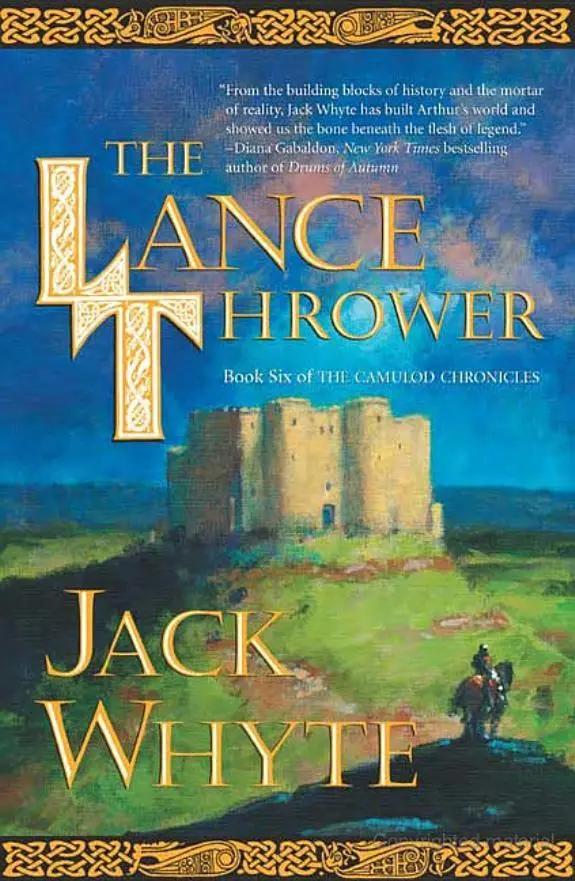
- Название:The Lance Thrower
- Автор:
- Жанр:
- Год:неизвестен
- ISBN:нет данных
- Рейтинг книги:5 / 5. Голосов: 1
-
Избранное:Добавить в избранное
- Отзывы:
-
Ваша оценка:
The Lance Thrower: краткое содержание, описание и аннотация
Предлагаем к чтению аннотацию, описание, краткое содержание или предисловие (зависит от того, что написал сам автор книги «The Lance Thrower»). Если вы не нашли необходимую информацию о книге — напишите в комментариях, мы постараемся отыскать её.
Clothar is a young man of promise. He has been sent from the wreckage of Gaul to one of the few schools remaining, where logic and rhetoric are taught along with battle techniques that will allow him to survive in the cruel new world where the veneer of civilization is held together by barbarism. He is sent by his mentor on a journey to aid another young man: Arthur Pendragon. He is a man who wants to replace barbarism with law, and keep those who work only for destruction at bay. He is seen, as the last great hope for all that is good.
Clothar is drawn to this man, and together they build a dream too perfect to last--and, with a special woman, they share a love that will nearly destroy them all...
The name of Clothar may be unknown to modern readers, for tales change in the telling through centuries. But any reader will surely know this heroic young man as well as they know the man who became his king. Hundreds of years later, chronicles call Clothar, the Lance Thrower, by a much more common name.
That of Lancelot.
The Lance Thrower — читать онлайн бесплатно полную книгу (весь текст) целиком
Ниже представлен текст книги, разбитый по страницам. Система сохранения места последней прочитанной страницы, позволяет с удобством читать онлайн бесплатно книгу «The Lance Thrower», без необходимости каждый раз заново искать на чём Вы остановились. Поставьте закладку, и сможете в любой момент перейти на страницу, на которой закончили чтение.
Интервал:
Закладка:
The decision to abandon the northward search for the Duke was made by Ursus, but I made no objection when he suggested it. As we had moved north during the previous two days, the concentration of Burgundians around us had increased dramatically, and it was obvious that to continue moving as we were, haphazardly and without real objectives, was folly. It was already amazing that we had avoided detection for as long as we had. The single alternative open to us, Ursus decided, was to turn back and head southward, to wait for Lorco and his turmae at some spot where the lie of the land itself would dictate that they must pass close by us. That decision made, and its common sense plain and clear to both of us, we turned back with great feelings of relief and headed south to await Duke Lorco and his troops.
For the next two days we traveled steadily, following or paralleling the easiest and most obvious route to the south and finding ourselves being shepherded gradually but unmistakably in the southeasterly direction dictated by the river as it penetrated a wide, forested valley between two ranges of hills. The route we followed was one that had never seen the construction of a Roman road, yet it was wide and obviously well traveled, and by the time we had gone a score of miles along it, it had become obvious that the Burgundian invaders had no interest in it, because we saw little sign of them. The few isolated groups that we did see were making their way hurriedly and single-mindedly to the north, paying no attention to whatever might be going on around them.
By noon the following day, having spent the entire morning watching for Burgundians and seeing none, we finally accepted that we had left them and their invasion route safely behind us. We made a comfortable camp that night, close by the road but sufficiently far away from it among the trees to be confident that we could safely light a fire without risk of its being seen by any late-night travelers, and then we lay awake for several hours in the firelight, talking about our missing companions, wondering where they might be and when we would encounter them again.
We never did. Nor, to the best of our knowledge, did anyone else. I learned later, after my eventual return to Auxerre, that there had been a deal of speculation in their home region during the months that followed their disappearance, but Phillipus Lorco himself had quickly been replaced by a new governor who was faced with his own priorities, and the disappearance of Lorco and his three turmae had quickly faded into acceptance, its urgency diffused by the other events surrounding the Burgundian invasion that summer.
The most widely accepted version of what might have happened was that Lorco and his party had ridden blindly into a trap and had been wiped out, but there were those who refused to accept such a notion. Those doubters, claiming personal experience, friendship, and long-standing knowledge of Governor Lorco, swore that Lorco would never commit such an elementary error as to ride through unknown and potentially hostile territory without deploying scouts on all sides of his force. Bishop Germanus, having spent years as Lorco’s Legatus in the field, was a voluble proponent of that belief, but when I heard it, I found myself wondering immediately if there might be any truth to the less acceptable version. Thinking back to the dilatory conduct and the unconscionable laziness of Lorco’s lieutenant, Harga, and that man’s failure to take even the simplest of precautions, thus leading us into an entrapment from which Ursus and I should never have escaped, I was forced to wonder about the degree to which Harga’s laziness might have been inspired or encouraged by his own observation of his superiors’ behavior. I felt uncomfortable and disloyal to Duke Lorco for thinking such things, but I could not avoid them. For a period of days I frequently found myself wondering if I had been a fool to give up the honor of winning Cato’s spatha merely to make a son look good to a father who did not merit such an honor. I kept such thoughts to myself, however, knowing they were both unjust and unworthy, and never expressed my own personal doubts or misgivings to anyone. Lorco was dead, whatever his failings might or might not have been, and his son had been my closest friend, killed in front of my eyes. I determined that no hint of criticism that might affect the honor of their name would ever pass my lips.
On the afternoon of our third day’s journey south we came to a spot where the entire valley narrowed to the width of a narrow gorge through which the river poured, changing from a broad, placid, meandering stream to a raging torrent within the space of half a mile. Here, Ursus said, was the spot where we would wait for Duke Lorco. He remembered passing through the narrow passage on their way north, and told me that Lorco himself had said that if anything untoward occurred later in their journey and anyone found himself cut off, they should head for this place and wait for the remainder of the group to come back. We searched the narrow riverbank for evidence of the cavalry’s passage but we found none and so were able to settle in to wait, confident in the knowledge that the main group was still behind us.
We set up camp, dangerously and precariously, on the steep side of the cliff that formed the left side of the gorge, and we took time to ensure that it was the best site we could find, secure from casual detection from beneath yet affording us an unimpeded view of everything that happened in the gorge itself, on both sides of the river. And there we remained for days, watching and waiting. Several groups of travelers passed by us, going in both directions, some of them strongly armed and alert for interference, others less so. None of them suspected our presence and none of them bore any resemblance to our missing Duke or to any of his people.
After four days our concern had grown too great to ignore. We could not go back, and we could no longer afford to remain where we were. Ursus had shot a deer on the second morning of our stay and we had been eating that ever since, but we had no other provisions. I had found some wild onions and garlic growing along the riverbank, and Ursus had found some succulent mushrooms, so we had been able to augment the taste of the deer meat, if only slightly. But we had no salt and no flour, nor had we anything in the way of dried fruit, roasted grain, or nuts. It had become clear to us by then that one of two things, each equally unlikely and unwelcome, had occurred: either Lorco and his party had encountered a strong Burgundian force and been captured or defeated, or they had decided, for reasons unknown to us, to make their way home by an alternative route. Whichever was true, it was clearly futile for us to remain where we were. So once again we headed south.
Ursus had only nine arrows left by that time, and now, accepting that we would not be rejoining Lorco’s cavalry and were in fact to be solely reliant on our own resources, those nine missiles took on a greater significance than they had ever held before. They were our sole means of dealing death at anything greater than arm’s length, and in consequence we were loath to take aim with them at anything that offered us even the slightest threat of losing another. Fortunately, Ursus was an excellent fisherman and he also knew how to construct a snare for catching hares and even ground birds like grouse and partridge. He would rummage carefully among a patch of underbrush until he detected the narrow pathways—sometimes more akin to tunnels—along which the small animals and birds made their way, and then he would fashion a noose from an old bowstring and anchor it with a solidly driven tent peg before carefully suspending it close to the ground and disguising its outline with cunningly blended grasses. We would then withdraw and leave the noose to do its work, and it seldom failed. We took partridge and grouse and, twice, badgers, neither of which submitted to the noose, far less succumbed to it. Each of them completely destroyed the trap into which it had blundered, and made off with the invaluable bowstring, presumably still wrapped about its neck.
Читать дальшеИнтервал:
Закладка:
Похожие книги на «The Lance Thrower»
Представляем Вашему вниманию похожие книги на «The Lance Thrower» списком для выбора. Мы отобрали схожую по названию и смыслу литературу в надежде предоставить читателям больше вариантов отыскать новые, интересные, ещё непрочитанные произведения.







Обсуждение, отзывы о книге «The Lance Thrower» и просто собственные мнения читателей. Оставьте ваши комментарии, напишите, что Вы думаете о произведении, его смысле или главных героях. Укажите что конкретно понравилось, а что нет, и почему Вы так считаете.