Jack Whyte - The Lance Thrower
Здесь есть возможность читать онлайн «Jack Whyte - The Lance Thrower» весь текст электронной книги совершенно бесплатно (целиком полную версию без сокращений). В некоторых случаях можно слушать аудио, скачать через торрент в формате fb2 и присутствует краткое содержание. Жанр: Старинная литература, на английском языке. Описание произведения, (предисловие) а так же отзывы посетителей доступны на портале библиотеки ЛибКат.
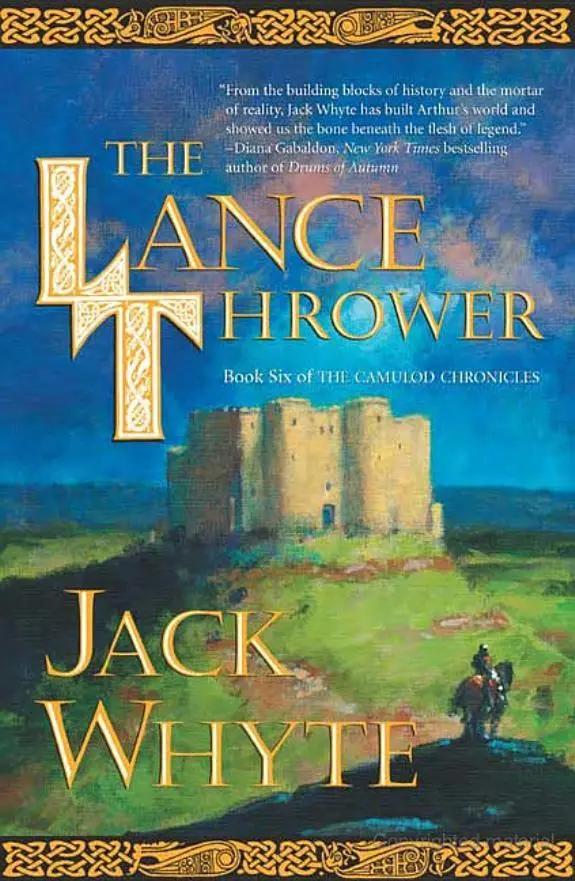
- Название:The Lance Thrower
- Автор:
- Жанр:
- Год:неизвестен
- ISBN:нет данных
- Рейтинг книги:5 / 5. Голосов: 1
-
Избранное:Добавить в избранное
- Отзывы:
-
Ваша оценка:
The Lance Thrower: краткое содержание, описание и аннотация
Предлагаем к чтению аннотацию, описание, краткое содержание или предисловие (зависит от того, что написал сам автор книги «The Lance Thrower»). Если вы не нашли необходимую информацию о книге — напишите в комментариях, мы постараемся отыскать её.
Clothar is a young man of promise. He has been sent from the wreckage of Gaul to one of the few schools remaining, where logic and rhetoric are taught along with battle techniques that will allow him to survive in the cruel new world where the veneer of civilization is held together by barbarism. He is sent by his mentor on a journey to aid another young man: Arthur Pendragon. He is a man who wants to replace barbarism with law, and keep those who work only for destruction at bay. He is seen, as the last great hope for all that is good.
Clothar is drawn to this man, and together they build a dream too perfect to last--and, with a special woman, they share a love that will nearly destroy them all...
The name of Clothar may be unknown to modern readers, for tales change in the telling through centuries. But any reader will surely know this heroic young man as well as they know the man who became his king. Hundreds of years later, chronicles call Clothar, the Lance Thrower, by a much more common name.
That of Lancelot.
The Lance Thrower — читать онлайн бесплатно полную книгу (весь текст) целиком
Ниже представлен текст книги, разбитый по страницам. Система сохранения места последней прочитанной страницы, позволяет с удобством читать онлайн бесплатно книгу «The Lance Thrower», без необходимости каждый раз заново искать на чём Вы остановились. Поставьте закладку, и сможете в любой момент перейти на страницу, на которой закончили чтение.
Интервал:
Закладка:
Wasting no more time, and talking aloud to my horses in order to avoid having to think about anything else, I set out to find the river first and then the Duke and his men.
I had ridden about five miles, and the terrain had been changing very gradually for the previous couple of miles; I had been aware of climbing an unseen gradient for some time, a barely discernible slope that only became really evident when it eventually leveled out into a plateau. Near the top my horses had to scramble to crest the steep west bank of a fast-flowing brook that had cut itself a channel in the soft ground in its rush to join the river, flowing down from a rocky outcrop south of me that was the closest thing to a hill I had seen all morning. And suddenly there was the river, straight ahead, beyond the crest of the slope and less than a hundred paces distant.
No osier willows lined the low-lying banks here. The swollen river, broad and silent but sullen and dangerous looking, filled its muddy bed almost completely, its silt-laden waters reaching to within a couple of handspans of the grassy edges of the channel. The river must have been flowing westward for some time, more or less paralleling my own route, to the north of where I was. It must have changed direction, swinging west, within a mile of the killing ground, and the only reason I found it at all was that it meandered again, southward this time, to cross my path. As soon as I found the riverbank, however, I knew that something was far from well.
I drew rein and peered into the distance, looking for signs of life and confidently expecting to see Phillipus Lorco’s horsemen somewhere ahead of me, but there was nothing. Surprised, but not yet uneasy, I turned in my saddle and looked to left and right, but there was nothing to be seen there, either, although I could see that the open grassland ended in dense woodland on my right, about a mile north of where I sat. Nothing stirred there; no flash of sun on metal, no moving column, no pillar of dust. Puzzled now, I turned to look back the way I had come, as though I might have passed them along the way without noticing the dust and the noise or the sight of more than a hundred mounted men, and it was then that I noticed the absence of the track.
Six score of mounted troopers, three fully manned Roman turmae, one composed of light cavalry, one of mounted archers, and the third of heavy, spear-wielding contus cavalry, with all of their extra mounts, supply wagons, and ancillary personnel, create a significant amount of damage when they pass over a grassy plain, particularly when the troopers are riding in formation, four or five abreast in a single column. It is impossible to conceal the evidence of their passing. When we were attacked, we had been riding two abreast on the narrow, packed-clay path beside the river precisely because of the mess that had been created and the dust that had been churned up when Lorco’s turmae had ridden over the dry fields on our left earlier that morning. We had had no wish to stir up that dust again because all of us knew from long experience how choking and debilitating it would be. We were privileged, we knew, to be apart from the main body of our force on such a hot day, because the unavoidable presence of swirling, choking, all-pervading dust, caking your face and gathering in the folds of your skin and neck, coating your tongue and filling your eyes and nostrils, trickling down your body beneath your armor back and front on runnels of sweat, to dry out and create unbearable itches in unreachable places, was a fact of cavalry life in the late spring, summer, and autumn months.
There was no such track to be seen here, no matter where I looked, and so great was my disbelief that I began to ride hither and yonder, searching for it as though it was something I might have mislaid through sheer carelessness. I had good reason to be concerned, for the absence of a track meant, beyond dispute, that Lorco’s cavalry had not come this way. They had taken another route, which meant that I was now lost and alone in an unknown and hostile land. I reined in my horse and sat staring up at the cloudless sky while the terror from the day before, reborn at full strength and ravening for release, built up inside me until I found myself incapable of moving. Fortunately, I recognized the peril in that thought even as it occurred to me, and I rebelled against it, hearing a new, angry voice rising inside me and insisting that although I had played the coward by moving too fast the previous day, I would not do the same this day by sitting still.
I jerked my head around hard, breaking my paralysis, and looked to my right, northward, to where the missing troopers now had to be, and forced myself to think about what could possibly have gone wrong with them. Duke Lorco, I was convinced, would not have changed direction before we caught up to him, not with his son and me riding with the hunting party. So if they had not changed direction, then they could not have passed this way yet, which plainly meant that something must have detained them. But what? And then the answer came to me, and relief swelled up in me like an enormous bubble.
They would have waited for us to catch up to them in camp the previous evening, and when we did not arrive, they would have assumed the hunting had been poor and we had remained in the field to try again at dusk. After that they would have continued to wait until long after dark before deciding we had opted for another dawn hunt. But Duke Lorco, I estimated, would not have been comfortable with his son’s prolonged absence, so he might well have sent couriers to ride back early in the morning—I was convinced, in fact, that he would have done precisely that—to find the hapless and incompetent Harga and to chivvy him into making better time. And then, that done, the Duke would have waited where he was, doubtless fuming, but impotent to change anything before his lost hunting party caught up. He would not have traveled farther without first seeing his son safely back in camp.
Feeling as though someone had lifted the weight of my two horses off my shoulders, I swung them around and set out to the north at a canter, following the river again until it entered the tree line, after which I stayed as close to the riverbank as I could. I had to pick my way in places between the densest clumps of undergrowth, so that the progress I made was less swift than I would have wished. However, now that I had a purpose and a direction I could follow with confidence, I made better speed than I might have otherwise.
As I rode, weaving my way between the trees and through the undergrowth, my mind was racing ahead of me, following the logic of my suppositions about Duke Lorco’s behavior. If he had in fact sent out couriers and waited for them to return, then it was likely that by the time I caught up with him he would already have learned of his son’s death and of my disappearance. The prospect of not having to be the one to tell him of his son’s death was an attractive one, but I could not imagine any meeting between the two of us that would not entail my having to tell him, somehow, of what had happened to Lorco, how he had died, and how I had run away, leaving everyone else behind me to be slaughtered. Thus my guilt revived and grew stronger as I rode, and my misery and self-loathing, forgotten for a brief time, returned to drape themselves over my shoulders.
That is how I was feeling when I rounded the bole of an enormous oak tree and found myself face-to-face with a trio of men on foot, no more than twenty paces ahead of me. The sight of them made my breath catch in my throat, but I have no doubt their surprise was as great as mine, because it was evident in the startled way they leaped backward, groping for their weapons. For a moment my heart bounded in joy, my first thought being that they were scouts and I had found Duke Lorco and his men, but it took no more than a glance to show me that these were not Roman soldiers, far less cavalry. They were all dressed differently, but in a predominant color of red. Two of them were armored in what looked like legionary plate armor, while the third wore a tunic of bronze-colored ring mail and had dull silver greaves strapped to his legs. This one, the smallest of the three, had been walking with an arrow nocked to his bow string, and as he sprang backward at the sight of me, he nevertheless sighted hastily and loosed his arrow. It hit me hard and high on the left breast and was deflected by my cuirass, but it caught me off balance, and the force of its impact sent me reeling backward, toppling me over my horse’s rump to land sprawling on my knees and hands.
Читать дальшеИнтервал:
Закладка:
Похожие книги на «The Lance Thrower»
Представляем Вашему вниманию похожие книги на «The Lance Thrower» списком для выбора. Мы отобрали схожую по названию и смыслу литературу в надежде предоставить читателям больше вариантов отыскать новые, интересные, ещё непрочитанные произведения.






Обсуждение, отзывы о книге «The Lance Thrower» и просто собственные мнения читателей. Оставьте ваши комментарии, напишите, что Вы думаете о произведении, его смысле или главных героях. Укажите что конкретно понравилось, а что нет, и почему Вы так считаете.