Jack Whyte - The Lance Thrower
Здесь есть возможность читать онлайн «Jack Whyte - The Lance Thrower» весь текст электронной книги совершенно бесплатно (целиком полную версию без сокращений). В некоторых случаях можно слушать аудио, скачать через торрент в формате fb2 и присутствует краткое содержание. Жанр: Старинная литература, на английском языке. Описание произведения, (предисловие) а так же отзывы посетителей доступны на портале библиотеки ЛибКат.
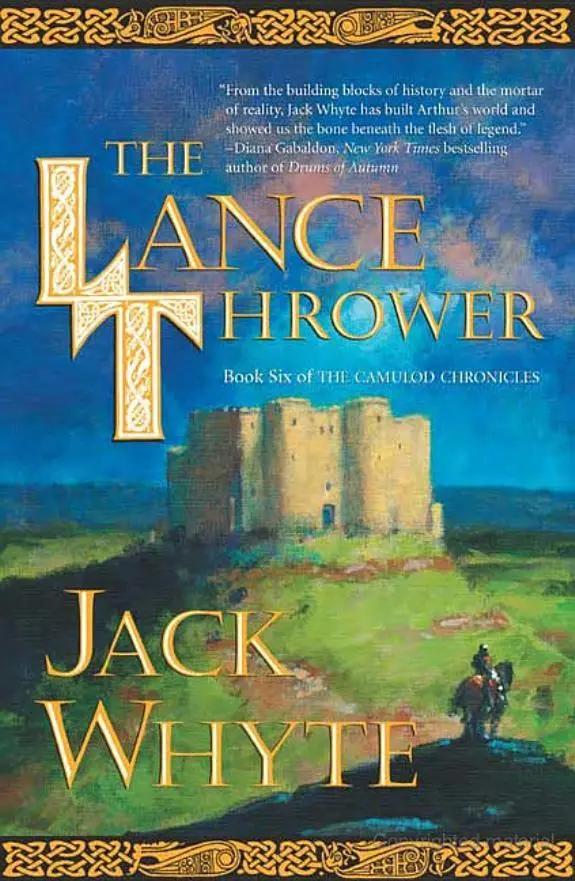
- Название:The Lance Thrower
- Автор:
- Жанр:
- Год:неизвестен
- ISBN:нет данных
- Рейтинг книги:5 / 5. Голосов: 1
-
Избранное:Добавить в избранное
- Отзывы:
-
Ваша оценка:
The Lance Thrower: краткое содержание, описание и аннотация
Предлагаем к чтению аннотацию, описание, краткое содержание или предисловие (зависит от того, что написал сам автор книги «The Lance Thrower»). Если вы не нашли необходимую информацию о книге — напишите в комментариях, мы постараемся отыскать её.
Clothar is a young man of promise. He has been sent from the wreckage of Gaul to one of the few schools remaining, where logic and rhetoric are taught along with battle techniques that will allow him to survive in the cruel new world where the veneer of civilization is held together by barbarism. He is sent by his mentor on a journey to aid another young man: Arthur Pendragon. He is a man who wants to replace barbarism with law, and keep those who work only for destruction at bay. He is seen, as the last great hope for all that is good.
Clothar is drawn to this man, and together they build a dream too perfect to last--and, with a special woman, they share a love that will nearly destroy them all...
The name of Clothar may be unknown to modern readers, for tales change in the telling through centuries. But any reader will surely know this heroic young man as well as they know the man who became his king. Hundreds of years later, chronicles call Clothar, the Lance Thrower, by a much more common name.
That of Lancelot.
The Lance Thrower — читать онлайн бесплатно полную книгу (весь текст) целиком
Ниже представлен текст книги, разбитый по страницам. Система сохранения места последней прочитанной страницы, позволяет с удобством читать онлайн бесплатно книгу «The Lance Thrower», без необходимости каждый раз заново искать на чём Вы остановились. Поставьте закладку, и сможете в любой момент перейти на страницу, на которой закончили чтение.
Интервал:
Закладка:
The corpses were not all completely naked, but all had been stripped of everything of value—weaponry and armor. I had to check each of them, including those not ours, before I could identify the missing man, but eventually it became clear that the man called Ursus, the Bear, was not among the dead. He was a loner, a taciturn, self-sufficient man who asked nothing of anyone and expected to be treated the same way. I had never heard him speak, but even in the short time I had spent in his company, I had learned that he had a reputation as a fearsome fighter. Now he was missing, and I found myself wondering if he, too, had run away as I had.
I had not once descended from my horse since my return to the killing ground, and thus I ended up sitting high in the saddle and gazing down at the carnage on the ground, wondering what I should do next. I had no desire to ride away and simply leave the bodies lying there to rot, but I could see no alternative. There were fifteen dead men lying here—fourteen men and one boy, my best friend—and I had no means of burying them, having nothing to dig with other than a narrow-bladed sword. Nor was there any way to burn them in a pyre. The scrub willows that lined the riverbank were green and wet and no more than an inch thick at any point, and the closest trees of any adequate size were half a mile away and it was growing dark already.
Aching with the knowledge of what I must do, I dismounted beside Lorco, who lay where he had fallen, close by the wagon. He was flat on his back and mercifully his eyes were closed above the ruin of the lower part of his face. I stooped and picked up one of the loose garments that lay by my feet, and draped it very gently over his head, concealing his wounds. That done, I dug into my saddlebag to pull out the small codex that Germanus had given me before I left the school. It contained a transcription of several prayers attributed to the blessed Saint Anthony, and others attributed to Saint Martin, a native of Gaul. I opened it to the beginning of the first prayer, then knelt beside the body of my friend and read the entire selection of the prayers of Saint Martin aloud, dedicating them in the reading to the surrounding dead while focusing on my beloved friend.
By the time I finished reading it was almost too dark to see, and I stood up to leave, knowing I could do no more for Lorco or for any of them, but as I turned to remount my horse, I again saw the garments scattered about my feet and realized that I would be a fool to leave all of them there when I would surely have need of them later. I sorted through the things that I could find, surprised at how much had been left undisturbed in at least one of my chests. I filled my own saddlebags and Lorco’s with clean, dry clothing, then improvised a pair of bags from two spare tunics and stuffed those full as well before tying them together and slinging them over Lorco’s saddle. Only then, in what was close to full darkness, did I ride away from the killing ground, unwilling to spend a single moment longer than I had to in that place.
I rode though the dark along the riverbank for more than an hour, following the narrow path that traced the black line of willow shrubs along the waterside, and then the moon rose, full and large in a cloudless sky, and I was able to see clearly enough eventually to identify a large stand of trees that would shelter me for the remainder of the night.
I made a dry, dark camp at the base of one huge tree and God blessed me with a sound and dreamless sleep.
I awoke with the sun shining directly into my eyes through the screen of leaves that hung over me, and the first thought that came into my mind was a vision of Lorco dead on the ground as I prayed over him. I knew that before I did anything else, I had to find Duke Lorco and tell him about his son, about what had happened to him and about how I had come to survive the attack. It was not an encouraging incentive to leap up and be on my way, but nothing could have induced me to leap up that morning under any circumstances, since I had slept wearing full armor and my awakening body was now busily making me aware of the outrages to which it had been subjected overnight. I struggled to a sitting position and scrubbed at my eyes with the heels of my hands.
Moments later, still barely awake but trudging painfully in the direction of the river to relieve myself and wash the sleep from my eyes, I was astonished to discover that there was no river. The last vestiges of sleepiness vanished instantly as it became clear to me that at some point during my night walk—and it must have been early, probably in the darkness before the moon rose—I had somehow taken a divergent path and wandered inland, away from the river’s edge. A fringe of shrubs still edged the path along which I had arrived here the previous night, and I remembered how determinedly I had watched and clung to the bulk of their blackness. But these were hazel shrubs, not osier willows as I had thought, and search as I might, they concealed no broad, placid stream of water.
That discovery led me to think about drinking water and that, in turn, made me think of food and realize that I had none, which meant that I must now think myself not merely as a coward but as a fool, as well. Until the moment we were attacked, it was true, none of us had had any reason to worry about food—we had food in abundance, from fresh-killed venison to dried chopped fruit and nuts and roasted grain. We had ground flour and salt and various dried and smoked meats, too, all of it safely stored on the wagon in boxes and casks. But now I was alone, hungry and thirsty and more than a little apprehensive of what might lie ahead of me.
All the more reason then, I thought, pulling myself together, to find Duke Lorco and his expedition quickly, and thereafter, I swore to myself, I would never go anywhere or venture into any situation without food and at least a full flask of water in my saddlebags.
I had unsaddled my two mounts and brushed them down before going to sleep the night before, and although I had been working in the dark I had tried to be thorough and militarily professional in seeing to their needs, knowing they had been saddled all day long. I was grateful that, thanks to the training hammered into us in the school stables, they had not been without rations, for it was the law according to Tiberias Cato that every horseman carry a bag of grain for his mount and keep it in his saddlebags at all times. So I had brushed the animals down and given them each a handful of grain in their nosebags before hobbling them for the night. Water had not crossed my mind, for they had both drunk deeply merely a few hours earlier, and I had been confident then that the river lay right behind our campsite. Now I examined the animals in the light of day and decided I had not done badly by them, considering the darkness under the trees the night before. I brushed them both down again, briskly, saddled them, and then swung myself up onto my own and led the other out into the full morning light.
Open fields stretched away in every direction from the copse where we had sheltered, and it was easy to see from the absence of farm buildings that the land belonged to one of the latifundiae , the huge collective farming corporations that provided most of the Empire’s annual grain harvest. There were no hills of any description, anywhere, just broad, flat fields with an occasional copse of trees that had been left standing to serve as windbreaks in bad weather. Far to my left, at the very limit of my vision, the fields came to an end, hemmed by dense trees. There was nothing at all on the right. The fields there simply stretched away to the low horizon, and presumably beyond that to infinity. I turned and rode back and around to where I could see, beyond the copse, the path along which I had traveled the previous night. Sure enough, a single line of hazel shrubs, clearly a demarcation line or border of some kind set up by the landowners, extended from where I stood to the flat horizon, indicating the way I had come, and the direction of the sun on my right told me that I had been traveling from northwest to southeast. The river, I remembered from what Dirk the Huntsman had said, had been running mainly southwest at the point where we had been attacked, so I knew it must now be somewhere to my left, westward of where I now sat.
Читать дальшеИнтервал:
Закладка:
Похожие книги на «The Lance Thrower»
Представляем Вашему вниманию похожие книги на «The Lance Thrower» списком для выбора. Мы отобрали схожую по названию и смыслу литературу в надежде предоставить читателям больше вариантов отыскать новые, интересные, ещё непрочитанные произведения.







Обсуждение, отзывы о книге «The Lance Thrower» и просто собственные мнения читателей. Оставьте ваши комментарии, напишите, что Вы думаете о произведении, его смысле или главных героях. Укажите что конкретно понравилось, а что нет, и почему Вы так считаете.