Jack Whyte - The Lance Thrower
Здесь есть возможность читать онлайн «Jack Whyte - The Lance Thrower» весь текст электронной книги совершенно бесплатно (целиком полную версию без сокращений). В некоторых случаях можно слушать аудио, скачать через торрент в формате fb2 и присутствует краткое содержание. Жанр: Старинная литература, на английском языке. Описание произведения, (предисловие) а так же отзывы посетителей доступны на портале библиотеки ЛибКат.
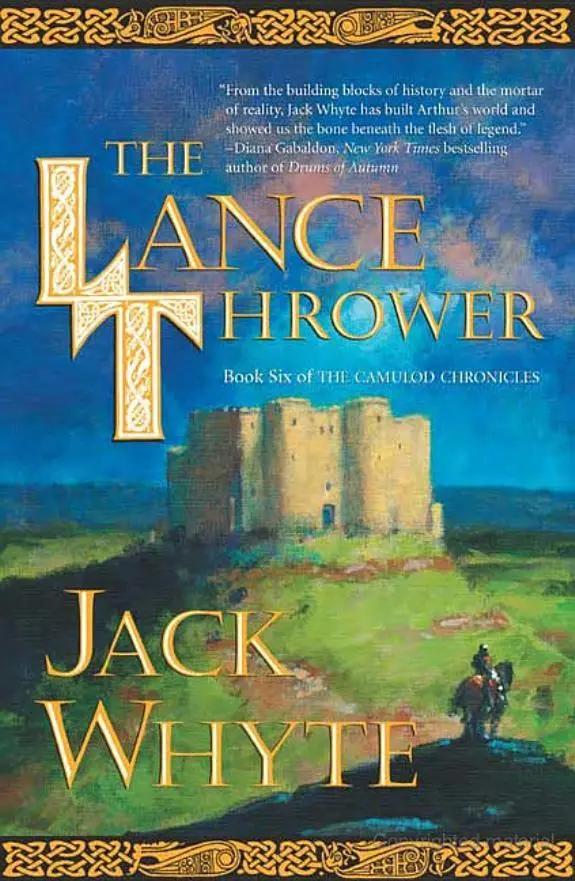
- Название:The Lance Thrower
- Автор:
- Жанр:
- Год:неизвестен
- ISBN:нет данных
- Рейтинг книги:5 / 5. Голосов: 1
-
Избранное:Добавить в избранное
- Отзывы:
-
Ваша оценка:
The Lance Thrower: краткое содержание, описание и аннотация
Предлагаем к чтению аннотацию, описание, краткое содержание или предисловие (зависит от того, что написал сам автор книги «The Lance Thrower»). Если вы не нашли необходимую информацию о книге — напишите в комментариях, мы постараемся отыскать её.
Clothar is a young man of promise. He has been sent from the wreckage of Gaul to one of the few schools remaining, where logic and rhetoric are taught along with battle techniques that will allow him to survive in the cruel new world where the veneer of civilization is held together by barbarism. He is sent by his mentor on a journey to aid another young man: Arthur Pendragon. He is a man who wants to replace barbarism with law, and keep those who work only for destruction at bay. He is seen, as the last great hope for all that is good.
Clothar is drawn to this man, and together they build a dream too perfect to last--and, with a special woman, they share a love that will nearly destroy them all...
The name of Clothar may be unknown to modern readers, for tales change in the telling through centuries. But any reader will surely know this heroic young man as well as they know the man who became his king. Hundreds of years later, chronicles call Clothar, the Lance Thrower, by a much more common name.
That of Lancelot.
The Lance Thrower — читать онлайн бесплатно полную книгу (весь текст) целиком
Ниже представлен текст книги, разбитый по страницам. Система сохранения места последней прочитанной страницы, позволяет с удобством читать онлайн бесплатно книгу «The Lance Thrower», без необходимости каждый раз заново искать на чём Вы остановились. Поставьте закладку, и сможете в любой момент перейти на страницу, на которой закончили чтение.
Интервал:
Закладка:
For more than five years I had been among the top students of the Bishop’s School and for the last three of those years I had shown myself to be virtually unbeatable in the military training segments of our daily curriculum. I had worked hard and trained constantly, cherishing dreams of being a warrior, until now, today, and my first opportunity to put my training to the test. And I had fled in terror.
A voice in my mind told me to stand up and be a man, but I tucked my hands into my armpits and drew up my knees, hunching myself into a ball and moaning aloud as I allowed myself at last to recall what had occurred. Again and again and yet again I watched poor Lorco’s face explode and saw him falling sideways into death, and yet, absurdly, I was concerned above all else that he was about to land on his head and injure himself on the hard ground. And then I began to recall the bodies of our companions as I had seen them last: . Harga, falling backward from his saddle, arms spread, an arrow in his skull and another protruding from beneath his left arm; Gorgo, our finest bowman, sprawled facedown in the dust of the path, his buttocks thrusting comically into the air because of the way he had fallen; Dirk the Huntsman and Alith and Fistus, his runners, and Petrarch the cook, who always liked to see his food being killed, and limping Tamarus, his assistant—all of them recognizable in a single glance, all of them dead within moments of each other, reduced to shapeless huddles of drab, bloodied rags.
And then my mind showed me images of our attackers, more than a score of them, perhaps as many as two score; screaming men, many of them aiming bows, many more running headlong, leaping and charging toward me and whoever else might have survived their first murderous onslaught. They had appeared from nowhere, it seemed, springing fully formed from the earth itself like the demons spawned by the dragon’s teeth in the ancient tale that had terrified and thrilled me as a child. As I thought about them at greater length, however, it became obvious that they had been lying waiting for us among the osier willows on the riverbank and in the long grass on the left side of the path we followed.
Harga had committed the primary sin of military command by riding through unknown territory without advance guards, and all of us had paid a fearsome price for his neglect, lulled into false security by the knowledge that we were following close on the heels of our own forces. Once more I saw the ground around our group covered suddenly with leaping, running men, and I heard their screams and felt again the terror that had consumed me. And I saw myself again kicking one man in the head and then spurring my horse into a dead run, running and running and running as far and as fast as the beast would carry me.
I had fled from battle at the first hint of hardship, and the knowledge burned in me like gall. I howled aloud and squirmed and kicked on the hard ground, weeping and wailing like an infant and wriggling and groveling in abject misery, and had I been able to dig like a mole I feel sure I would have buried myself alive, then and there.
Eventually, however, these convulsions of grief and self-loathing died away and gave place to emptiness and a great, welling, leaden-hearted misery. I lay motionless after that for a long time, mentally identifying and exploring the aches and pains I had imposed upon myself in lying there. I had used up all my store of tears and my whole chest felt hollow, like an inflated bladder, weightless and yet filled somehow with tension and unbearable loss.
I must have fallen asleep at some point during all of that, because the next thing I became aware of was a deep, explosive snort and the sound of a hoof stamping close by my head. I jerked awake to see my horse looming above me, and the sight of him filled me with another wave of guilt and shame, for I saw that I had left him fully saddled and bridled. I sat up, groaning with the effort, and pushed myself to my feet, where I stood swaying for a time before I felt strong enough to reach out and take hold of his reins. As soon as he felt the reins in my hand, he snorted again, softly this time, blowing air through his velvet muzzle, and raised his head high, pointing his ears forward and then standing motionless, as though waiting for me to mount. I stroked his neck and muzzle, then slapped him on the neck and told him to wait while I returned to the water to kneel and drink again from the stream, more decorously this time and knowing that I would not be sick again. I dried my mouth with the back of my hand and swung myself up into the saddle, where I sat for a time, simply looking about me and trying to decide what I ought to do. My horse whickered again, his ears twitching as he waited for my signal, and as I bent forward slightly to lay my hand on his neck, my outstretched fingers touched the top of the heavy bronze helmet that hung from the hook on my saddlebow.
I stopped, staring at the helmet and remembering the sight of Harga’s helmet hanging from his saddle in the same way. Had he been wearing the thing, the arrow that pierced his skull would probably have been deflected and he might never have had to fling up his arm the way he had, exposing his vulnerable armpit to the second arrow that struck him. I suddenly felt the welcome weight of my own full-body armor: a complete front and back cuirass of hammered bronze, with matching kirtle of armored straps and, strapped to my riding boots, long, heavy leg greaves that came up above my knees. A long-bladed spatha hung by my left side from a sword belt that crossed my chest, and a matching dagger hung in a sheath from my right hip.
I should not have been wearing armor that day at all, as a member of a hunting party, but Harga had been in a vengeful frame of mind that morning and had ordered both of us, Lorco and me, to wear full armor as a punishment for being what he called “insolent smart-arses.” He had discovered, the previous afternoon, that the wagon we were using to transport the deer we killed also contained the four chests belonging to Lorco and me containing our clothing and our armor. They had been loaded in Auxerre when we joined the Lorco expedition to ride south with them. Harga had thought it highly amusing to make us undo the bindings and unpack our chests and to display all our goods and possessions to the others in the hunting party. He took a malicious pleasure in trying to humiliate us that way, but we, having spent the previous five years living in communal quarters with close to a hundred other boys, saw nothing belittling in what he made us do, because in fact the complete display of everything brought from home into the Bishop’s School was a ritual event, undergone by every new boy who joined the scholastic ranks, and in those instances much, including anything edible, was confiscated by the older boys. Of course, we said nothing about that to Harga.
And so this day we had worn armor in the blazing sun. But we had been on our best behavior for most of the day and even Harga had not objected—in fact he had pretended not to see—when we took off our helmets. A new wave of grief swept over me as I realized belatedly that Lorco, too, might still be alive had he been wearing his helmet. My eyes awash again with sudden tears I would have sworn a moment earlier could not be in me, I gulped and swallowed and bent forward to take the heavy bronze helmet from its hook and slide it over my head. The sudden hollow hush that surrounded me as the leather-lined cask sank over my ears was unexpectedly peaceful, and the restriction of vision caused by the broad, hinged cheek protectors forced me to sit straighter and turn my head when I wanted to look at anything that did not lie directly ahead of me. I unsheathed my spatha and held it up to where I could see the blade, unbloodied, unsullied, unused. I sheathed it again and kicked my horse forward in a walk.
Читать дальшеИнтервал:
Закладка:
Похожие книги на «The Lance Thrower»
Представляем Вашему вниманию похожие книги на «The Lance Thrower» списком для выбора. Мы отобрали схожую по названию и смыслу литературу в надежде предоставить читателям больше вариантов отыскать новые, интересные, ещё непрочитанные произведения.







Обсуждение, отзывы о книге «The Lance Thrower» и просто собственные мнения читателей. Оставьте ваши комментарии, напишите, что Вы думаете о произведении, его смысле или главных героях. Укажите что конкретно понравилось, а что нет, и почему Вы так считаете.