Jack Whyte - The Lance Thrower
Здесь есть возможность читать онлайн «Jack Whyte - The Lance Thrower» весь текст электронной книги совершенно бесплатно (целиком полную версию без сокращений). В некоторых случаях можно слушать аудио, скачать через торрент в формате fb2 и присутствует краткое содержание. Жанр: Старинная литература, на английском языке. Описание произведения, (предисловие) а так же отзывы посетителей доступны на портале библиотеки ЛибКат.
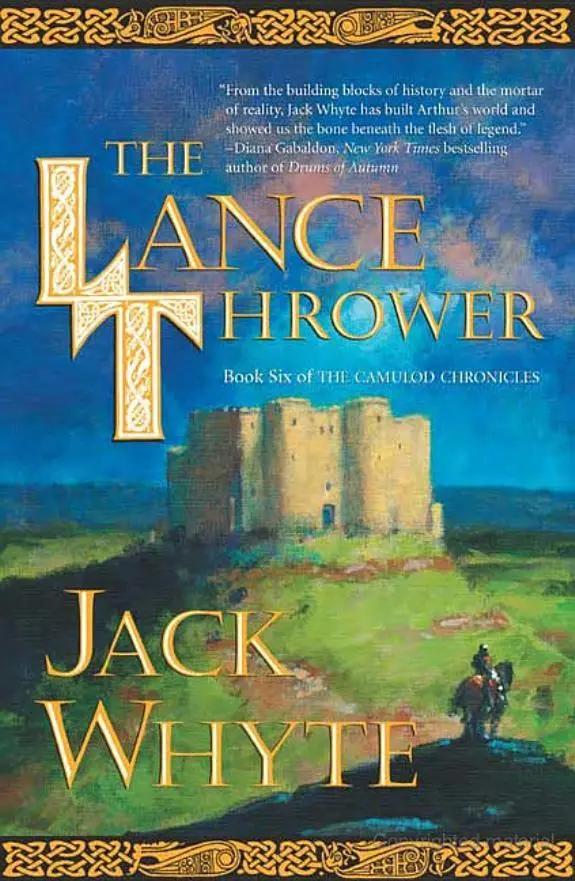
- Название:The Lance Thrower
- Автор:
- Жанр:
- Год:неизвестен
- ISBN:нет данных
- Рейтинг книги:5 / 5. Голосов: 1
-
Избранное:Добавить в избранное
- Отзывы:
-
Ваша оценка:
The Lance Thrower: краткое содержание, описание и аннотация
Предлагаем к чтению аннотацию, описание, краткое содержание или предисловие (зависит от того, что написал сам автор книги «The Lance Thrower»). Если вы не нашли необходимую информацию о книге — напишите в комментариях, мы постараемся отыскать её.
Clothar is a young man of promise. He has been sent from the wreckage of Gaul to one of the few schools remaining, where logic and rhetoric are taught along with battle techniques that will allow him to survive in the cruel new world where the veneer of civilization is held together by barbarism. He is sent by his mentor on a journey to aid another young man: Arthur Pendragon. He is a man who wants to replace barbarism with law, and keep those who work only for destruction at bay. He is seen, as the last great hope for all that is good.
Clothar is drawn to this man, and together they build a dream too perfect to last--and, with a special woman, they share a love that will nearly destroy them all...
The name of Clothar may be unknown to modern readers, for tales change in the telling through centuries. But any reader will surely know this heroic young man as well as they know the man who became his king. Hundreds of years later, chronicles call Clothar, the Lance Thrower, by a much more common name.
That of Lancelot.
The Lance Thrower — читать онлайн бесплатно полную книгу (весь текст) целиком
Ниже представлен текст книги, разбитый по страницам. Система сохранения места последней прочитанной страницы, позволяет с удобством читать онлайн бесплатно книгу «The Lance Thrower», без необходимости каждый раз заново искать на чём Вы остановились. Поставьте закладку, и сможете в любой момент перейти на страницу, на которой закончили чтение.
Интервал:
Закладка:
That sword had gone everywhere with Tiberias Cato since the day it came into his possession. It had hung either from his waist or from his saddle on every campaign in which he fought for two decades and more. I was astonished to think that he would ever consider giving it away, even though he had no real use for it nowadays. My astonishment, however, quickly gave way to chagrin that it had not been won by me.
I heard applause from behind me and looked up to where Phillipus Lorco stood by his chair on the reviewing stand, flanked by Bishop Germanus and Brother Ansel and backed by everyone who had assembled to watch the day’s events. All of them were applauding noisily, their eyes fixed on Lorco. I sniffed and shrugged off my disappointment, then made my way to the medical stand, where I knew I could at least find some cold water to drink. I had no injuries to speak of, apart from a few bumps and bruises that would soon fade and disappear.
Less than an hour later, having bathed and changed into fresh clothing, I was standing stiffly at attention in front of the worktable in Tiberias Cato’s quarters, hearing him repeat the question he had growled at me earlier.
“Don’t feed me that swill,” he barked when I responded as though I didn’t know what he meant. “You know damned well what I mean. I asked you if he is that good a friend that you’d willingly give up a prize like that one today simply to make him look good—and don’t try to deny what you did, either. I was watching you. You looked up so many times to where his father was sitting that you almost lost count of who was still in the arena. You were swiveling your head from side to side like a thief caught between two angry dogs.”
There did not seem to be much I could say in response without lying or blustering, and so I said nothing, fighting against the urge to grow angry and staring directly at the wall behind him, my eyes leveled just above his head. He was partially correct, I told myself. I remembered looking from father to son and perhaps back again, that much was true; but I had not done it as often as he had suggested, and not in the way he seemed to mean. And besides, I was far from sure that I had willingly done anything to give up the fight. The more I thought about that, in fact, the more convinced I became that I had done no such thing. Cato, however, was not interested in any self-justification I might develop.
“Look at me, boy. Damnation, look me in the eye!” I did. “Humph! That’s better. Don’t ever be afraid to look a man right in the eye while he’s tearing a piece off you with his tongue. As a matter of fact, you should teach yourself to be afraid not to look him in the eye. Everyone deserves a reprimand once in a while, because God knows everyone makes mistakes. But you show respect for the man who’s dressing you down while he’s doing it. It’s his responsibility to do whatever he has to do to straighten you out and get you to mend your ways. Staring over his head as though he isn’t there will just make him angry.
“Now, one more time, from a different viewpoint. Would your friend Lorco have done the same for you? Think hard. If your stepfather, Ban of Benwick, had been up there on the stand, would Lorco have done for you what you did for him today?”
“I don’t—”
“Think, I said, before you answer.”
“But—” He cut me off with a sidewise slash of his hand. I subsided, gritting my teeth, and began to think honestly about his question, since it was plain he would permit me to do nothing else. Would Lorco, in fact, have done the same thing for me, to his own cost?
“And before you answer that one, here’s another. D’you think he knows what you did?”
Another question I had failed to consider. But that one was easier. I shook my head, emphatically. “No, Magister. He could not possibly know; because I don’t even know if I did what you say I did. I thought about it, perhaps—no, I know I did—but only in the back of my mind. So, no … Lorco doesn’t know.”
“Well, let me ask you this: if we could restart the battle, would you be tempted to do it again—to give up the fight to make your friend look good? Would you?”
I was able to smile for the first time. “Not if I knew, going into the arena, what the prize was to be.”
“Ignore the prize; prizes can change. Would you do it again?”
I thought about the last time I had seen Lorco, as I emerged from the bathhouse a short time earlier. He had been on his way in, walking toward the main entrance with its multicolored windows of tiny red- and gold-stained glass diamonds mounted between thin strips of lead. He had been talking to his father, his head tilted up toward the Duke’s face and his left hand curled around the hilt of his new spatha, which now hung from a belt at his waist. Neither of them had seen me pass, so completely were they focused one upon the other. Now I remembered Lorco’s smile as he gazed up at his father and I found myself smiling.
“Yes, Magister,” I said. “I would do it again.”
“Good!” The Master of Horse almost leaped to his feet. “That was decisive enough, even should it turn out to be a wrong decision.” He paused then, one hand suspended in the air, as though about to bless me—something that he would never dream of doing, being both a layman and a warrior. “But you still have not answered the first question: would Lorco do the same for you?”
I shook my head but spoke with conviction. “I can’t say, Magister, one way or the other. I don’t know whether he would or not, but I have just realized that, either way, the answer to your question is not important. Whatever I might have done out there, it felt like the right thing to do at the time. I certainly don’t feel bad about having done it now. If, as I said, I did it.”
Cato shrugged. “Very well, then. You’re probably right. He was bound to beat you eventually and today was his time. Lucky thing you’re not going to be here for much longer. I doubt you’d enjoy being second best more than once.”
“Second best!” That stung me, but Cato had already begun to grin by the time I was able to think of a response, and I immediately swallowed what I had been about to say.
He nodded his head. “Aye, right. Let’s forget about it from now on, shall we? The bishop wants to meet with you before dinner. He’s tied up now with Brother Ansel and some of the other senior brethren, but he told me to send you in to wait for him when I was done with you. Now get out of here and don’t keep him waiting. And let’s both hope you’ll never have to depend seriously on a friend’s willingness to make a sacrifice for you. Out!”
I walked very slowly on my way to the bishop’s chambers, dawdling unconscionably as I sought to grapple with new and strange ideas. I was beginning to realize, but only slowly and imperfectly because it ran counter to what I saw then as logic, that Tiberias Cato was not angry at me at all, even while he clearly believed I had lost that day’s battle deliberately. But then, even as that thought was occurring to me and challenging my beliefs about the man I thought I knew, I found myself amending it as a new understanding began to build upon itself: Cato would never condone such a thing as a deliberate loss. That is what was so confusing about what I had been thinking. The idea of someone setting out deliberately to lose a fight smacked of cheating; there was a definite connotation of dishonesty within that premise at some level; and that, from all I had come to know and admire about Tiberias Cato, would have been anathema to him, violating every principle of conduct that he possessed.
But then a new thought occurred to me, possibly the first purely philosophical thought I had ever had. The idea of someone deliberately choosing not to win was not at all the same thing as that person’s making a deliberate choice to lose. As soon as I glimpsed that notion, seemingly solid in its logic, I snatched at it to examine it and devour it whole, but it eluded my grasp like smoke and left me feeling vaguely anxious, somehow mildly threatened, and aware that I had almost mastered a profound and tantalizing abstraction. I wanted to sit down there in a doorway by the edge of the thoroughfare to think the whole sequence of ideas through from front to back and from end to end, but then I noticed that the doorway in which I had paused was the one leading into the bishop’s quarters and I was already too late to do anything but make my way inside.
Читать дальшеИнтервал:
Закладка:
Похожие книги на «The Lance Thrower»
Представляем Вашему вниманию похожие книги на «The Lance Thrower» списком для выбора. Мы отобрали схожую по названию и смыслу литературу в надежде предоставить читателям больше вариантов отыскать новые, интересные, ещё непрочитанные произведения.







Обсуждение, отзывы о книге «The Lance Thrower» и просто собственные мнения читателей. Оставьте ваши комментарии, напишите, что Вы думаете о произведении, его смысле или главных героях. Укажите что конкретно понравилось, а что нет, и почему Вы так считаете.