Jack Whyte - The Lance Thrower
Здесь есть возможность читать онлайн «Jack Whyte - The Lance Thrower» весь текст электронной книги совершенно бесплатно (целиком полную версию без сокращений). В некоторых случаях можно слушать аудио, скачать через торрент в формате fb2 и присутствует краткое содержание. Жанр: Старинная литература, на английском языке. Описание произведения, (предисловие) а так же отзывы посетителей доступны на портале библиотеки ЛибКат.
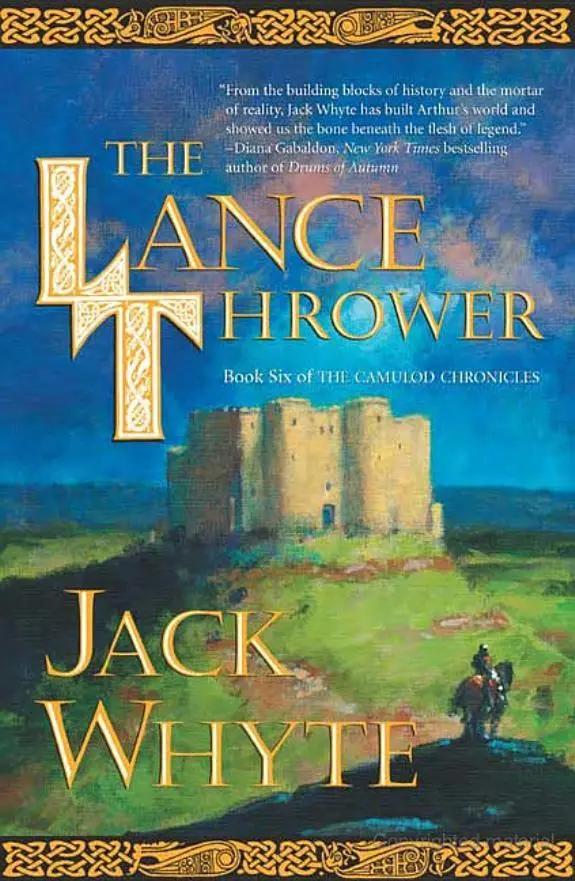
- Название:The Lance Thrower
- Автор:
- Жанр:
- Год:неизвестен
- ISBN:нет данных
- Рейтинг книги:5 / 5. Голосов: 1
-
Избранное:Добавить в избранное
- Отзывы:
-
Ваша оценка:
The Lance Thrower: краткое содержание, описание и аннотация
Предлагаем к чтению аннотацию, описание, краткое содержание или предисловие (зависит от того, что написал сам автор книги «The Lance Thrower»). Если вы не нашли необходимую информацию о книге — напишите в комментариях, мы постараемся отыскать её.
Clothar is a young man of promise. He has been sent from the wreckage of Gaul to one of the few schools remaining, where logic and rhetoric are taught along with battle techniques that will allow him to survive in the cruel new world where the veneer of civilization is held together by barbarism. He is sent by his mentor on a journey to aid another young man: Arthur Pendragon. He is a man who wants to replace barbarism with law, and keep those who work only for destruction at bay. He is seen, as the last great hope for all that is good.
Clothar is drawn to this man, and together they build a dream too perfect to last--and, with a special woman, they share a love that will nearly destroy them all...
The name of Clothar may be unknown to modern readers, for tales change in the telling through centuries. But any reader will surely know this heroic young man as well as they know the man who became his king. Hundreds of years later, chronicles call Clothar, the Lance Thrower, by a much more common name.
That of Lancelot.
The Lance Thrower — читать онлайн бесплатно полную книгу (весь текст) целиком
Ниже представлен текст книги, разбитый по страницам. Система сохранения места последней прочитанной страницы, позволяет с удобством читать онлайн бесплатно книгу «The Lance Thrower», без необходимости каждый раз заново искать на чём Вы остановились. Поставьте закладку, и сможете в любой момент перейти на страницу, на которой закончили чтение.
Интервал:
Закладка:
“Bring me one,” he said, then walked away. Unsure of myself and even of what he meant, I watched him as he went, and when the trees blocked my view I followed him again, keeping him in sight until he disappeared inside a small, low-roofed building with thick stone walls. He had not glanced back once in my direction, and so I moved closer, stopping only when I drew close enough to identify the building as a small smithy with a forge and a heavy, sturdy-looking bellows. Cato was already bent over the bellows, blasting gales of air into the coals of the forge and filling the smithy with clouds of smoke and ashes. As the scent of the hot ashes reached my nostrils I grasped my coils of rope more firmly and turned back toward the horses.
I knew I was facing some kind of test here, but I had no idea what was being tested, and yet I knew somehow that time was of no great importance in whatever it was. And so I made myself think about what I knew. Cato had told me to bring him one, and the only thing there in numbers greater than one was horses, so he evidently expected me to bring him a horse. Clearly he meant me to select one from the herd, and I was to be judged, in some manner, on the one I chose. I began to walk among the animals, looking at them, and quickly made a number of discoveries. Scattered among the herd, but numerous enough to be clearly evident, were horses of a breed I had never seen. They were all completely black and larger than any of the other animals in the herd; big, strongly muscled animals with dense, extraordinarily heavy coats of deepest black, long, thick manes and tails, and beautiful feathered fetlocks that almost covered their hooves. The other herd animals were of several breeds and sizes, all familiar to me, and their colors ranged from gray to red to chestnut brown. There were mares and fillies, immature colts and a preponderance of geldings, but there were no stallions. And then, mere moments after realizing that, I found the first of the stallions and smiled in admiration. There were six of them, I soon discovered, each one magnificent and each securely confined in its own strong enclosure. The six enclosures were strung along the paddock’s perimeter fence like beads, each separated from the others by a distance of at least twenty paces. Two of these six animals were of the beautiful long-haired black breed, and I found myself admiring them even more than I had earlier.
It was evident, however, that I was not expected to select a stallion, so that left me facing a choice between a mare or a gelding—all of the colts were too immature to qualify as horses in this instance, I suspected. I examined all of them again, and all of them were beautiful, but my eyes kept returning to the big black animals.
A short time after that, I reached the door of the small smithy, leading the horse I had chosen. Tiberias Cato, hunched over his forge and peering into the blue-white coals, paid me no heed until I stepped across the threshold and called out to him. He started slightly and straightened up, swinging to face me, his eyes taking in the horse I was holding. He tossed the tongs he had been holding onto a heavy workbench and came toward me, wiping his hands on a rag he had pulled from somewhere.
“Why’d you pick him?” he asked when he reached me.
“He’s beautiful,” I replied. “I’ve never seen his like before. What kind is he?”
“Forest horse. Wild stock. But why him in particular? He’s not two years old yet.”
“He’s magnificent, and when he’s two, and older, he’ll be the best here.”
“Will he, by God? D’you say so?” Listening to him say that, I actually believed he had not realized that and was surprised, but I had not yet come to an appreciation of sarcasm or irony. His eyes were already moving beyond me to another mount, and he pointed. “That one. Let’s see you mount him.”
Not catch him or bring him, but mount him. I turned to look at the bay gelding Cato had indicated and then swung back, tightening my grip on the reins in my hand. “Why can’t I mount this one?”
“Because he’s not broke yet. Trying to ride him now could get you killed, or it could end up with his being ruined as a good horse. Besides, I showed you the one I want you to mount, and I’m waiting.”
Disappointed, but no longer feeling rebellious, I quietly took the rope bridle off the black gelding, then loosened and removed the noose around his neck. I coiled my rope again and went after the bay, which stood placidly watching me and allowed me to come close enough to slip both the noose and the bridle over his head. He was not a tall horse, and his head was too big and heavy to be beautiful or even handsome, but he was stocky and deep chested, strongly muscled. When the bridle was secured, I led him to an old tree stump that was obviously much used as a mounting block and heaved myself up onto his broad back. The bay stood there with his head down, his ears twitching back toward me as though he was listening to my breathing. Apart from that, however, he remained motionless as I made myself comfortable.
Then he exploded into motion, leaping high into the air and spinning in a head-snapping half circle to land stiff-legged, head down, hooves together with his back bowed upward so that he almost jarred me off, which was his intent. By sheer good fortune, this was a trick with which I was thoroughly familiar, having had to deal for more than a year with a cantankerous horse in King Ban’s stables that had mastered the same turning leap and must have been one of this animal’s relatives, and so I recognized the preliminary movements under me and adjusted to them practically without thought, relaxing my posture and leaning into his spinning jump, allowing the slackness of my body to absorb the shock of his stiff-legged landing.
He must have been greatly surprised to find himself still burdened after this exertion, because he stood stock-still long enough to permit me to lock my fingers in the hair of his mane and hammer him in the ribs with my heels, and then he went into action again, bucking, rearing, and spinning, determined to rid himself of me. I, for my part, was just as determined that he would not do so, because I had caught a glimpse of Tiberias Cato’s face just before this second rampage erupted and it was plain to see that he was even more surprised than the horse was by its failure to reject me. And so the gelding cavorted and reared like a mad creature and I clung on, adapting to his every feint and trick until he stopped again, quivering with fury. I did not relax for a moment, however. I knew he was not yet finished and I stayed poised, ready to adjust to whatever he might do next. Even so, what he did caught me unprepared.
With a mighty surge of powerful muscles he launched himself into a run, his stride lengthening rapidly into a full gallop, and I rode him easily, enjoying the sensation of speed until I saw where he was taking me. We were headed directly toward a huge old solitary elm tree in the center of the paddock, and it was clear that he was either going to run straight into it or brush very closely past it, using it as a tool to scrape me off his back. Incredulous, I watched until there was no doubt of what he was doing: the rough bark of the tree would scrape along the horse’s right side, and my right leg would not survive the impact. Then, a bare two leaps before disaster struck, I anchored my fists more solidly in his mane and swung my right leg backward across his back, twisting my pelvis and bringing my knees together on his left side, my right hip against his surging side. I allowed my body to swing down, straight-legged, until my feet hit the ground and rebounded, and then I used his speed to swing myself back up to straddle him again. I felt his speed start to flag immediately and he had no more tricks after that, so that I found it easy to turn him around and head him back toward Cato, his speed slackening until we drew to a halt in front of the stable master, whose face remained blank even after I had dismounted.
Читать дальшеИнтервал:
Закладка:
Похожие книги на «The Lance Thrower»
Представляем Вашему вниманию похожие книги на «The Lance Thrower» списком для выбора. Мы отобрали схожую по названию и смыслу литературу в надежде предоставить читателям больше вариантов отыскать новые, интересные, ещё непрочитанные произведения.







Обсуждение, отзывы о книге «The Lance Thrower» и просто собственные мнения читателей. Оставьте ваши комментарии, напишите, что Вы думаете о произведении, его смысле или главных героях. Укажите что конкретно понравилось, а что нет, и почему Вы так считаете.