Jack Whyte - The Lance Thrower
Здесь есть возможность читать онлайн «Jack Whyte - The Lance Thrower» весь текст электронной книги совершенно бесплатно (целиком полную версию без сокращений). В некоторых случаях можно слушать аудио, скачать через торрент в формате fb2 и присутствует краткое содержание. Жанр: Старинная литература, на английском языке. Описание произведения, (предисловие) а так же отзывы посетителей доступны на портале библиотеки ЛибКат.
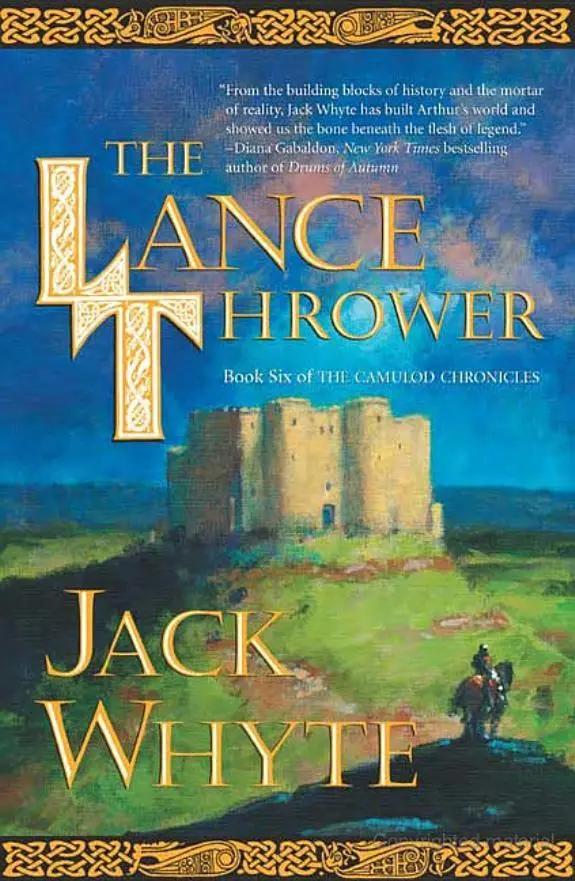
- Название:The Lance Thrower
- Автор:
- Жанр:
- Год:неизвестен
- ISBN:нет данных
- Рейтинг книги:5 / 5. Голосов: 1
-
Избранное:Добавить в избранное
- Отзывы:
-
Ваша оценка:
The Lance Thrower: краткое содержание, описание и аннотация
Предлагаем к чтению аннотацию, описание, краткое содержание или предисловие (зависит от того, что написал сам автор книги «The Lance Thrower»). Если вы не нашли необходимую информацию о книге — напишите в комментариях, мы постараемся отыскать её.
Clothar is a young man of promise. He has been sent from the wreckage of Gaul to one of the few schools remaining, where logic and rhetoric are taught along with battle techniques that will allow him to survive in the cruel new world where the veneer of civilization is held together by barbarism. He is sent by his mentor on a journey to aid another young man: Arthur Pendragon. He is a man who wants to replace barbarism with law, and keep those who work only for destruction at bay. He is seen, as the last great hope for all that is good.
Clothar is drawn to this man, and together they build a dream too perfect to last--and, with a special woman, they share a love that will nearly destroy them all...
The name of Clothar may be unknown to modern readers, for tales change in the telling through centuries. But any reader will surely know this heroic young man as well as they know the man who became his king. Hundreds of years later, chronicles call Clothar, the Lance Thrower, by a much more common name.
That of Lancelot.
The Lance Thrower — читать онлайн бесплатно полную книгу (весь текст) целиком
Ниже представлен текст книги, разбитый по страницам. Система сохранения места последней прочитанной страницы, позволяет с удобством читать онлайн бесплатно книгу «The Lance Thrower», без необходимости каждый раз заново искать на чём Вы остановились. Поставьте закладку, и сможете в любой момент перейти на страницу, на которой закончили чтение.
Интервал:
Закладка:
The reasons for that were not hard to find, for anyone who cared to look for them, for in the decades and even centuries that the old Empire had been tottering, a victim of its own corruption, people had learned to subsist on their own terms, to be more self-sufficient and independent of imperial dictates. And so the crash of collapse, when it came, proved to be less surprising, less demoralizing than it might have been, and even the majority of the peoples who were on the move had benefited from the civilizing influence of Rome for a millennium.
Not surprisingly, since Auxerre was firmly in the center of Gaul, we experienced very little of the upheavals that were happening elsewhere. The Frankish presence in the north and west continued to increase, but that meant nothing to us, since we ourselves were Franks and our migration had been ongoing for more than a hundred years. It was similar with the Burgundians, whose settled borders almost abutted ours in the south. They had practically overrun the entire southwest of Gaul. But although neither of us was amicably disposed toward the other and there were sometimes clashes between our people and theirs, the situation between us never degenerated into outright war. Each of us knew the other and had his measure, and we both knew it was more important to guard ourselves against outside aggression than to fret over what our neighbors might be planning.
Bishop Germanus, of course, was aware of all of this, but he made it his business to ensure that none of us were bothered by such things. We had an education to absorb, he believed, and the form in which we absorbed it would dictate, to a very great extent, the fashion in which we later reacted to such external priorities and distractions. If our grounding in the classical elements of education was sufficiently substantial, he argued, then we would be perfectly well equipped to deal with whatever the world might throw at us, and so we studied logic and philosophy, geometry and polemics and geography—this while the world was changing daily—and we conversed in Greek and Latin and were conversant with the written works of the great Masters: the Greeks Socrates, Aristotle, and Plato, Aeschylus, Euripides, Herodotus, and Homer, and the Roman works of Caesar, Cicero, Pliny, Ovid, and many others. And over and above all of these, we studied the Christ and his teachings.
When I consider that we studied all of these things between predawn morning prayers and noon, and that the second half of each day was given over completely to our military training and discipline, then add the additional consideration that we somehow had to accommodate all of our daily chores and duties within the fabric of those activities, finding and making time between classes to tend to our community responsibilities, I am never surprised that we had no time for talk, or even thoughts, of girls or women.
And then, of course, there was the fighting: the training … the horses. I have to admit that that aspect of our education, the physical, militaristic part, was supposed to be a relatively minor element of our growth, recognized and provided for but of significantly less importance than our scholastic and clerical training. That was never the case with me, however, despite the concerted efforts of my other tutors, and to his credit Father Germanus never sought to influence me to conform to their wishes. He had promised Ban and the Lady Vivienne that my training in the military skills would continue and he never deviated from his word.
I had been born and bred among King Ban’s horse soldiers and had learned to ride as soon as my legs could spread widely enough to span a pony’s back, so I had no inhibitions about thrusting myself, the morning after my arrival in Auxerre, into the world of the school’s stables and its small but carefully selected and extremely valuable collection of horses. I walked in through the gates with all the arrogance and innocence of trusting youth only to be stopped short with a barked command before I was three paces over the threshold. I froze, taken aback by the ferocity of the shout and the wild appearance of the man who had uttered it, and my challenger bade me stand right where I was, the tone of his voice defying me to move another step at. my peril. He strode toward where I stood gaping at him, glowering at me from beneath bushy white eyebrows that formed a solid bar across his forehead.
He was a small man, tiny perhaps being an even more accurate word, because he was not much taller than me and I was only ten. He was carrying a smallish coil of limber, well-used rope—seven, perhaps eight loops in all. I remember that clearly, because when he reached me he slipped his arm through the loops and shrugged the coil upward to hang from his shoulder. Seeing him glare at me, I tried to smile back, but I was intimidated, and my face would not relax, so I simply stared back at him, wide-eyed. Finally he hawked loudly and spat off to one side.
“Benwick, right?” His voice was loud and harsh, rough edged as though seldom used. “You’re the brat came back with the Gen’ral?”
The General. I realized he was talking about Father Germanus and remembered Germanus saying that a man called Tiberias Cato would be my teacher and that he had served in the army with him. This must evidently be Cato. I nodded, and looked at him more closely.
Although he was small in stature, I saw now that he was built perfectly in proportion and his limbs were clean lined and clearly defined, dense with corded muscle. He was hairy, too, his entire body—or all that I could see of it—apart from his clean-shaven face, coated with a thick pelt of soft blond hair, its color ranging from faded yellow in places to grayish white in others, with one swirling whorl of a cowlick thatch at his crown that showed signs of once having been a bright yellowy gold. His forearms and the legs below his knee-length tunic were deeply sun-bronzed, and the hair that coated them was bleached almost white. I was fascinated to see that the hair on the back of his hands grew right down to his knuckles and that the phalanges of his fingers had coarse black hair growing on them, utterly unlike the hair on the rest of his body.
It may have been the thickness and profusion of his body hair that made the bareness of his face so obvious, but irrespective of what caused it to seem so, the man’s face, smooth cheeked and deeply tanned and dominated by brilliant, flower blue eyes, glowed with health and a special kind of self-sufficient beauty. His eyebrows, the first thing I had noticed about him, were a thick, unbroken bar of white, and the tangle of hair surmounting his forehead was unkempt and long untrimmed.
“Hmm,” he grunted, oblivious to or uncaring of my scrutiny. He lowered his shoulder and allowed the coil of rope to slide off and drop into his waiting hand, and then he threw the coil to me. I caught it with both hands. It was a running noose of the exact kind used by Ban’s stablemen.
“You know how to use that?”
“Yes,” I managed to say.
“Hmm. We’ll see. Come.”
He led me to a wide, barred wooden gate at the far end of the stable yard and held it open as I went through, after which he closed it carefully behind us and secured it in place with a loop of rope. We were in a long passageway now, with two paddocks on each side, each of them measuring approximately fifty paces in length by the same in width. The first enclosure on my right held eight mares, all of them in foal, and in the one beyond that, I could see others, these accompanied by newborn colts. The paddock on my immediate left held five healthy young geldings, and the fourth space lay empty. I followed the stable master as he led me the length of the passageway to the gate at the far end and beyond that into a wide, fenced pasture with clumps of trees scattered here and there and a lazy brook meandering among them. I had no idea how big the pasture was, because the trees obscured the boundary fences, but I knew it was enormous and I guessed from the position of the sun that we had to be close to the northern outskirts of the town. There were horses everywhere, and I immediately began to count them, but I lost track as I passed thirty and realized that just enough of them were moving to make my task impossible. The wiry little man looked around him and then glanced at me.
Читать дальшеИнтервал:
Закладка:
Похожие книги на «The Lance Thrower»
Представляем Вашему вниманию похожие книги на «The Lance Thrower» списком для выбора. Мы отобрали схожую по названию и смыслу литературу в надежде предоставить читателям больше вариантов отыскать новые, интересные, ещё непрочитанные произведения.







Обсуждение, отзывы о книге «The Lance Thrower» и просто собственные мнения читателей. Оставьте ваши комментарии, напишите, что Вы думаете о произведении, его смысле или главных героях. Укажите что конкретно понравилось, а что нет, и почему Вы так считаете.