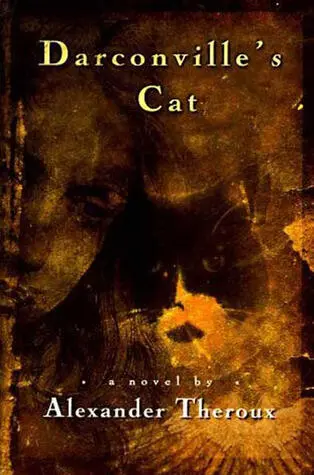
Alexander Theroux - Darconville’s Cat
Здесь есть возможность читать онлайн «Alexander Theroux - Darconville’s Cat» весь текст электронной книги совершенно бесплатно (целиком полную версию без сокращений). В некоторых случаях можно слушать аудио, скачать через торрент в формате fb2 и присутствует краткое содержание. Год выпуска: 1996, Издательство: Holt Paperbacks, Жанр: Современная проза, на английском языке. Описание произведения, (предисловие) а так же отзывы посетителей доступны на портале библиотеки ЛибКат.
- Название:Darconville’s Cat
- Автор:
- Издательство:Holt Paperbacks
- Жанр:
- Год:1996
- ISBN:нет данных
- Рейтинг книги:3 / 5. Голосов: 2
-
Избранное:Добавить в избранное
- Отзывы:
-
Ваша оценка:
Darconville’s Cat: краткое содержание, описание и аннотация
Предлагаем к чтению аннотацию, описание, краткое содержание или предисловие (зависит от того, что написал сам автор книги «Darconville’s Cat»). Если вы не нашли необходимую информацию о книге — напишите в комментариях, мы постараемся отыскать её.
Darconville's Cat Its chapters embody a multiplicity of narrative forms, including a diary, a formal oration, an abecedarium, a sermon, a litany, a blank-verse play, poems, essays, parodies, and fables. It is an explosion of vocabulary, rich with comic invention and dark with infernal imagination.
Alexander Theroux restores words to life, invents others, liberates a language too long polluted by mutters and mumbles, anti-logic, and the inexact lunacies of the modern world where the possibility of communication itself is in question. An elegantly executed jailbreak from the ordinary,
is excessive; funny; uncompromising; a powerful epic, coming out of a tradition, yet contemporary, of both the sacred and the profane.
Darconville’s Cat — читать онлайн бесплатно полную книгу (весь текст) целиком
Ниже представлен текст книги, разбитый по страницам. Система сохранения места последней прочитанной страницы, позволяет с удобством читать онлайн бесплатно книгу «Darconville’s Cat», без необходимости каждый раз заново искать на чём Вы остановились. Поставьте закладку, и сможете в любой момент перейти на страницу, на которой закончили чтение.
Интервал:
Закладка:
The knowledge for Darconville that it was too late to offer apologies to Isabel suddenly became a haunting penance for him that exceeded the sin itself. But what sin? What had he done ? Surely something! Or was this happening to someone else? Again, he thought of Crucifer: was this guilt by innocence? Oversight? Presumption? It has long been observed that men do not suspect faults which they themselves would not commit; so it was with Darconville, who nevertheless, too wracked with guilt to disallow the possibility of his personal hand in this, too deeply in love to want to discern it elsewhere, assailed himself in a fit of remorse and self-accusation that he mightn’t absolve in himself what he wouldn’t accuse in another. He spoke in a daze of baseless, unanswerable self-reproach, admitting his faults, proclaiming his regrets, but all to no avail — for she looked away — and even the joys in their lives he rehearsed suddenly seemed never to have happened as he recalled them. There was nothing to say he could manage, with but one exception.
“I love you,” he said.
She deigned not to answer.
“Yet you wanted me. Didn’t you? Why, you must have wanted me to be with me so long. She assumed a lethargic sulkiness. “I know you love me.” He spoke into the hands that covered his face, a stammerer, literally afraid of what he might say. “I b-beg you to love me. Please?”
“Don’t lose your pride. Lord.”
Darconville looked up ashen and startled, for he suddenly saw that two personalities coming together can create a third, with each becoming different yet together making up one they are both surprised at separately.
“What have I got left?”
“Your genius.” She shrugged. “Everything.”
“I don’t want everything that’s nothing. I want anything that’s something.” His head was splitting. “I love you.”
“None of that matters now.”
“By the truth of your right hand,” asked Darconville, searching her mind through her eyes, “do you mean that?” She nodded. Her eyes were clear and well-opened.
Was there no history? No memory? No continuity or meaning to love? They were questions the weight of which Darconville, weakened to the heart, hadn’t now the strength to bear asking. He had grown yellow and pasty with fatigue, his face perspiring so much it looked as though it had just been raised from a basin, and his swollen eyes seemed to have taken their moisture directly from his lips which were now dry to smacking.
“After four years? You mean”—his throat stuck shut—”everything’s g-gone?”
Isabel was unmoved. She turned away, exhaling in irritation and thinking to herself: is this to go on forever? Her hands were ice-cold. She touched the back of her left hand with the fingers of her right: gelid. Confecta res est : it was hopeless, for as she could no longer see in him what by the new dispensation she could not understand, she could consequently feel no sympathy for what she could not imagine. Where there is no imagination, there can be no horror. There was nothing to be done. The girl was gone.
“May I,” asked Darconville, like a statue whose fixed stare corresponds to a once genuine reality but reflects in its cold and empty sockets no understanding at all, “may I sleep here tonight?”
“I don’t think that would be right.”
Reasoning, Isabel scrutinized him. She looked disgustedly at his trembling hands, then sighed, and relented — with the stipulation, however, that he understood it would only be this one night. It seemed a kindness to Darconville whose complete exhaustion, coupled with the sedative she’d given him, almost prevented him from walking. She proceeded with him to an empty bedroom where, overcome with shock, bewilderment, and grief, he fell onto the bed and let the darkness roll over him. Something rose out of him and actually looked down at himself from the ceiling, from the sky, and then from beyond the universe, making him feel smaller than anything that ever was in the world.
The exigencies of life quickly resumed control of Isabel. Excusing herself, she assured him she’d be right back; she shut the bedroom door, listened a moment, and quickly disappeared into the kitchen. And then with an efficiency that seemed a distorted echo, an ironic recurrence, of a previous but now long forgotten dénouement — one characterized as much by opportunity as desire — she acted with dispatch. She looked apprehensively back to the bedroom and then picked up the telephone to share with the only person that mattered now the sudden good-fortune she could only express in breathless, disconnected whispers which, while the consequence of her elation, nevertheless seemed to recapitulate in composition what only the most skillfully malignant and exitial of changelings could have transformed into a rhetoric of joy from the fragments of another’s broken heart. She had not forgotten her stamp this time. The die was cast. It was over.
The facies hippocratica : Darconville’s face, as he lay there semiconscious, had lost its subjective expression; it did not reflect his thoughts, he had none, but only the objective fact of the approach of death-in-sleep. It belonged to the supraindividual sphere of the ancestral life of the body, and had Isabel returned to him, which she didn’t, she would have seen, in his sunken eyes, taut forehead, and leaden skin color, how that face in no longer resembling itself had but vacated the premises, going blank, in a gape of sudden fatality: the shroud in which, mercifully, one lies down to relax the heart. He spiraled down into unconsciousness. There was slowly no end of agony, the dance of unutterable sorrow and pain within causing him to writhe and twist in ceaseless turmoil as he wondered over and over again how Divine Providence could allow for such a cruel absurdity as God. The suffering grew unbearable, the sensations too ungraspable, too immense to handle, and in an instant, helpless, he sank to the terrible depths of what night really means, descending far, far below the reaches of mere sleep to perpetual delirium where flocks of ravaged, scissor-winged angelbats with pointed ears thrashed each other in turn to perch upon his toes, suck his blood, and fan him into further unconsciousness in order to continue the profanity of complete possession in a darkness that would never disembogue. Darconville suddenly screamed — and sat bolt upright!
He was alone in a room.
It was early morning, about six o’clock by the fading darkness outside the window. Reflecting on the events of the previous night, he wasn’t certain of what to do. His first impulse was to wake Isabel with a kiss, or had what happened really happened? Reality, he thought, was too varied, too abundant, to be mirrored in anything smaller, narrower, less varied than itself, but comprehension on any plane, of any size, was impossible. It was all he could do to keep in mind who he was at that moment, for dialogues within him were stumbling doubles out in a profusion that by reminding him he was no one suggested he be all.
Darconville dressed and walked outside to the fence in back of the house where mists hung over the distant cowfields and the air smelled of deep pools of rain. Some stars were still shining coldly in the sky. Should he leave? He deliberated, rubbing his eyes which were dry and inflamed. Should he try to stay? He walked around to the outside of her bedroom window and softly called to her. There was no answer. He thought
Only the false are falsely true,
Only the true are truly false;
You are false and you are true,
Sweet child. Sweet song.
He decided, to urge her to the moment, to prepare to leave and so returned to his room, packed his suitcase, and let himself — not noiselessly — out the front door. It was a vapor-smoked morning, and although the lethal dark still sat full on the uparching hills the east was gradually whitening. There was no one in sight and not a sound as he headed some ways up the lonely road. Surely, thought Darconville, this is a dream. This road? The silence? Miles away from where I’m supposed to be? He turned, hesitantly, and waited. The light in Isabel’s room came on for a moment — and his heart leapt. He hadn’t returned a few steps when the light went off, when the room, significantly, was dark again. He began to write sentences with his tongue on the top of his mouth. The panic he felt literally immobilized him. And she? She didn’t want to know he was leaving, only that he was gone.
Читать дальшеИнтервал:
Закладка:
Похожие книги на «Darconville’s Cat»
Представляем Вашему вниманию похожие книги на «Darconville’s Cat» списком для выбора. Мы отобрали схожую по названию и смыслу литературу в надежде предоставить читателям больше вариантов отыскать новые, интересные, ещё непрочитанные произведения.








Обсуждение, отзывы о книге «Darconville’s Cat» и просто собственные мнения читателей. Оставьте ваши комментарии, напишите, что Вы думаете о произведении, его смысле или главных героях. Укажите что конкретно понравилось, а что нет, и почему Вы так считаете.