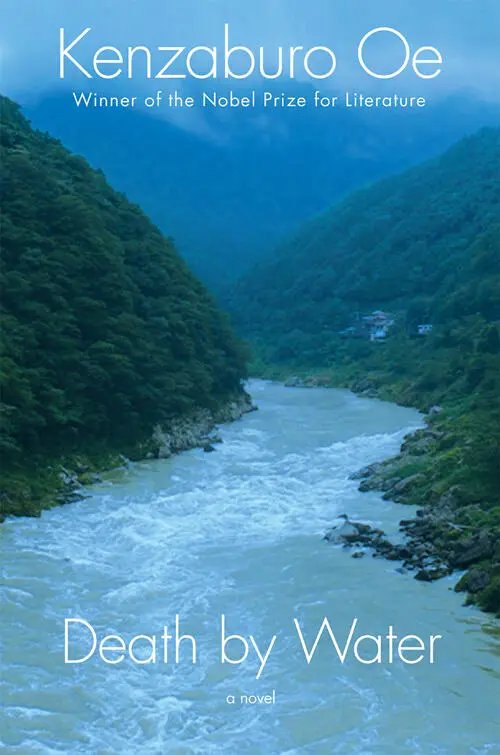
Kenzaburo Oe - Death by Water
Здесь есть возможность читать онлайн «Kenzaburo Oe - Death by Water» весь текст электронной книги совершенно бесплатно (целиком полную версию без сокращений). В некоторых случаях можно слушать аудио, скачать через торрент в формате fb2 и присутствует краткое содержание. Год выпуска: 2015, ISBN: 2015, Издательство: Grove/Atlantic, Inc., Жанр: Современная проза, на английском языке. Описание произведения, (предисловие) а так же отзывы посетителей доступны на портале библиотеки ЛибКат.
- Название:Death by Water
- Автор:
- Издательство:Grove/Atlantic, Inc.
- Жанр:
- Год:2015
- ISBN:9780802190871
- Рейтинг книги:3 / 5. Голосов: 1
-
Избранное:Добавить в избранное
- Отзывы:
-
Ваша оценка:
Death by Water: краткое содержание, описание и аннотация
Предлагаем к чтению аннотацию, описание, краткое содержание или предисловие (зависит от того, что написал сам автор книги «Death by Water»). Если вы не нашли необходимую информацию о книге — напишите в комментариях, мы постараемся отыскать её.
, his recurring protagonist and literary alter-ego returns to his hometown village in search of a red suitcase fabled to hold documents revealing the details of his father’s death during WWII: details that will serve as the foundation for his new, and final, novel.
Since his youth, renowned novelist Kogito Choko planned to fictionalize his father’s fatal drowning in order to fully process the loss. Stricken with guilt and regret over his failure to rescue his father, Choko has long been driven to discover why his father was boating on the river in a torrential storm. Though he remembers overhearing his father and a group of soldiers discussing an insurgent scheme to stage a suicide attack on Emperor Mikado, Choko cannot separate his memories from imagination and his family is hesitant to reveal the entire story. When the contents of the trunk turn out to offer little clarity, Choko abandons the novel in creative despair. Floundering as an artist, he’s haunted by fear that he may never write his tour de force. But when he collaborates with an avant-garde theater troupe dramatizing his early novels, Kogito is revitalized by revisiting his formative work and he finds the will to continue investigating his father’s demise.
Diving into the turbulent depths of legacy and mortality,
is an exquisite examination of resurfacing national and personal trauma, and the ways that storytelling can mend political, social, and familial rifts.
Death by Water — читать онлайн бесплатно полную книгу (весь текст) целиком
Ниже представлен текст книги, разбитый по страницам. Система сохранения места последней прочитанной страницы, позволяет с удобством читать онлайн бесплатно книгу «Death by Water», без необходимости каждый раз заново искать на чём Вы остановились. Поставьте закладку, и сможете в любой момент перейти на страницу, на которой закончили чтение.
Интервал:
Закладка:
In the movie, as a narrative device to move the action along, the spirit of the late Meisuke’s mother appears and chants in a melodic, singsongy way, while the story of the second uprising unfolds on the screen. However, the movie wasn’t one-dimensional by any means, and it utilized a large variety of techniques and a number of different locations. For instance, in the scenes featuring the spirit or ghost of Meisuke’s mother, the musical base is a revival of the kind of old-style samisen accompaniment we associate with Kabuki. That seems to jibe with the first-person accounts I’ve heard from people who participated in the filming, mostly as extras. Mr. Choko’s grandmother and mother started things off, right after Japan lost the war, by mounting a stage production at the local playhouse. Much later, when Sakura became involved, the play was reenacted on a specially constructed stage at the Saya, and the performance was informally recorded on film, just for reference. The next step was to create a feature film that would be a full-fledged period drama. The basic story, in every version, is about the cruel oppression of the farmers in this area by the local feudal clan. A charismatic young farmer named Meisuke leads the first uprising in response to that tyrannical treatment, and it is a success. After the victory, however, Meisuke is captured by the losing faction and imprisoned in the clan-operated jail, where he becomes desperately ill. In an important scene, Meisuke’s mother (who is still young and attractive) visits her son in jail. As she is leaving, she bids farewell to her ailing son in a deeply affectionate way, speaking the famous lines: “There’s no need to worry — even if you die, I’ll just give birth to you again.”
The next scene features a reprise of the recitative by Meisuke’s mother’s ghost or spirit, in which she tells us how, a decade and a half after the first uprising, the local farmers once again find themselves in exceedingly dire straits. On that occasion as well, those brave souls aren’t willing to knuckle under without a fight. At this point in the filmscript, the spirit of Meisuke’s mother stands up from the platform where she has been chanting, suddenly transformed back into a real, live person. A moment later she is joined by Meisuke II, the young boy who is widely believed to be the reincarnation of her late son, Meisuke (the hero of the first uprising). There are a number of female farmers surrounding Meisuke’s mother, wailing and shaking their bodies in an apparent display of sympathy. Now they line up along the proscenium, and as they drop to their knees and gaze at their leader, Meisuke’s mother begins the famous battle cry:
Women warriors, let us go
Off to face our latest foe.
Into battle we will soar
Strong and brave forevermore.
All together, here we go
We shall vanquish every foe!
The women join in, singing along, and they begin to dance as well. Hoisting their primitive armaments—’bamboo spears, pointed sticks, and the like — the village women shuffle around until they’re in a perfectly regimented formation. Then the group goes marching off to battle, led by Meisuke II and his mother.
The screenplay doesn’t show what happens to Meisuke’s mother and her son following the successful uprising. (According to legend, they were set upon by a gang of masterless samurai who raped Meisuke’s mother after they had thrown her young son into a hole in the ground and stoned him to death.) Instead, in the filmed version, we’re back on the platform at the Saya, and the ghost of Meisuke’s mother is sitting there relating the tale of the victorious uprising. She tells us that the country is in the throes of a major reconstruction, and the adversary who was vanquished in the second uprising wasn’t the despotic clan, but rather some troops sent from Tokyo by the administrator in charge of the area. While the triumphant insurrectionists were raising a flag of victory over their base camp at Okawara, the government administrator committed suicide in shame and the interlopers slunk away with their tails between their legs.
As the majestic voice of Meisuke’s mother seems to take flight, the camera is borne along with it, pulling up into a crane-shot panorama of the stunning scenery of the Saya and beyond. The entire mountain is ablaze with colorful autumn leaves. We see Meisuke’s mother leading a horse with Meisuke II riding astride, and we watch as they ascend a steep, narrow path into the forest, occasionally emerging from behind the trees and then vanishing once more, but we never see the depraved samurai who are lying in wait to ambush them. After a moment the theme music — one of Beethoven’s piano sonatas — kicks in, and then over the music we hear the voice of a woman wailing “Aah, aah” in agony and anguish. The background music grows ever louder, and then the words “THE END” appear on the screen.
I gave Unaiko a quick synopsis of this sequence over the phone. Then later, after I’d sent her a copy of the shooting script, she read the whole thing from beginning to end, and this is what she said to me during our next phone convo:
“When Sakura’s wailing voice suddenly rends the air in the final scene, I found it intensely sad. I also think, without a doubt, that her heartfelt cry represents the misery and suffering of all the women who have been raped on an unbroken continuum from the time of Meisuke’s mother until today. I mean, you have to keep in mind that the film was made to give expression to Sakura’s own traumatic memories of being sexually abused as a young girl. So why do I feel compelled to turn it into another ‘dog-tossing’ play? I think it’s because I identify so strongly with this story on a personal level, and I want to dramatize its terrible, timeless realities openly and honestly, with my own body, rather than merely suggesting the hideous acts of violence by the faraway sound of someone keening offstage.”
While Unaiko was speaking, I just listened in silence. I felt somehow as if she had abandoned me as a collaborator and was going off by herself to explore some private, uncharted realm. For some reason I thought about how, after the uprising had been won, Meisuke’s mother and her son split off from their female followers and headed into the forest, on their way back to the village. Since the feudal structure had been abolished, a great many young samurai had banded together in gangs of freelance thugs, and they were hiding out between the former castle town and a high mountain pass, lying in wait to cause whatever violent mischief they could. At that moment I felt as disenfranchised as those young outlaws, but Unaiko didn’t seem to notice.
“Look, I can see that it would have been inappropriate to show a graphic rape as the ending of a movie with this kind of soft, elegiac tone,” she continued. “But even so, the denouement of the tragedy, in the original stage version produced here after the war, was the scene where Meisuke’s mother sat onstage and told that dreadful story as a recitative, right? I’m sure you’ve heard about how, after the war ended, Mr. Choko’s mother and grandmother made a nice pile of money by selling their stock of paperbush bark on the black market. (The bark was no longer being used to make paper currency, but it was still in demand for making paper, which was one of many scarce commodities in those postwar days.) Anyway, they used some of their profits to stage a play at the little playhouse in the valley, and apparently every time the battle cry was invoked the audience went nuts and joined in, and the interactive chanting seems to have enabled the postwar women from around here to feel a visceral connection with their ancestors who had taken part in the uprising some eighty years earlier. Of course, this was during a period when all the menfolk were struggling to come to terms with the mortifying fact that Japan had lost the war.
Читать дальшеИнтервал:
Закладка:
Похожие книги на «Death by Water»
Представляем Вашему вниманию похожие книги на «Death by Water» списком для выбора. Мы отобрали схожую по названию и смыслу литературу в надежде предоставить читателям больше вариантов отыскать новые, интересные, ещё непрочитанные произведения.





Обсуждение, отзывы о книге «Death by Water» и просто собственные мнения читателей. Оставьте ваши комментарии, напишите, что Вы думаете о произведении, его смысле или главных героях. Укажите что конкретно понравилось, а что нет, и почему Вы так считаете.