Kenzaburo Oe - Death by Water
Здесь есть возможность читать онлайн «Kenzaburo Oe - Death by Water» весь текст электронной книги совершенно бесплатно (целиком полную версию без сокращений). В некоторых случаях можно слушать аудио, скачать через торрент в формате fb2 и присутствует краткое содержание. Год выпуска: 2015, ISBN: 2015, Издательство: Grove/Atlantic, Inc., Жанр: Современная проза, на английском языке. Описание произведения, (предисловие) а так же отзывы посетителей доступны на портале библиотеки ЛибКат.
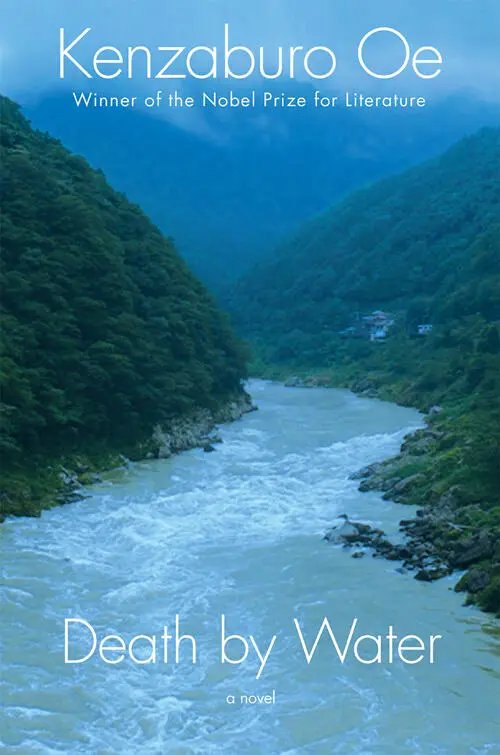
- Название:Death by Water
- Автор:
- Издательство:Grove/Atlantic, Inc.
- Жанр:
- Год:2015
- ISBN:9780802190871
- Рейтинг книги:3 / 5. Голосов: 1
-
Избранное:Добавить в избранное
- Отзывы:
-
Ваша оценка:
Death by Water: краткое содержание, описание и аннотация
Предлагаем к чтению аннотацию, описание, краткое содержание или предисловие (зависит от того, что написал сам автор книги «Death by Water»). Если вы не нашли необходимую информацию о книге — напишите в комментариях, мы постараемся отыскать её.
, his recurring protagonist and literary alter-ego returns to his hometown village in search of a red suitcase fabled to hold documents revealing the details of his father’s death during WWII: details that will serve as the foundation for his new, and final, novel.
Since his youth, renowned novelist Kogito Choko planned to fictionalize his father’s fatal drowning in order to fully process the loss. Stricken with guilt and regret over his failure to rescue his father, Choko has long been driven to discover why his father was boating on the river in a torrential storm. Though he remembers overhearing his father and a group of soldiers discussing an insurgent scheme to stage a suicide attack on Emperor Mikado, Choko cannot separate his memories from imagination and his family is hesitant to reveal the entire story. When the contents of the trunk turn out to offer little clarity, Choko abandons the novel in creative despair. Floundering as an artist, he’s haunted by fear that he may never write his tour de force. But when he collaborates with an avant-garde theater troupe dramatizing his early novels, Kogito is revitalized by revisiting his formative work and he finds the will to continue investigating his father’s demise.
Diving into the turbulent depths of legacy and mortality,
is an exquisite examination of resurfacing national and personal trauma, and the ways that storytelling can mend political, social, and familial rifts.
Death by Water — читать онлайн бесплатно полную книгу (весь текст) целиком
Ниже представлен текст книги, разбитый по страницам. Система сохранения места последней прочитанной страницы, позволяет с удобством читать онлайн бесплатно книгу «Death by Water», без необходимости каждый раз заново искать на чём Вы остановились. Поставьте закладку, и сможете в любой момент перейти на страницу, на которой закончили чтение.
Интервал:
Закладка:
“For example, let’s talk about one of your more recent books, The Chilling and Killing of the Beautiful Annabel Lee. It begins with an outdoor scene in which a corpulent old writer (who is obviously meant to be you) and his equally fat, middle-aged son are out walking together. It’s immediately clear, at least to me, that the son (who, we’re told, was born with some cognitive difficulties) is supposed to be Akari. I found it interesting to read about the vagaries of making a film with an international consortium back in the 1970s, even though it was before my time. As a general rule I’m dubious about the idea that certain readers will automatically feel a bond with the author just because they’re from the same generation, or be put off if they aren’t, but both those bits of conventional wisdom are surely true in many cases, and I realize that generational demographics do have an impact on book sales.”
“Well,” Unaiko said, “it’s certainly true there’s a generation or two between me and Sakura, the international movie star who plays a big role in the book, but I still found her character very engaging on a personal level.”
“Point taken,” Katsura said. “I’ll freely admit that with the Annabel Lee book, I was quite captivated by the elderly movie producer who was a classmate of the writer’s at Tokyo University and who introduces him to Sakura. However, I couldn’t help thinking it would have been better to give the older characters less prominent roles; in other words, to make them into unobtrusive supporting players and — sorry, I know this will sound like blatant age discrimination, but I have to say it — to let the featured players be the younger versions of those same men and women. In that way, by allowing the character arcs to develop over time while inventing the necessary details, I think the book could be turned into a serious novel.”
“It’s certainly true that the narrator of Annabel Lee is the book’s author himself, barely disguised, and he was familiar with the international movie star because he’d seen her on the screen when she was a young girl, so in that respect it is an ‘I novel,’ absolutely,” Unaiko said. “But even so, you can’t dismiss it out of hand as an unserious piece of work.”
“No, you’re completely right,” Katsura said. “For Mr. Choko, this probably is a ‘serious novel,’ both in terms of structure and literary style. However, the thing is, over the past ten or fifteen years all of Mr. Choko’s long works of fiction have more or less been cut from the same cloth, most notably in terms of the protagonist (who is often the first-person narrator as well). Not to put too fine a point on it, but the author’s alter ego is nearly always the main character in his books. At some point, doesn’t it become overkill? I mean, can these serial slices of thinly veiled memoir really be considered genuine novels? Generally speaking, books like this will never win over the people who want to read a novel that’s actually novelistic : that is, an imaginative work of fiction. So at the risk of seeming rude, I really have to ask: Why do you choose to write about such a solipsistic and narrowly circumscribed world?”
“Everything you say is true,” I said. “I admit that freely. The novel I had been gearing up to write for a very long time — I’ve abandoned it now, but that’s another story — was going to be about my father, who drowned more than six decades ago when he was only fifty years old. I’ve accepted that I will never be able to complete the book, and in the process I have thought about every single one of the points you raised. I’ve often asked myself how I ended up following such a constricted path in my fiction, but I always seem to come back to the sobering realization that if I hadn’t used the quasi-autobiographical approach I wouldn’t have been able to write anything at all. In other words, I’ve had to maintain this narrow focus out of sheer necessity.”
“And yet it’s evident from a quick glance at these bookshelves that you’re a person with wide-ranging interests,” Katsura said. Then, with what appeared to be a conscious effort not to dwell too mercilessly on my flaws as a writer, he guided the conversation in a different direction. “Another thing someone could glean from the contents of these bookshelves is that they belong to a person with a distinctive way of reading,” he went on. “Take T. S. Eliot, for example. You have a great many highly specialized scholarly books, written in English, but you also have a sizable collection of Japanese translations of Eliot’s work. I can also see that for other major poets of the past century, such as Yeats and Auden, you have looked at the work of the people who have translated those poets into Japanese, found the ones whose style you really love, and then collected their published books. It’s easy to see who your favorites are, but really, I don’t think even scholars in the field spend this much money on poetry translations!”
“The truth is, I rely on the advice of one scholar who has been a friend of mine ever since we met at university,” I said. “He went on to become an expert on the work of Coleridge and Eliot, and he tells me which translators are better than others. What I’ve been noticing lately is that when it comes to poems in foreign languages — whether it’s English or French, or, in the case of Dante, Italian — I simply can’t grasp the meaning in the original language anymore. So I’ll memorize the originals and then keep muttering the lines to myself, over and over, in the hope that dogged repetition will somehow help me to ‘get’ them. At the same time, I still seem to hear the Japanese translations (in the case of Eliot, the ones by Fukase and Nishiwaki) ricocheting around my brain and resonating with the original, and by that rather roundabout method I’m finally able to arrive at a solid sense of what the poet is trying to say.”
“Because your private life exists in a place of receptivity, perhaps your novels are conceived in the same place as well?” Katsura asked rhetorically. “Take William Blake, for instance. When you wrote a novel inspired by his poetry, you included the quoted passages in both the original English and your favorite Japanese translation, printed side by side. That seemed like an act of kindness toward Japanese readers, and for me, having those bilingual pairings of Blake’s poems sprinkled throughout gave the book a pleasing visual texture.”
“I agree,” I said. “And for a bilingual reader it can also be interesting to take note of the striking discrepancies between the original and the Japanese translations, which occur more often than you might think.”
“This is a stanza from the latter part of The Waste Land, isn’t it?” Katsura asked, pointing to an index card tacked to one of the bookshelves. “I see that you’ve written the English original first, followed by several Japanese translations, starting with Fukase’s.”
“Ah, that’s just a relic left over from when I was still struggling to write my drowning novel,” I said. “Putting aside the fact that my command of English has never been as strong as it might be, it’s painful for me to realize that even though I’ve been reading the same stanza over and over for half a century, I seem to comprehend it less now than when I began. In my prime, I used to think that I understood those lines, and the loss of insight makes me fear that my intellectual capacities are deteriorating at a rapid rate. Sometimes when I’m lying awake in bed in the middle of the night Fukase’s version will spring to mind, and I’ll try to translate it back into the original English, as a mental exercise. I can never seem to get it right, so I’ll get up and open The Waste Land to check how far off the mark I was. That was how I came to discover that I had been misinterpreting this one particular line for decades!”
Читать дальшеИнтервал:
Закладка:
Похожие книги на «Death by Water»
Представляем Вашему вниманию похожие книги на «Death by Water» списком для выбора. Мы отобрали схожую по названию и смыслу литературу в надежде предоставить читателям больше вариантов отыскать новые, интересные, ещё непрочитанные произведения.

Обсуждение, отзывы о книге «Death by Water» и просто собственные мнения читателей. Оставьте ваши комментарии, напишите, что Вы думаете о произведении, его смысле или главных героях. Укажите что конкретно понравилось, а что нет, и почему Вы так считаете.