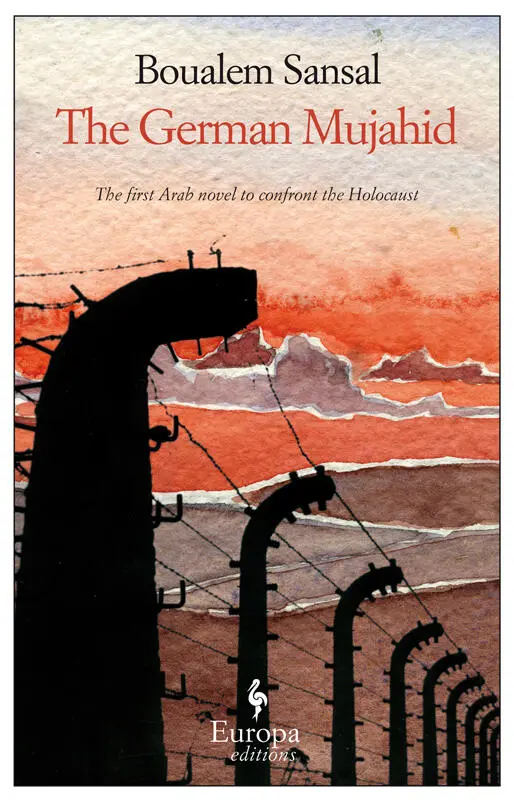
Boualem Sansal - The German Mujahid
Здесь есть возможность читать онлайн «Boualem Sansal - The German Mujahid» весь текст электронной книги совершенно бесплатно (целиком полную версию без сокращений). В некоторых случаях можно слушать аудио, скачать через торрент в формате fb2 и присутствует краткое содержание. Год выпуска: 2009, Издательство: Europa Editions, Жанр: Современная проза, на английском языке. Описание произведения, (предисловие) а так же отзывы посетителей доступны на портале библиотеки ЛибКат.
- Название:The German Mujahid
- Автор:
- Издательство:Europa Editions
- Жанр:
- Год:2009
- ISBN:нет данных
- Рейтинг книги:4 / 5. Голосов: 1
-
Избранное:Добавить в избранное
- Отзывы:
-
Ваша оценка:
The German Mujahid: краткое содержание, описание и аннотация
Предлагаем к чтению аннотацию, описание, краткое содержание или предисловие (зависит от того, что написал сам автор книги «The German Mujahid»). Если вы не нашли необходимую информацию о книге — напишите в комментариях, мы постараемся отыскать её.
is a heartfelt reflection on guilt and the harsh imperatives of history.
The two brothers Schiller, Rachel and Malrich, couldn't be more dissimilar. They were born in a small village in Algeria to a German father and an Algerian mother, and raised by an elderly uncle in one of the toughest ghettos in France. But there the similarities end. Rachel is a model immigrant — hard working, upstanding, law-abiding. Malrich has drifted. Increasingly alienated and angry, his future seems certain: incarceration at best. Then Islamic fundamentalists murder the young men's parents in Algeria and the event transforms the destinies of both brothers in unexpected ways. Rachel discovers the shocking truth about his family and buckles under the weight of the sins of his father, a former SS officer. Now Malrich, the outcast, will have to face that same awful truth alone.
Banned in the author's native Algeria for of the frankness with which it confronts several explosive themes, The German Mujahid is a truly groundbreaking novel. For the first time, an Arab author directly addresses the moral implications of the Shoah. But this richly plotted novel also leaves its author room enough to address other equally controversial issues; Islamic fundamentalism and Algeria's "dirty war" of the early 1990s, for example or the emergence of grim Muslim ghettos in France's low-income housing projects. In this gripping novel, Boualem Sansal confronts these and other explosive questions with unprecedented sincerity and courage.
The German Mujahid — читать онлайн бесплатно полную книгу (весь текст) целиком
Ниже представлен текст книги, разбитый по страницам. Система сохранения места последней прочитанной страницы, позволяет с удобством читать онлайн бесплатно книгу «The German Mujahid», без необходимости каждый раз заново искать на чём Вы остановились. Поставьте закладку, и сможете в любой момент перейти на страницу, на которой закончили чтение.
Интервал:
Закладка:
An hour later, the special agents came back. They lined us all up in front and the head guy asked each of us a series of questions. When it came to my turn, he asked if my name was really Malek Ulrich Schiller, if I’d got my passport through the legal channels, if I really was going to Aïn Deb to see my family, if I was planning anything illegal and if I harboured any ill intentions. He was a bit thrown by my name, he said, “Your father is German, but you’re Algerian?” I explained that my father was a scientist, a Muslim, a hero, a veteran Mujahid, a respected cheïkh and a chahid . He pointed to his left and said, “Go stand over there.” A minute later my new best friend Slim joined me. An hour later, there were two groups, one on the right, one on the left. We eyed each other tearfully, resentfully, everyone thinking, it’s their fault we’re in this mess. The selection process finished, the group on the right were loaded back onto the truck and driven off. Where to, I don’t know. A cop came over to our group and said, “Follow me.” We trailed after him like sheep. He led us to the building marked Arrivals Hall, Welcome to Algeria . He said, “Now fuck off.” We didn’t need to be told twice. Still shaking, we went through the necessary formalities: immigration, customs, baggage check, body search, brief routine interrogation, sundry declarations, compulsory foreign exchange, payment of taxes and found ourselves outside, half dead from exhaustion, hunger, thirst, cold, humiliation, soaked to the skin but free and ecstatic to be free. I felt like I’d just done a thirty-year stretch. The sunlight hurt my eyes and aunt Sakina’s suitcase was ripping my arm out of its socket. For a long time I wondered what had happened to the other group. I can’t bring myself to believe that the cops tortured them, killed them, deported them. I’d rather believe they just locked them up and that their parents aren’t worried. Some day, when the war is over, when the camps are liberated, we’ll find out.
Slim phoned his parents and got them to come and pick him up. “They were convinced I’d been turned back at the border or murdered or something — it was complete panic, the old man was already on the phone to Paris,” he said, laughing. Slim is a spoiled royal pain in the arse. While we waited, we watched the comings and goings in the airport. The whole place was deathly silent. The people looked normal but maybe they were being extra careful. At one point we saw some cop dragging away a gang of young guys handcuffed together in pairs. They’d obviously thought they could just up and leave the country. They’ve had it now. Trying to leave is an insult. They’re bound to be gassed. We were trying to get into the country and we’d been given the third degree. Later, I saw the special agents, who’d been sitting in the cafeteria, suddenly get to their feet, button their raincoats, slip on their dark glasses and march off quickly. They walked straight past us, but we ducked out of sight just in time. Compared to Algiers airport, our estate is like an old-folks home, everyone hanging out, bored senseless. Or it used to be — because since the new imam and his emir showed up, the Fourth Reich is well under way. By the time I left for Algeria, it was all set, the propaganda machine was up and running, strict security was being enforced and you could smell Blitzkrieg in the air. I wonder what it will be like by the time I get back, whether my family, my neighbours, my mates will still be there. I miss them already. I can’t imagine a future without my mates, without Momo, Raymou, Togo-au-Lait, Idir-Quoi, Cinq-Pouces, Manchot and Bidochon, the coffee jockey who can’t even make a decent cup of coffee, all sons of dirt-poor, honest working men. Slim, the royal pain in the arse, told me about his life in Paris, his mates, his girlfriends, and he told me about what he did in Algeria during the holidays, days spent playing video games, big family meals, little parties at the house, his sisters inviting their friends over pretending they needed to revise. I didn’t know what the fuck he was talking about. I told him about life on the estate and he looked at me like I was from another planet. Just then, his father showed up, frantic but happy, he’s some important professor at Algiers hospital, he used to work in some hospital in Paris. They gave me a lift, dropped me at the bus station. Slim, the royal pain in the arse, winked at me and said, “Come by the house when you get back from that godforsaken hole you’re going to, we can do some revision.”
Rachel was a bit of spoiled pain in the arse himself. I mean, he didn’t have to spend a fortune taking a taxi to Aïn Deb. They have got buses in Algeria and for a couple of dinar they’ll drive you, your family and all your belongings to the ends of the earth and back. Outside the bus station — a patch of waste ground with barbed wire fences where a hundred rusty ramshackle buses waged all out war to get in, fight over passengers and get the fuck out — was a guy like a scarecrow whose job was to give directions. I told him my story. For fifty dinar he told me what I needed to do, all the while giving directions to a bunch of other lost souls, “Yeah, yeah, that’s right, take bus number 12 to Sétif. . You, you need to take the number 8 to Oran. . and you. . uh. . 36, that’ll take you to Sidi-Bel-Abbes. . What? Oh yeah, so when you get to Sétif, take the bus for Bordj Kédir. . and you. . give me a minute. . you can take the bus to Tiaret or the one to Mascara, doesn’t matter. . You need to take the Ouargla bus and from there you take the caravan that goes to El Goléa. . and you. . you need to hitchhike the rest of the way to — where was it again?” I repeated the name pronouncing it carefully. “Aïn what. .?” He said as he hurried over to pick a fight with another scarecrow who was cutting in on his turf. “Aïn Deb? Yeah, yeah. . it’s like I said.” And he left me standing there in the mud and the chaos.
It was all exactly the way Rachel had described it in his diary. The military convoys, the roadblocks, the police, the deserted roads, the stupefying silence, the bus driver, foot to the floor, not looking left or right, the passengers so scared they were throwing up. The only difference was that it was bucketing down and wind whipped at us on the near side. At every bend, the wheels of the bus hung over the cliff. If the terrorists don’t kill us, the bus will. Or the cold. We stopped in a tiny village that looked like it had died out with the last dinosaur. Not a man or a ghost, nothing but shapeless figures muffled up so you could hardly see their faces. The guy in the café served us scalding hot coffee, took our money and disappeared. I had to change busses in Sétif, but things there were more efficient than they’d been in Algiers. In Sétif, the self-appointed guide only charged me five dinar to tell me, “all the blue mini-busses go to Bordj Kédir, you can’t miss it.” In Bordj Kédir I managed to find a taxi driver who was prepared to take me closer to Aïn Deb for a reasonable price. His Peugeot 403 looked like nothing I’d ever seen. “There’s something strange going on out in Aïn Deb,” he told me, “people coming and going all the time. . it’s weird.” “What people?” I asked, “What are they looking for?” He stared at me but said nothing. Maybe he didn’t trust me, maybe he didn’t understand me, I was talking to him in my best pidgin French with a thick sink-estate Arabic accent. I have to say I didn’t really understand him. I assumed that he was talking about terrorists, because he was looking around him all the time like he was expecting an ambush. He dropped me off at a crossroads of two flooded dirt tracks you could barely see in the darkness. To the left, the path climbed steeply, to the right, it ran downhill. “It’s that way. . about three kilometres.” He said, at least that’s what I understood from him pointing to the left and waving three fingers in my face. “Kilometre” is international, it didn’t need translating. He disappeared back into the darkness, his headlights turned off. I took a deep breath and slogged uphill through the driving rain, but at the least the wind was now whipping at my arse.
Читать дальшеИнтервал:
Закладка:
Похожие книги на «The German Mujahid»
Представляем Вашему вниманию похожие книги на «The German Mujahid» списком для выбора. Мы отобрали схожую по названию и смыслу литературу в надежде предоставить читателям больше вариантов отыскать новые, интересные, ещё непрочитанные произведения.




Обсуждение, отзывы о книге «The German Mujahid» и просто собственные мнения читателей. Оставьте ваши комментарии, напишите, что Вы думаете о произведении, его смысле или главных героях. Укажите что конкретно понравилось, а что нет, и почему Вы так считаете.