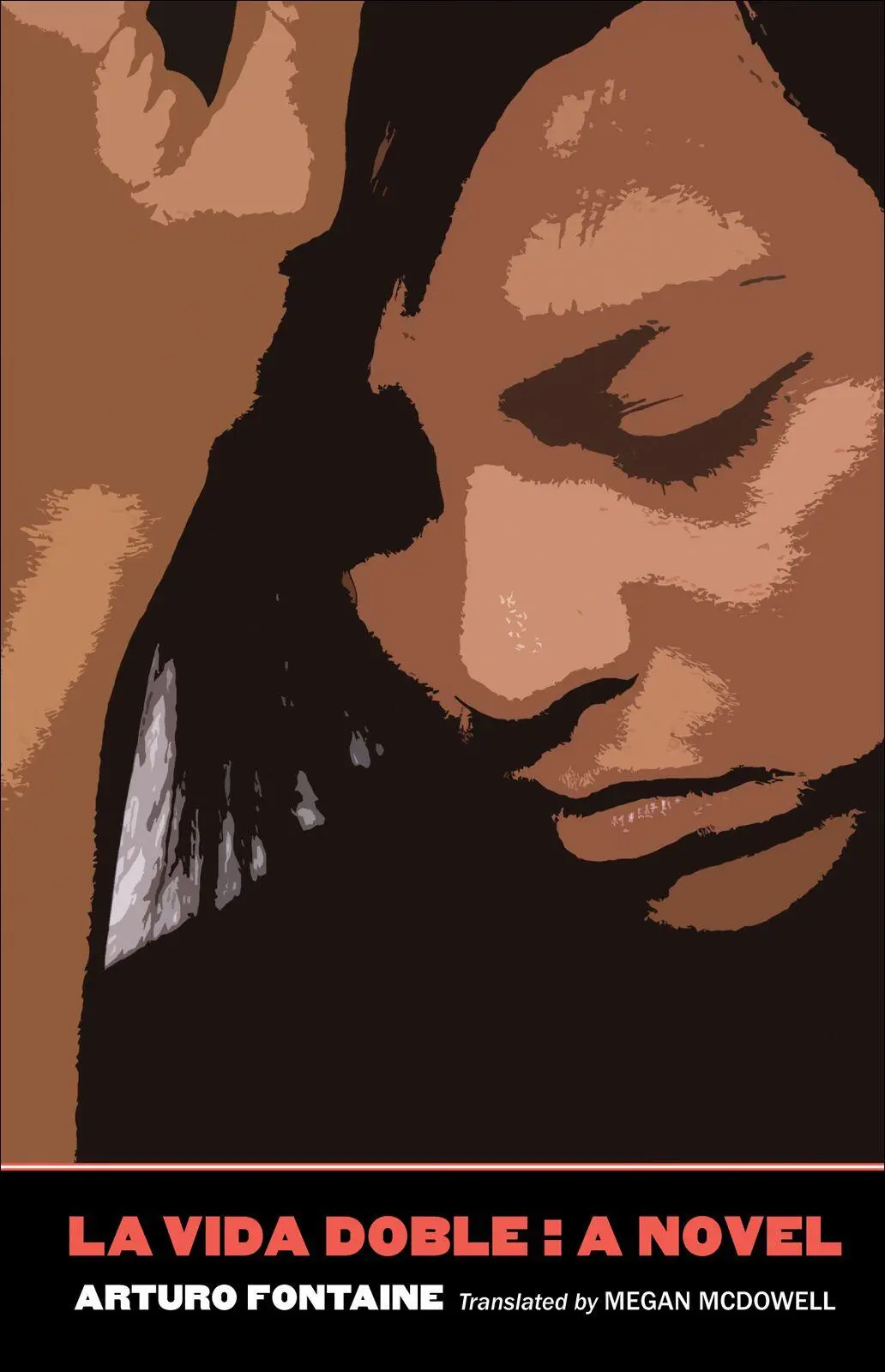
Arturo Fontaine - La Vida Doble
Здесь есть возможность читать онлайн «Arturo Fontaine - La Vida Doble» весь текст электронной книги совершенно бесплатно (целиком полную версию без сокращений). В некоторых случаях можно слушать аудио, скачать через торрент в формате fb2 и присутствует краткое содержание. Год выпуска: 2013, Издательство: Yale University Press, Жанр: Современная проза, на английском языке. Описание произведения, (предисловие) а так же отзывы посетителей доступны на портале библиотеки ЛибКат.
- Название:La Vida Doble
- Автор:
- Издательство:Yale University Press
- Жанр:
- Год:2013
- ISBN:нет данных
- Рейтинг книги:3 / 5. Голосов: 1
-
Избранное:Добавить в избранное
- Отзывы:
-
Ваша оценка:
La Vida Doble: краткое содержание, описание и аннотация
Предлагаем к чтению аннотацию, описание, краткое содержание или предисловие (зависит от того, что написал сам автор книги «La Vida Doble»). Если вы не нашли необходимую информацию о книге — напишите в комментариях, мы постараемся отыскать её.
is the story of Lorena, a leftist militant who arrives at a merciless turning point when every choice she confronts is impossible. Captured by agents of the Chilean repression, withstanding brutal torture to save her comrades, she must now either forsake the allegiances of motherhood or betray the political ideals to which she is deeply committed.
Arturo Fontaine’s Lorena is a study in contradictions — mother and combatant, intellectual and lover, idealist and traitor — and he places her within a historical context that confounds her dilemmas. Though she has few viable options, she is no mere victim, and Fontaine disallows any comfortable high moral ground. His novel is among the most subtle explorations of human violence ever written.
Ranking with Roberto Bolaño and Mario Vargas Llosa on Latin America’s roster of most accomplished authors, Fontaine is a fearless explorer of the most sordid and controversial aspects of Chile’s history and culture. He addresses a set of moral questions specific to Pinochet’s murderous reign but invites us, four decades later, to consider global conflicts today and question how far we’ve come.
La Vida Doble — читать онлайн бесплатно полную книгу (весь текст) целиком
Ниже представлен текст книги, разбитый по страницам. Система сохранения места последней прочитанной страницы, позволяет с удобством читать онлайн бесплатно книгу «La Vida Doble», без необходимости каждый раз заново искать на чём Вы остановились. Поставьте закладку, и сможете в любой момент перейти на страницу, на которой закончили чтение.
Интервал:
Закладка:
They were books that the military police had burned. “Salvaged remains from the shipwreck,” Canelo said. “A treasure,” he said. We spent all day and much of the night thumbing through those pages rescued from the barbarians: “Hey, let me read you this paragraph. .” Or “I think it’s put more clearly here, I’ll read it to you”—and searching at random for yet another passage that would confirm us in our faith with its light.
The Spartan was almost friendly toward us, though too formal. His suggestions and advice were, really, orders. But he gave them to us with the utmost respect. He talked to us about chemistry and explosives. That’s what he was interested in. His great love was his 9mm SIG-Sauer P-230 with a silencer on the barrel. He loved that gun and he showed it to us proudly. “The best gun in the world,” he’d say. “It’s already had its baptism of blood. It was up to the test, let me tell you.” Once, we were in a safe house waiting for a mission, and a kitten fell off the roof. The Spartan turned into a mother. He gave it milk every six hours. When we left, he set out a bowl full of milk and a blanket for it to keep warm in.
He was extremely important to us, the Spartan. On dangerous missions, like placing a bomb or holding up a bank, he conducted himself with machinelike precision. He was obsessive about details. “The devil’s in the details,” he would tell us over and over. After any armed mission, he made us throw away our used sneakers and buy new ones of a different brand.
But still and all, the ascetic allowed himself one luxury: Cuban cigars. A taste he’d picked up from officials at the Military Academy G. S. Rakovski in Sofia; not in Havana, certainly, where his brothers smoked Populares or, if they dared smoke blond tobacco and be seen as queers, Aromas. And if the scarcity was really bad, they would content themselves with tearing out a page from a soviet book and rolling themselves a “tupamaro” with the tobacco gathered from the butts they’d collected at hotels. He, on the other hand, would offer us a Partagás, or a Romeo y Julieta. Sometimes, a real Cohiba. All of them, tobacco for export. No one ever asked him how he got them. But the fact that he had them was a sign.
In those long periods of waiting that fill, like I’ve said, a good part of a combatant’s actual life, he talked to us about cigars, and he lingered over explanations that were more detailed than necessary. “A Flor de Cano cigar,” he’d say for example, “is a cigar with short filler, made with tobacco trimmings. That’s why it’s cheaper. Though it’s not bad.” His eyes shone and he went on talking with a fascination that we didn’t understand: “The binder tobacco is every maestro’s recipe,” he’d say. “You have to combine a light tobacco, which comes from high leaves and gives the cigar its strength, with dry tobacco from the center of the plant, which gives it its aroma, and the flammable tobacco, which comes from the lower leaves and determines the cigar’s combustibility. The cigar roller braids the leaves in a fan so the air can pass through, which facilitates the draw and allows each puff to incorporate all the blended flavors. This,” he’d say, “is the crucial moment, the most delicate moment. Technique isn’t enough, experience isn’t enough. Sweet Mother of God! It takes love. . A cigar of the highest distinction is born of an act of love.”
He would get caught up in his lecture, giving us more and more connoisseur’s details. He didn’t care that we got bored. Or he didn’t notice, who knows?
“A Cohiba Lancero,” he’d say, “has a wrapper with a fine, smooth, and light texture.” He touched the air, seeming to feel that smoothness. “The famous Eduardo Rivero, who came from Por Larrañaga, started making them. He and Avalino Lara created the Cohiba that was produced in El Laguito. Che was Minister of Industry then. Great chess player, Che. Didn’t you know? It’s a high-caliber cigar, and it’ll last me about an hour. It’s smoother at first, it’s filtered, see? That’s why it lasts so long.”
He convinced me to try them when he brought a cigar that was smooth and light — the best of the light cigars, he insisted — a Le Hoyo du Prince petit corona. I loved it. And like that, by his hand, I started to become an aficionado myself, gaining in tolerance. And Cuyano stuck his nose in and shouted, “Coño! How I love a woman with a Havana between her lips. The smoke billowing around her, the aroma. .” I tried a Ramón Allones, a Partagás, a Montecristo, a Rey del Mundo. The Spartan loved to smoke a Rey del Mundo. He promised me that one day he would get a Sancho Panza gran corona, a Sanchos, which had a rough texture, and would last him over two hours. That promise was never kept.
For us, who didn’t understand anything, like I say, the smoke from each cigar the Spartan lit was an invisible thread connecting us to Pinar del Río, to the meadows of Vuelta Abajo, and its aroma had us smelling with our own noses the omnipresent power of the revolution, of Havana, and of the Spartan within the apparatus. Faith is transmitted by witnesses. That smoke was our incense rising up to the heavens. That’s why I didn’t like something Canelo told me in sworn secrecy — it lodged a doubt in my head. The Spartan had left a lover in Cuba, Canelo told me, a girl who worked as a cigar roller in the gallery of the Fonseca cigar factory in Quivicán. What if she was the one who arranged things so she could send him those export-quality cigars, the kind a common Cuban would get only, maybe, if he was invited to the Convention Palace? But the question didn’t last long in my mind: even if it were true that they came from Quivicán to Santiago de Chile, into his clandestine hands with their alibi and legend, it was proof that he possessed some truly influential friends within the apparatus.
I’m telling you about him because without him, you can’t understand what we were. In these times of skeptical hypocrisy it’s hard for someone to believe me. But the Spartan really was as I’m describing. His mold is incomprehensible to the weaklings and egotists of today. His complete devotion to the cause, his abnegation, gave him an unquestioned moral authority over us. “We are violent Christs,” he repeated. But he didn’t remind you of Christ. He was too machinelike for that. Maybe Canelo did. And Canelo was his brother. That’s what he always called him as soon as he saw him: Brother, in English. An old friendship, from their time in Cuba. I know how much Canelo’s death hurt him. Even though when we met at the restaurant in the Central Market he stayed cold, almost.
SIXTEEN
I always wanted a Paris love. I’m talking now about some years before that fateful day I was captured. I was twenty-four. When I had landed for the third time at Charles de Gaulle, I’d told myself: this is it, third time’s the charm. Nothing happened. I completed the mission I’d been given, returned to Chile, and that was it. And now, as I said, I was twenty-four and I was in Paris again, at a table at the back of La Closerie des Lilas, telling Pelao Cuyano: “I always wanted a Paris love.” And he almost died laughing at my petit bourgeois romanticism, my bovarism. He had devoured over a hundred pages of Sartre’s essay about Flaubert before reading a line of Flaubert himself. He told me that while we were killing time in that café. We talked about Hemingway — we saw his bronze plaque — who came here to write in a notebook with a pencil. He brought a sharpener with him. Zola, I told him, was a habitué, as well as Cézanne, and, in the twenties of the twentieth century, Tristan Tzara, André Breton, Picasso, Modigliani. . He knew all that. What he didn’t know was that Lenin used to play chess here. We guessed at whether, among the people around us, so comme il faut, there could be some Tzara, some Hemingway, some contemporary Picasso. We decided not.
Читать дальшеИнтервал:
Закладка:
Похожие книги на «La Vida Doble»
Представляем Вашему вниманию похожие книги на «La Vida Doble» списком для выбора. Мы отобрали схожую по названию и смыслу литературу в надежде предоставить читателям больше вариантов отыскать новые, интересные, ещё непрочитанные произведения.



Обсуждение, отзывы о книге «La Vida Doble» и просто собственные мнения читателей. Оставьте ваши комментарии, напишите, что Вы думаете о произведении, его смысле или главных героях. Укажите что конкретно понравилось, а что нет, и почему Вы так считаете.