Marcos Giralt Torrente - Paris
Здесь есть возможность читать онлайн «Marcos Giralt Torrente - Paris» весь текст электронной книги совершенно бесплатно (целиком полную версию без сокращений). В некоторых случаях можно слушать аудио, скачать через торрент в формате fb2 и присутствует краткое содержание. Год выпуска: 2014, ISBN: 2014, Издательство: Hispabooks, Жанр: Современная проза, на английском языке. Описание произведения, (предисловие) а так же отзывы посетителей доступны на портале библиотеки ЛибКат.
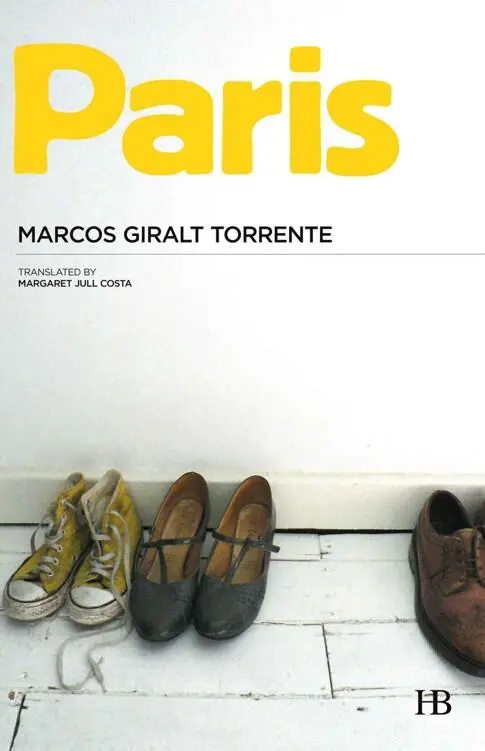
- Название:Paris
- Автор:
- Издательство:Hispabooks
- Жанр:
- Год:2014
- ISBN:9788494228452
- Рейтинг книги:5 / 5. Голосов: 1
-
Избранное:Добавить в избранное
- Отзывы:
-
Ваша оценка:
Paris: краткое содержание, описание и аннотация
Предлагаем к чтению аннотацию, описание, краткое содержание или предисловие (зависит от того, что написал сам автор книги «Paris»). Если вы не нашли необходимую информацию о книге — напишите в комментариях, мы постараемся отыскать её.
Paris — читать онлайн бесплатно полную книгу (весь текст) целиком
Ниже представлен текст книги, разбитый по страницам. Система сохранения места последней прочитанной страницы, позволяет с удобством читать онлайн бесплатно книгу «Paris», без необходимости каждый раз заново искать на чём Вы остановились. Поставьте закладку, и сможете в любой момент перейти на страницу, на которой закончили чтение.
Интервал:
Закладка:
If I wanted to get any real results, I would, therefore, have to act before my mother found out, I would have to be prepared for the moment when, once my aunt’s foreseeable intervention had taken effect, my mother would finally have to decide to face up to making reparation for her faults. Right from the start, I saw clearly, albeit in a disorderly, impulsive, and rather less considered manner than you might think from what I’ve said, that I would have to anticipate my mother; of that, during the torments that gripped me following my reckless phone call to my aunt, I had no doubt. What I was less clear about — either then or in the two days that passed before my aunt’s sudden arrival in Madrid and the no less surprising and unexpected outcome that emerged from it — was how to do it, how to resolve my burning desire to find out or what to include in that “something more” I needed to know. Of course, I wanted to know if there had been any kind of deceit involved in my mother’s trip to Paris, but the answer to that question was so closely bound up with other enigmas, fears, and griefs — possibly unconscious and unacknowledged but nonetheless pressing and troubling ones — that it would be ingenuous to argue that it was the sole or most important question. Too many things inside me depended on the answer to that question for me not to wonder if it was in fact an excuse that concealed other controversies. Too many things were too closely bound up with each other for me to expect that one answer could resolve them all. There was my mother and everything related to her: What did she want? What had she done? Was she really the cool, persistent person who, almost to the point of exaggeration, carefully weighed up any matter directly affecting me, or was she the gullible fool capable of stumbling again and again over the same obstacles and errors or endangering herself and me by pursuing some unachievable dream? Then there was me and the various ways of interpreting my situation according to the answers given to each of the preceding questions: Should I be grateful or reproachful? Could I free myself from the great weight I felt, or should I, on the contrary, remain tied to my mother, eternally indebted to her unconditional love and devotion? There was my father, too, and his incorrigible egotism, which might come to be seen in a new light, depending on how my mother had behaved: Was he the only guilty person, or was he only partly to blame? Had he himself been deceived or betrayed in some way? But alongside these unknowns, which I converted into stark dichotomies when there was really no reason why they should rule each other out, there were other dilemmas that I found equally worrying and that also referred to a past I knew nothing of, but that would probably have continued to bother me even had there been no deceit, either real or suspected: What to make, for example, of my mother and the childhood she never mentioned? What to think of myself or my father, of the fragility I had sensed in him as I trailed after him through the Madrid streets? Where did my parents end, and where did I begin? Should my view of them depend on their view of me? Was I free to decide on things that had to do with me alone, or was I conditioned by things I knew nothing about? Did I really have the right to use their behavior as the yardstick by which to judge them?
I did not, of course, think any of this so literally; these are speculations that arise from recalling my confused state at the time, suppositions that I can’t even be sure existed but that I must, nevertheless, set down and accept as real in the light of a feeling that appeared unexpectedly in the days following that conversation with my aunt, while I was still scrambling vainly around for a way to come up with new evidence that would help prepare me for the moment when my mother did finally decide to talk to me. It was, I suppose, a feeling of irrepressible filial solidarity after my aunt’s harsh words about my father, as well as a delayed bonding reflex that, on the rainy evening I’d spent following him, I had felt spring up between us under the cover of the darkness and the overwhelming weariness clouding my mind. Whatever it was, the fact is that, almost unwittingly, I found myself thinking about my father, and I felt an irresistible need to justify and even absolve him, despite all the rancorous feelings that had been quietly accumulating in the two or three years that had passed since his sudden disappearance. I don’t mean that I began to judge him differently or that I suddenly began to endow him with new qualities. After his sudden departure from our lives, I had placed him outside the field of my preoccupations, and that is how it has continued to this day. I mean only that in the face of Delfina’s scornful comments, I allowed myself to be swept away by anger and was, for the first time, capable of thinking about him independently from what he meant for my mother or for me, and I was filled by a kind of proud acceptance of what he was. In the face of all the conventionalisms and external considerations urging me to condemn his behavior, to understand it as an illness or an oddity that threatened the normal order of things, I was seized with unusual force by the contrary impulse, namely, an involuntary admiration and respect that, in the light of my own rebellion, I felt he deserved because he had broken certain social rules and regulations which, ever since my prolonged stay in La Coruña, I tended to associate with my Aunt Delfina and her husband, with their rigid way of life, their cold way of relating to each other and the world around them.
That same unthinking estimation of him, which sprang unbidden from my deepest memories, that same, sudden fellow feeling for what my father represented, and onto which I spontaneously projected my own latent dissatisfaction and resentment at the hostility shown him by my aunt and uncle, extended to my mother, as well, and to the inexplicable tenacity with which she had tried for years, despite everything, to bind her fate to his; while it’s true that I knew of the urgent, desperate hopes for change she had nurtured all that time, I knew, too, ever since our conversation on the way to Burgos, that those hopes did not, as they did in my aunt and uncle, have their roots in an explicit condemnation of my father’s personality, but in the mere impossibility, for as long as he continued to go off the rails, of their having a life in common, a desire that was as natural in her as the obstacles that planted themselves in her way were inevitable. You could say that, without admitting as much to myself, I sympathized with my mother, and the earlier incomprehension with which I once viewed her insistence on putting her trust in my father over and over again was replaced by a greater understanding, one that allowed me to see how generous and rare and bold she had been in making that choice.
A product of my subterranean reconciliation with my parents’ attitude — in opposition to the gray, hypocritical normality I was beginning to associate with my aunt and uncle as well as with the world of absolute certainties surrounding me at school and among my friends and acquaintances — was the inclusion, in my urgent need to know, of questions that went beyond my understandable eagerness to find out what had really happened in Paris, the extra worry of trying to work out the reasons for my parents’ behavior, above and beyond its concrete manifestations. Shortly after I first became aware that being an only child made me different, I became aware that my parents were different, too, and a need to compare myself with them emerged quite naturally, a need to contrast what was innate and what was inherited, what was mine because that is how I would have ended up anyway and what was, on the contrary, the product of circumstances and of decisions not made by me. It wasn’t just a matter of finding out once and for all if they had been together in Paris and, if they had, what they had done there, but finding out, too, what had led them there, what it was they lacked, what they secretly longed for or desired, if they felt alone or were perfectly content, what they thought, what they hoped for, what their childhoods had been like, if they resembled me or were completely different, if Paris had been what separated them or if they would have separated anyway.
Читать дальшеИнтервал:
Закладка:
Похожие книги на «Paris»
Представляем Вашему вниманию похожие книги на «Paris» списком для выбора. Мы отобрали схожую по названию и смыслу литературу в надежде предоставить читателям больше вариантов отыскать новые, интересные, ещё непрочитанные произведения.







Обсуждение, отзывы о книге «Paris» и просто собственные мнения читателей. Оставьте ваши комментарии, напишите, что Вы думаете о произведении, его смысле или главных героях. Укажите что конкретно понравилось, а что нет, и почему Вы так считаете.