Marcos Giralt Torrente - Paris
Здесь есть возможность читать онлайн «Marcos Giralt Torrente - Paris» весь текст электронной книги совершенно бесплатно (целиком полную версию без сокращений). В некоторых случаях можно слушать аудио, скачать через торрент в формате fb2 и присутствует краткое содержание. Год выпуска: 2014, ISBN: 2014, Издательство: Hispabooks, Жанр: Современная проза, на английском языке. Описание произведения, (предисловие) а так же отзывы посетителей доступны на портале библиотеки ЛибКат.
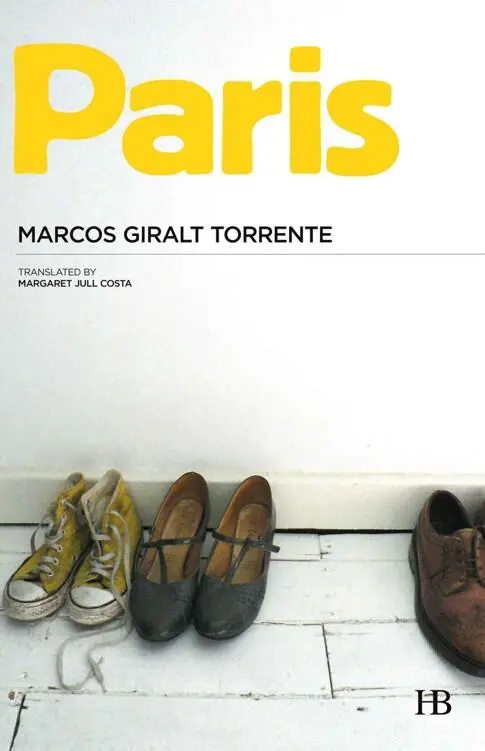
- Название:Paris
- Автор:
- Издательство:Hispabooks
- Жанр:
- Год:2014
- ISBN:9788494228452
- Рейтинг книги:5 / 5. Голосов: 1
-
Избранное:Добавить в избранное
- Отзывы:
-
Ваша оценка:
Paris: краткое содержание, описание и аннотация
Предлагаем к чтению аннотацию, описание, краткое содержание или предисловие (зависит от того, что написал сам автор книги «Paris»). Если вы не нашли необходимую информацию о книге — напишите в комментариях, мы постараемся отыскать её.
Paris — читать онлайн бесплатно полную книгу (весь текст) целиком
Ниже представлен текст книги, разбитый по страницам. Система сохранения места последней прочитанной страницы, позволяет с удобством читать онлайн бесплатно книгу «Paris», без необходимости каждый раз заново искать на чём Вы остановились. Поставьте закладку, и сможете в любой момент перейти на страницу, на которой закончили чтение.
Интервал:
Закладка:
XXVIII
My aunt arrived the following day on the morning train, but I didn’t find this out until the afternoon, on my return from school, when, as soon as I’d closed the front door and was about to walk down the hallway leading to the living room, I heard my mother’s voice and, shortly afterward, that of my aunt energetically interrupting her. Despite my surprise at how fast things had happened, I noticed that although they were both trying hard not to raise their voices, they were not talking but arguing. I was so taken aback that I couldn’t absorb what they were saying, but it took only a few seconds for me to realize that the bomb had finally exploded and that all my attempts to anticipate events had been in vain. My first impulse was to turn around and run away, and, given that they hadn’t heard me come in, to go out into the street again and only come back when they had calmed down, or at least when I felt more able to cope with a three-way conversation for which, naïvely, I had not prepared myself. I was afraid to confront them from a position of weakness, without knowing exactly what each of them knew, what the fight was all about, or how long it had been going on. Soon, however, my need to know won out over my need to escape, and I continued on down the hall, taking care not to make any noise and, at the same time, pricking up my ears, which received, quite clearly, these words from my aunt: “I don’t care. You simply can’t do it. It doesn’t belong to him.” I was walking deliberately slowly and wasn’t even halfway down the hall when I heard my mother answer, “Yes it is. It’s his. He paid for half of it.” And then I heard my aunt cutting in, “No, it isn’t. It may have been his years ago, but that doesn’t matter. Now it belongs to you and to your son.” I was, by then, standing right next to the door leading into the living room, where they were sitting; I stood there with my back pressed against the wall, my ears straining to catch every word they said, but I was ready, too, to flee back down the hallway should there be the slightest risk of them discovering me; I could then pretend to be an entirely innocent new-arrival. That was almost all I had time to do. While I was thinking about what I had already heard and wondering in amazement at its possible meaning, and after a rhetorical pause or an explicit refusal to reply on the part of my mother, my aunt spoke again, adding emphatically, “It’s your son’s inheritance. You can’t just throw it away. You have to compensate him in some way.” Immediately after this, I heard footsteps, but before I realized the threat they represented, my Aunt Delfina had appeared in the doorway and, after a startled glance in my direction, she stopped on the very threshold and stood looking at me. For a few very long seconds, I could hear all three of us breathing. I was looking at my aunt; my aunt was looking at me; my mother, as yet unaware of my presence, was waiting for her sister. I think she said “What’s wrong? What are you doing?” but I’m not sure, because my memory is filled by what happened next. In response to these questions, or possibly spontaneously, my aunt leaned back in the doorway, immediately across from where I was hiding, and without saying hello or smiling, she turned toward my mother and said dryly, “Tell your son, go on, tell him you’re going to sell the apartment and give his father half the money. Go on, tell him, and see if he understands.” Having said this, she again turned to look at me, then leaned back further against the doorframe and, giving a theatrical wave of the hand as if to usher me in, waited for my mother’s reaction. I didn’t move, feeling both terribly embarrassed and, at the same time, struggling to take in this news; then, when I heard a dull thud like the sound made by someone stamping hard on the ground, I sidled into the living room, my back against the wall, at the very moment when my mother, a look of alarm on her face and both hands resting on the arms of the chair facing the door, seemed about to get up and come over to me. “Go on, ask her to tell you. See if she can,” I heard my aunt saying to me as if from the depths of a very deep sleep.
I need hardly describe the state of embarrassment and extreme distress in which I waited for what my mother might say. My amazement at her plans for the apartment, my unease because I still didn’t know if Delfina had told her about our conversation, and my awareness that she must realize that my aunt had not just happened upon me right then in the hallway but had caught me eavesdropping, as well as my continuing suspicions about her time in Paris all conspired to keep me on the back foot, rendering me incapable of uttering a single word of excuse in all the seemingly endless time during which, after my aunt’s last words, my mother fell back again into her armchair and looked at me in silence. I had been so preoccupied and caught up in the past, trying to make plans in order to get to the bottom of it, that I had completely lost sight of the present, and now, when it came to meet me, I had no answers, no idea how to face it. My situation then was a kind of preparation for what would come afterward, not on that particular day, which was already drawing to a close, but on the following day, when, suddenly, in a truly rare and radical way, I would have to reconsider my whole life up until then. Nevertheless, perhaps because the echo of that more powerful experience cancels it out, the image of those seconds in which my mother looked at me without speaking is somewhat vague in my memory. I know that I stood stockstill, caught in the grip of a noisy confusion of fears, but it’s also true that memory imposes order and hierarchy, and now, when I look back, I cannot imagine the episode with all the intensity I imagine it must have had. Compared with what would happen twenty-four hours later, my feeling is that it did not last long. It passed quickly, or so it seemed to me. Between the instant when our eyes met and the moment when my mother broke her silence, almost nothing survives — it’s a void that immediately begins to fill up, and I can see her blinking and, still looking me straight in the eye, saying to my aunt, “I’m sure he’ll agree with me, not that it’s any of your business, anyway. That’s something he and I will have to work out.”
I remember the ensuing silence, like a kind of truce, during which, since I was momentarily not the focus of attention, I had time to review all the hasty decisions that had arisen from my witnessing that clandestine meeting in the café. But apart from that succession of fleeting images that sent me back to the first appearance of a suspicion that was, it turned out, perfectly capable of being cleared up, and, therefore perfectly measurable, what I remember during the cascade of seconds after my mother spoke was the growing sensation that I was about to enter an unknown and even unimaginable reality, unlike the one inhabited by the doubts and fears that had plagued me during the past few days. I felt the terrible coldness with which my mother had answered my aunt, as well as the frank and equally chilly way in which Delfina had spoken to her earlier. I had never been present at such a serious quarrel between the two sisters, nor had I imagined they could possibly clash in this way. I knew they were very different in temperament and in the ways they judged and dealt with the superficial aspects of life, but I had never thought there could be any insuperable differences between them. I was, then, entering unexplored territory, compared with which any explanation for the motives behind the meeting between my parents paled into insignificance. The fact that my mother was preparing to sell the apartment, whether on her own initiative or under pressure from my father, was as nothing compared with what was about to rain down upon me. To tell the truth, I still don’t know how it happened, I don’t know why my mother didn’t stop my aunt, why she didn’t interrupt the conversation but instead set off along the path opened up by Aunt Delfina, apparently oblivious to the fact that I was there listening intently to every insinuation, every hesitation, every assertion. I can only think that she wanted this to happen, to thus create the right conditions for our conversation the following day, the moment I had so longed for and that, in the end, came about in the most unexpected manner. As for me, what can I say except that I listened with growing incredulity, still pressed up against the wall by the door, making no noise, not moving a muscle, trying to appear invisible, not wanting to remind them in any way of my presence, and not wanting them not to stop, either, but to go on talking. Then Aunt Delfina, on hearing my mother’s defiant words, stepped back into the living room and retorted, “That’s where you’re wrong. It is my business. Of course it is. I can’t allow you to go on ruining your life and his. You’ve gone wrong too many times already.”
Читать дальшеИнтервал:
Закладка:
Похожие книги на «Paris»
Представляем Вашему вниманию похожие книги на «Paris» списком для выбора. Мы отобрали схожую по названию и смыслу литературу в надежде предоставить читателям больше вариантов отыскать новые, интересные, ещё непрочитанные произведения.









Обсуждение, отзывы о книге «Paris» и просто собственные мнения читателей. Оставьте ваши комментарии, напишите, что Вы думаете о произведении, его смысле или главных героях. Укажите что конкретно понравилось, а что нет, и почему Вы так считаете.