Marcos Giralt Torrente - Paris
Здесь есть возможность читать онлайн «Marcos Giralt Torrente - Paris» весь текст электронной книги совершенно бесплатно (целиком полную версию без сокращений). В некоторых случаях можно слушать аудио, скачать через торрент в формате fb2 и присутствует краткое содержание. Год выпуска: 2014, ISBN: 2014, Издательство: Hispabooks, Жанр: Современная проза, на английском языке. Описание произведения, (предисловие) а так же отзывы посетителей доступны на портале библиотеки ЛибКат.
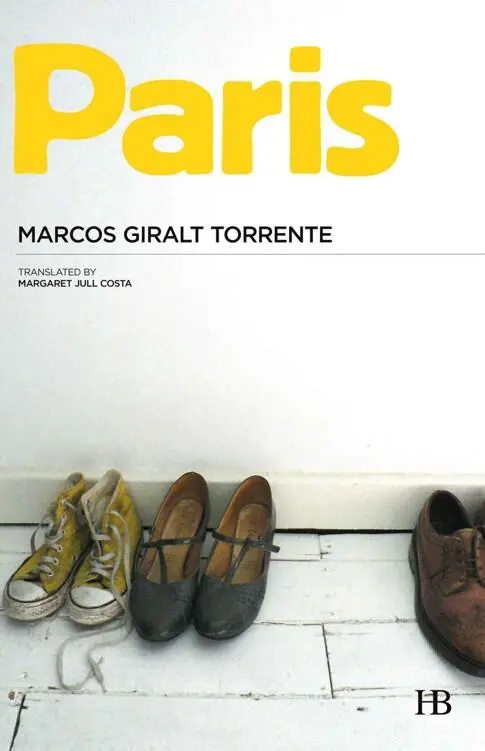
- Название:Paris
- Автор:
- Издательство:Hispabooks
- Жанр:
- Год:2014
- ISBN:9788494228452
- Рейтинг книги:5 / 5. Голосов: 1
-
Избранное:Добавить в избранное
- Отзывы:
-
Ваша оценка:
Paris: краткое содержание, описание и аннотация
Предлагаем к чтению аннотацию, описание, краткое содержание или предисловие (зависит от того, что написал сам автор книги «Paris»). Если вы не нашли необходимую информацию о книге — напишите в комментариях, мы постараемся отыскать её.
Paris — читать онлайн бесплатно полную книгу (весь текст) целиком
Ниже представлен текст книги, разбитый по страницам. Система сохранения места последней прочитанной страницы, позволяет с удобством читать онлайн бесплатно книгу «Paris», без необходимости каждый раз заново искать на чём Вы остановились. Поставьте закладку, и сможете в любой момент перейти на страницу, на которой закончили чтение.
Интервал:
Закладка:
“What? What do you mean?” she asked with unusual urgency, with a directness and lack of caution that took me aback. I repeated what I’d said, and when I had, she launched three questions at me, in a tone of voice that sounded even more hysterical and demanding: “When? How do you know? Did you see him, too?”
“Yes,” I said, still perplexed by her spontaneous, unrestrained response, “yes, I saw them both.” And then, after a moment’s hesitation, “That’s how I know they met. But they don’t know that I know. It was pure chance. I saw them when I was coming back home after school.”
“Yes, but when?” she asked again.
“A few days ago,” I said, “in the afternoon, it was a Monday or a Tuesday.” I could have said more, I could have added that my mother had not mentioned the meeting since then, but I decided not to compromise myself and left my aunt to take the initiative.
As if she had read my mind, my aunt did not stay quiet for long. She took a deep breath, and as she exhaled, she asked me with renewed energy, “Did she tell you why she saw him? Have you spoken about it?” I replied in the negative to both questions, and she again fell silent. After a moment, she exclaimed, “This is horrible. She must be insane. I can’t believe it. What on earth is she doing meeting up with him again?” And then, almost without pausing, “That imbecile is going to end up making a fool of her again. I don’t know what your mother can be thinking. I really don’t understand her. As if she hadn’t had enough. As if—” My aunt did not finish her sentence. She left it incomplete, and I realized that, after her initial outburst, she had suddenly remembered who she was speaking to. I heard her breathe into the mouthpiece, and for a few seconds, she didn’t say another word. I sensed that this was the end of the conversation and that all I could do now was to wait for what would happen when my mother found out. I was about to come up with some excuse in order to say goodbye, when I heard her shamefacedly ask my forgiveness. Her tone was quite different and reminded me of that other plea for forgiveness two or three years before, on the eve of my mother’s return from La Coruña, on the afternoon when she had taken me to a café in order to lecture me about the future and I had burst into tears. On the other hand, unlike that other occasion, she did not withdraw her words. She apologized, and what she said was, “Look, don’t you worry. It’s probably nothing. They probably met by chance and she didn’t think it necessary to tell you.” And then, as if she found the words hard to say, “Just in case, though, don’t say anything. Don’t tell her that you’ve spoken to me. Wait until I’ve found out more.”
That was the last thing my aunt said to me. I will never know if that was, indeed, the last thing she was intending to say to me or if she would have said more. After her advice to say nothing, which, I confess, troubled me as much as would a similar piece of advice directed at my mother and in which I, not she, was the person being kept out of the loop, she lowered her voice to an almost inaudible whisper and said that her husband, my uncle, had just come in and that she could say nothing more. She hung up without so much as a goodbye, and I was left holding the phone in my hand until I heard our own front door closing and my mother’s voice calling from the hall, asking me to help her carry in the groceries. I cannot, therefore, know if that was or wasn’t the last thing my aunt was going to say to me, just as I cannot know what would have happened if I had decided not to phone her that afternoon, if my mother would ever have told me about Paris or if I would still be assailed by the same doubts, if I would have needed to put those doubts down in writing as I am doing now, or if I would have allowed it all simply to slide into oblivion. Of one thing I’m sure: it was thanks to that phone call that other, unimagined secrets finally surfaced and allowed me to understand both how very alone my mother was and the opposition she must have met with in order to do what I feared she had done but still don’t know if she did.
XXVII
I believed I had witnessed the definitive separation of my parents on that day when I spied on them through the café window, and yet I said nothing about that to my aunt during our phone conversation. I deliberately kept silent, not out of forgetfulness, but for the simple reason that my doubts were focused not on the future but on the past, and I would have achieved nothing by assuaging my aunt’s fears at the news of my father’s reappearance. Yes, I deliberately kept silent, although not out of forgetfulness, just as my mother had kept silent about her meeting with my father and just as my aunt would rather her husband didn’t know about my phone call to her, or, as now seems likely, just as she, over the years, had abstained from telling me things about my mother’s life of which I knew nothing. None of the three of us — my mother, my aunt, or me — was innocent, and seeing the past in this light lends my memories a slightly risible edge that rather undermines their seriousness but does not particularly bother me, for it’s far from reflecting my state of mind at the time. It’s one thing being able to distinguish the different interwoven elements of a past event in retrospect, but the mark left on our memory by that event is quite another matter. My mother concealed things from me and my aunt, I concealed things from them both, and my aunt concealed things from me and her husband; but if I was aware then of that trinity of parallel concealments, the truth is that it did not give me food for thought, nor did it make my need to know any less urgent. I only had eyes for what affected me directly. All that mattered to me was finding out if my mother had deceived me.
In that situation, phoning my aunt was a bold idea that left a bittersweet aftertaste; while on the one hand it served to confirm both her scant regard for my father and her equally scant, not to say non-existent confidence in my mother’s strength of will were she to be confronted by him unexpectedly, on the other, it neither confirmed nor settled the matter that had driven me to phone her, and it also irreversibly blocked any room for maneuver on my part. Delfina had asked me to say nothing to my mother, but I knew that the information I’d given her would inevitably have consequences and that my mother would, in the end, find out about my intervention. Before taking that step, I had abandoned myself to chance, not caring what consequences it might have for me, but having witnessed Delfina’s displeasure when she learned of my father’s reappearance, I could not ignore the fact that, whatever she had said in the heat of the moment, it would be very difficult for her to get the truth out of my mother without revealing the role I had played. It never occurred to me that she would actually come to Madrid, but from the moment I hung up, I knew that, sooner or later, my mother would find out, and that it was only a question of days, possibly hours, before she gave me an explanation, before she discovered, one way or another, that I had betrayed her.
This realization was like a short, sharp shock, which far from stopping me in my tracks, only exacerbated my need to know. I guessed that my mother would not stay silent, that she would not respond with indifference to my unexpected knowledge of something she would have preferred to keep secret. She would be sure to try and restore trust between us as quickly as possible, to quiet the distress that her silence had caused me. I was sure that she would speak and that when she did, she would not make do with a belated explanation of what I already knew or with justifying in some way her unusual decision not to tell me about her meeting with my father. She would probably want to talk, and talk at length, to clarify my doubts, to reestablish the pact we had sealed on that far-off morning on our way to Burgos, a pact of honesty and openness. If I had felt sure that, during our conversation, she would actually touch on the topic that most concerned me, I would have happily sat and waited for it to happen. The problem was that her explanation would almost certainly deal only with that clandestine meeting with my father and would not provide a parallel explanation for what really interested me: the time she had spent in Paris. If I wanted to learn anything about that, I would have to force it out of her, but to do so, if I didn’t simply want to make a stab in the dark, I needed something more solid than the feeble, disconnected intuitions on which my suspicions were built. Yes, I needed something more than that, and I needed it quickly, because if, when the time came, I had no alternative version to offer about the months we were apart, if I could not confront my mother with some pertinent comment that would catch her off-guard and compel her to come up with a more radical and more profound confession than the one she had been forced into, then later, after that conversation, it would be impossible for me to find another such opportunity to get her to talk. Confessions are not given in stages, because that would do away with the whole idea of wiping the slate clean, which, after all, is what confession is all about. Making a second confession would be tantamount to admitting that we hadn’t been quite as open and honest the first time as we might have been, and to admit that is tantamount to saying that this second time might not be definitive, either. That’s why, just as no one risks confessing twice, no one who has been less than frank at some earlier date would be so imprudent as to leave any loose ends, and my meticulous mother would be no exception. After speaking to me, she would almost certainly refuse to consider any new enquiry and would erase or try to nullify the evidence of any other concealments or infidelities she had left behind her.
Читать дальшеИнтервал:
Закладка:
Похожие книги на «Paris»
Представляем Вашему вниманию похожие книги на «Paris» списком для выбора. Мы отобрали схожую по названию и смыслу литературу в надежде предоставить читателям больше вариантов отыскать новые, интересные, ещё непрочитанные произведения.







Обсуждение, отзывы о книге «Paris» и просто собственные мнения читателей. Оставьте ваши комментарии, напишите, что Вы думаете о произведении, его смысле или главных героях. Укажите что конкретно понравилось, а что нет, и почему Вы так считаете.