Marcos Giralt Torrente - Paris
Здесь есть возможность читать онлайн «Marcos Giralt Torrente - Paris» весь текст электронной книги совершенно бесплатно (целиком полную версию без сокращений). В некоторых случаях можно слушать аудио, скачать через торрент в формате fb2 и присутствует краткое содержание. Год выпуска: 2014, ISBN: 2014, Издательство: Hispabooks, Жанр: Современная проза, на английском языке. Описание произведения, (предисловие) а так же отзывы посетителей доступны на портале библиотеки ЛибКат.
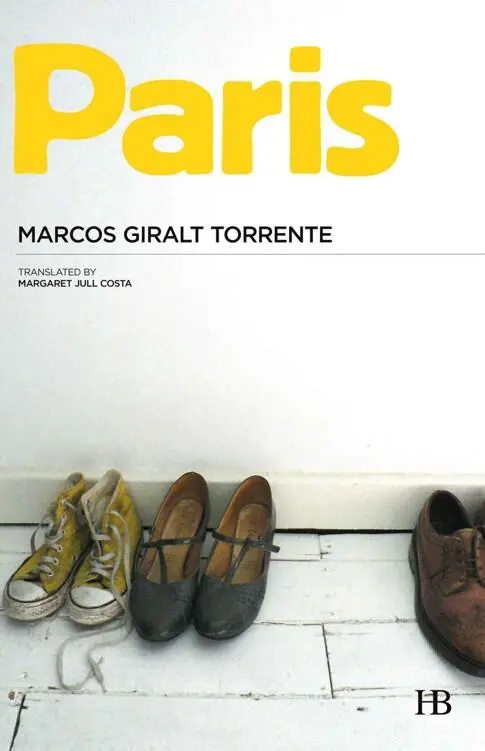
- Название:Paris
- Автор:
- Издательство:Hispabooks
- Жанр:
- Год:2014
- ISBN:9788494228452
- Рейтинг книги:5 / 5. Голосов: 1
-
Избранное:Добавить в избранное
- Отзывы:
-
Ваша оценка:
Paris: краткое содержание, описание и аннотация
Предлагаем к чтению аннотацию, описание, краткое содержание или предисловие (зависит от того, что написал сам автор книги «Paris»). Если вы не нашли необходимую информацию о книге — напишите в комментариях, мы постараемся отыскать её.
Paris — читать онлайн бесплатно полную книгу (весь текст) целиком
Ниже представлен текст книги, разбитый по страницам. Система сохранения места последней прочитанной страницы, позволяет с удобством читать онлайн бесплатно книгу «Paris», без необходимости каждый раз заново искать на чём Вы остановились. Поставьте закладку, и сможете в любой момент перейти на страницу, на которой закончили чтение.
Интервал:
Закладка:
Needless to say, these thoughts emerged fueled by the suspicion and the profound confusion gripping me at the time, and because of that, not all of them were fair or in keeping with my mother’s personality. Now, when so much time has passed, I can imagine her ceding defeat and, in despair at my father’s absence, running off to find him wherever he was, intending to try yet again to bring him back to us. I can imagine her, too, going to rejoin him without any intention of making him come back, knowing that she could never get my father to submit to the kind of life she wanted but nevertheless unable to resist the impulse of her passion. While both possibilities, if true, would somewhat contradict the air of calm prudence she had always tried to project, they do not seem to me completely inconceivable. They would reflect only the part of herself she tried to hide — her fragility and vulnerability. What I find less easy to accept is that she could have been privy to his flight and to any preceding heist or swindle, if there was one. Something like that would be inconsistent with and unrealistic in view of her naturally prudent nature, her attempts to set my father on a path that would lead him away from the dangers that might easily land him back in prison, and equally inconsistent and unrealistic with respect to my father, with his love of secrecy and his determination not to admit his true nature to anyone. After all, even if my mother had known about his plans in advance and, instead of trying to dissuade him, had agreed to them, I doubt he would have admitted to having such plans, much less have allowed her to become part of them. He would have denied them regardless of the evidence stacked against him; he would have said it was a mistake and there was nothing to fear. It would have been quite a different matter, however, if after his abrupt departure, my mother had found out where he was and decided to go in search of him. Her acceptance, in that case, would have been implicit, and he would no longer have had to struggle to maintain an idea of himself that was at odds with reality.
But I only come up with these arguments now that passing time has largely extinguished the doubts I had then, and I certainly wouldn’t claim that they’re incontestable. Whatever the truth, whether I’m right or wrong, one thing is certain: I imagined and thought all kinds of things during those days when my mother continued to say nothing about her furtive meeting with my father and I was caught between conflicting emotions and did and said things that she, not knowing the reason behind my erratic behavior, could not possibly understand but accepted with her usual resignation. I was nervous and irascible. I didn’t know what to do. My mother said nothing about her meeting with my father, and I would explode on the slightest pretext in an attempt to worry her, to trigger a crisis that would force her to explain herself. I spied on her. I went through her pockets. I listened in on her phone conversations and read her letters, hoping to find something that would either sanction or put an end to my fears. I was irritable and touchy. I was deliberately unfair and unpleasant, and while I regretted this, I lacked the necessary will to abandon my corrosive ways. And all the time this was going on and my anxiety was growing, she remained completely oblivious. As I discovered later on, other things were going on inside her head that either prevented her from noticing my nonsensical behavior or else forced her to postpone taking appropriate action.
I did a lot of silly things, but I don’t consider all of them to have been false steps, nor do all of them prick my conscience, although it’s true that none of them makes any sense except in the light of the anxieties eating away at me. I had no one to whom I could confess my thoughts, no one on whom I could offload my concerns, and I felt imprisoned by a renewed feeling of loneliness, not a loneliness filtered through or shared with my mother’s loneliness, but a loneliness of the kind I had experienced on that far-off night when I decided, most uncharacteristically, not to tell her about finding the business cards and the false ID hidden under my father’s table, a sense of being utterly alone in the world — similar to the feeling of desolation I’d sensed in my father on the night I followed him through the deserted streets of Madrid — a loneliness that prevented me from making a decision either to accept my mother’s silence or, on the contrary, to bring it to an end by speaking out and thus forcing her to speak. When my constant vigilance failed to produce the desired effect, I sought refuge in the past and spent hours scouring my memory for forgotten events or events that were simply ambiguous or strange and which I hadn’t known how to interpret when they happened. I thought about the days before and after my father’s departure, I thought about our own early departure for La Coruña, I thought about my mother’s departure for Paris, I thought about the months I had spent living with my aunt and uncle, and I thought, above all, about my mother’s unexpected return. In some way, I was aware that the true origin of my suspicions lay in that sequence of events, in what I had seen and heard and felt while they were happening, in the premeditated way in which my mother delayed telling me of her sudden decision to leave Madrid, in the terse intensity of her letters and phone calls, in her frequent changes of hotel during her time abroad, and the cool reception given her by my uncle. But just as those suspicions had remained dormant and only taken shape as I watched my parents through the café window, none of those past events was enough, when recalled, to transform suspicion into certainty. If they were of any use at all, it was as a reference point, and in that respect, only the frosty way in which my aunt’s husband had greeted my mother on her painful return to La Coruña gave me some room for maneuver. I was beginning to realize that my uncle did not like my father, and if, as I believed, my uncle’s attitude and my mother’s cowed behavior when she returned were due to her having been in Paris with my father, then a phone call to Delfina to tell her that my father was back and that my mother had even agreed to see him again could easily clear up my doubts and encourage her to speak openly to me.
When I think about it now, it seems like a completely crazy idea, and I find it hard to believe that I really thought my aunt would be so disloyal as to tell me about something that my mother had deliberately kept hidden from me. Surely I must have realized that she would probably say nothing — as was, in fact, the case — and, at the earliest opportunity, tell my mother that I had called her. After all, I only ever spoke to her when my mother was there, and I certainly never phoned her on my own account, and although my initial intention was to creep up on the subject and conceal my real reason for phoning by engaging her in a meandering and apparently banal conversation in which I would be content to interpret silences and telltale pauses rather than unearth any absolute certainties, I should have known that Delfina would only have to hear my voice to suspect that something was amiss. However, I would not go so far as to say that, simply because such a danger hung over my decision like a potential threat, phoning my aunt was an oblique way of alerting my mother to my feelings and provoking the longed-for explanation. That might have been my unconscious intention, or, more likely, I was poised between that wish and its opposite extreme — a total disregard, at once proud and troubled, for the consequences of such a gesture.
Anyway, I made the call, and although it’s true that, as I feared, my aunt signally failed to clear up the doubt that had me in its grip, talking to her proved decisive in another sense: it precipitated events and set my mother on the path toward telling me what she had perhaps thought she would never have to tell me. I chose a moment when my mother had gone out to the store, on the Saturday afternoon following the meeting in the café where my unease had first begun. Fortunately, Delfina was at home and was the one who answered the phone. For a few minutes, I could hardly get a word in. When she heard my name, she embarked on a whole litany of trivial questions about my life and school, and not until she had exhausted every topic and given me all the advice she deemed relevant did she fall silent, waiting for me to tell her the reason for my call or put my mother on the phone. Feeling suddenly unable to take the step I had planned, I responded to her silence with more silence, and after a few embarrassing seconds, she went ahead and asked about my mother. I said that she wasn’t at home, and my aunt asked in an alarmed voice, “Why? Has something happened?” I reassured her, telling her that my mother had just gone out to the store and would be back soon, and then, after a further pause, during which I rather regretted having phoned, I blurted out the news of my mother’s meeting with my father in a near-incomprehensible babble, as if by piling word upon word there was a chance she might not understand or notice that this was the real reason for my call. My exact words, spoken with my heart racing, were: “I think my father is in Madrid and that Mom has seen him.” Such was my uncertainty as to the effect my words might have on Delfina that what happened next inevitably took me completely by surprise. My aunt did not wait for this information to sink in before responding. She reacted at once, and instead of putting me off with some vague answer or saying what did it matter if my parents had seen each other, she did nothing to disguise her shock.
Читать дальшеИнтервал:
Закладка:
Похожие книги на «Paris»
Представляем Вашему вниманию похожие книги на «Paris» списком для выбора. Мы отобрали схожую по названию и смыслу литературу в надежде предоставить читателям больше вариантов отыскать новые, интересные, ещё непрочитанные произведения.









Обсуждение, отзывы о книге «Paris» и просто собственные мнения читателей. Оставьте ваши комментарии, напишите, что Вы думаете о произведении, его смысле или главных героях. Укажите что конкретно понравилось, а что нет, и почему Вы так считаете.