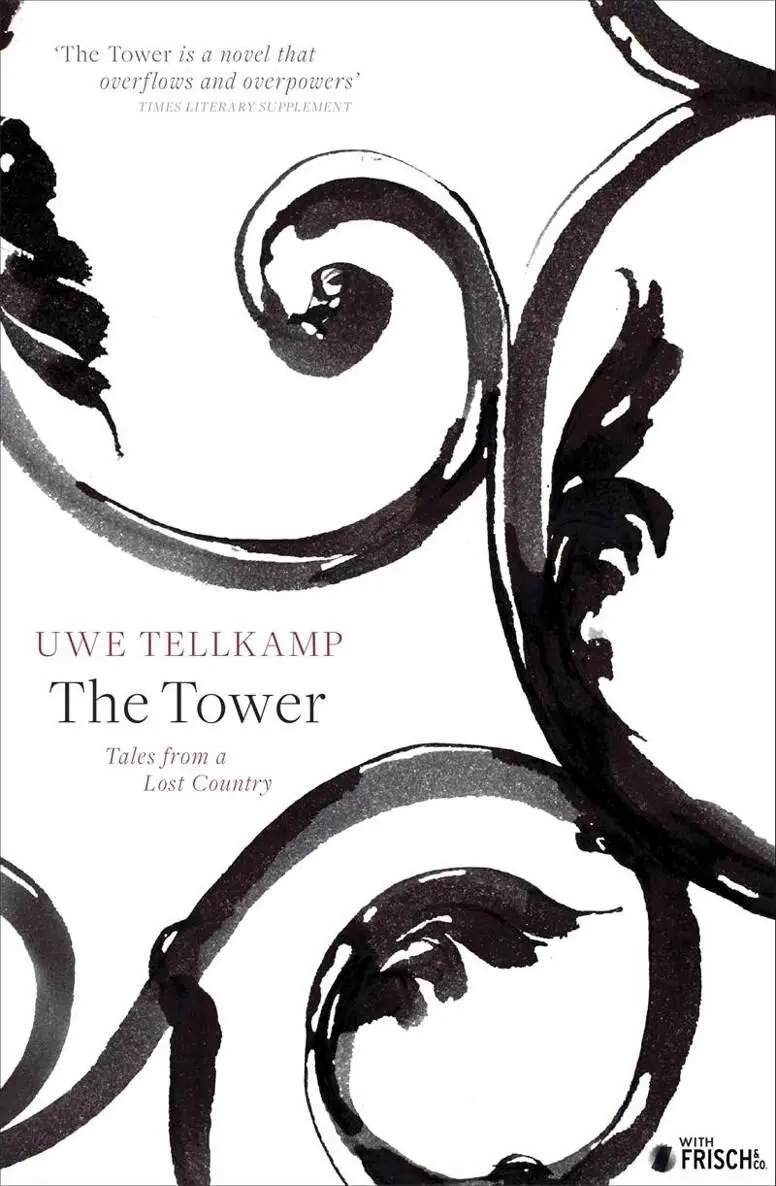
Uwe Tellkamp - The Tower
Здесь есть возможность читать онлайн «Uwe Tellkamp - The Tower» весь текст электронной книги совершенно бесплатно (целиком полную версию без сокращений). В некоторых случаях можно слушать аудио, скачать через торрент в формате fb2 и присутствует краткое содержание. Год выпуска: 2014, Издательство: Penguin, Жанр: Современная проза, на английском языке. Описание произведения, (предисловие) а так же отзывы посетителей доступны на портале библиотеки ЛибКат.
- Название:The Tower
- Автор:
- Издательство:Penguin
- Жанр:
- Год:2014
- ISBN:нет данных
- Рейтинг книги:5 / 5. Голосов: 1
-
Избранное:Добавить в избранное
- Отзывы:
-
Ваша оценка:
The Tower: краткое содержание, описание и аннотация
Предлагаем к чтению аннотацию, описание, краткое содержание или предисловие (зависит от того, что написал сам автор книги «The Tower»). Если вы не нашли необходимую информацию о книге — напишите в комментариях, мы постараемся отыскать её.
The Tower — читать онлайн бесплатно полную книгу (весь текст) целиком
Ниже представлен текст книги, разбитый по страницам. Система сохранения места последней прочитанной страницы, позволяет с удобством читать онлайн бесплатно книгу «The Tower», без необходимости каждый раз заново искать на чём Вы остановились. Поставьте закладку, и сможете в любой момент перейти на страницу, на которой закончили чтение.
Интервал:
Закладка:
‘By the way, I hope the dogs and the alarm system didn’t give you too much of a fright? It’s one of my husband’s passions, you know. He earned the money to set up his first firm by making cameras and alarm systems. The first camera went to me and burnt out, but that was intentional, Ludwig wanted to see me again … He’s so proud of his skill at making things.’ She examined her fingernails, took Meno’s empty glass and placed it beside her own on the tray that the housekeeper had left on the dragon table. ‘Yes, the picture. It’s very old. I brought it with me.’ The frame was square with sides of about six feet. The picture itself was in a circle that touched all four sides of the square but left the four corners free; they were painted over with copper paint and had an inscription with lots of flourishes that Meno couldn’t decipher. In a colonnade with stairs leading up to it, four men in long togas were quietly talking. In the foreground a man was sitting at a microscope; two men in green were standing by a telescope, one pointing up at the sky, the other observing an astrolabe with the seven planets; they looked like fruits ripening on his outstretched hand. A man with white hair was holding a carline thistle. A woman was doing calculations. In a meadow a child was playing; a wolf and a stag were drinking from a spring. A girl was holding a balance, a boy was drawing. Standing in the corner was someone with bad eyes. ‘Do you know what I always think when I see that man?’ The baroness pointed to a man in red with arms outstretched and face raised. ‘That he’s just about to invent the piano. Old Dutch school, that’s all I know; Ludwig says it’s a piece of good painting and I think he’s right, since most people who come to see us are interested in the picture. Fräulein Schevola, however, doesn’t think much of it … Too many old, learned men and if there has to be a woman, then a mathematician … She doesn’t like unjust pictures.’
‘Unjust?’
‘Pictures with totalitarian colours which are so strong that they demand humility and love, as she says. — You know Judith Schevola?’
‘From her books,’ Meno said, avoiding a direct answer.
‘She is a stimulating element in the circle of old debauchees who want to put the world to rights, some of whom you will meet this evening.’ She gave Meno a hard smile. ‘Let’s go. Ludwig would like you to see a few things before the others arrive. Ah, but he can show you them better than I.’ They went to meet Arbogast.
‘Herr Rohde. I’m delighted you’ve come. Please excuse my delay. Is there anything I can do for you? — Did you have some of our pomegranate juice brought out for him?’
‘Of course, Ludwig. — We were just looking at the picture. Herr Rohde was asking who painted it.’
‘You’re keen on painting? Oh, that is a pointless question to someone from Dresdner Edition.’ The Baron let go of Meno’s hand, which he, still standing on the bottom stair on which he was a good two heads higher than Meno, had been giving a weak but unceasing handshake.
‘I’ll go and check the preparations again. I’ll leave you two alone now.’
‘Of course, my jewel.’ Arbogast sketched a bow to his wife. She gave Meno a wink and left.
‘You must forgive my limp handshake, it’s what happens when you put your right hand in the one-million-volt electron-beam of a Van de Graaff generator. Do you know what that is? — Doesn’t matter. It corresponds to the ionizing effect of a hundred-kilogram radium source, which is, of course, purely hypothetical. Marie Curie had one gram at her disposal and for radium that is a considerable amount. So,’ Arbogast said coolly, looking at the blotchy burnt skin of his hand, ‘for the rest of my life as a physicist I’ll know what I’m talking about when I discuss radiation damage. My fingers are still a bit stiff … It’s something of an advantage at tennis. And Trude has never complained. My wife.’ Arbogast looked at the clock. ‘We still have fifty-two minutes and sixteen seconds before the official part of the evening begins. I would very much like to have a chat with you. If you’re agreeable?’ Arbogast spoke with a slightly nasal tone and a hint of a North German accent, which Meno had only just noticed from the way he pronounced the ‘st’ of stiff as ‘s-t’ rather than as the ‘sht’ usual elsewhere.
On the first storey the floor was made of smoothly polished clay-coloured stone with sea snails and ammonites that had been deposited in it; most were the size of a one-mark coin, a few had the diameter of a standard alarm clock, some that of a plate with the compartmentation clearly visible. Noticing Meno’s interest, Arbogast waited at the glass double door that had a proliferation of ferns engraved on it, bizarre plants with something of ice needles about them, very elaborately worked. The door handles were bronze sea horses.
Arbogast led Meno through a room with a conference table, at which Herr Ritschel and a few other white-coated assistants, without looking up, were slowly leafing through periodicals, to his study, quietly waving away Meno’s attempt at a general greeting. His study adjoined the conference room and was very plainly furnished: a large desk with two telephones, two chairs at an obtuse angle to each other, bookshelves that Meno scrutinized with curiosity the moment he went in: novels by Karl May stood beside handbooks of optics, a few Dresdner Edition volumes beside leather-bound annual numbers of physics journals. Meno couldn’t work out the system by which the books were ordered until he noticed that the books on any one shelf were all of the same height.
‘It looks better, I like this order, that might seem barbaric to you but, you know … Let’s sit down. Do you smoke?’
‘Now and then,’ Meno lied, ‘rarely and … not here, Herr Professor.’
‘We can abandon the formalities, Herr Rohde. Feel free as far as smoking is concerned, I’ve breathed in a fair number of substances.’ A thin smile appeared behind his steel-rimmed spectacles. ‘Be my guest.’
From his chair Meno could let his eye roam round the room unobtrusively. He had the impression that Arbogast noticed his curiosity and even approved of it, despite the fact that it wasn’t very polite to have a good look round while they were talking. Meno briefly wondered whether the chairs were deliberately placed at that angle to each other in order to allow guests to look round unobtrusively … At least it didn’t seem to bother Arbogast that Meno took advantage of the opportunity and that his answers were rather monosyllabic. Arbogast talked about Urania and the usual course the evenings took. He had crossed his legs and jiggled his foot in time to his words, and waggled his toes so that the leather of his snakeskin slippers was constantly undulating; in addition, though slightly out of time, Arbogast underlined his words with gestures of his long hands; Meno could see the black scarab slipping up and down on his ring finger. On the wall behind the desk were some framed tables and a coloured representation of the human organs of vision with the eye, suspended from fine ligaments, shown in various sections and perspectives. They were, as far as Meno could tell, physical and mathematical tables, but he couldn’t make head or tail of the one in the middle. Arbogast noticed what he was looking at. ‘That table is, in fact, only related to the others in general terms. I have been keeping it since I was young, since the inflation period, to be precise. On the left are the individuals I have got to know. On the right the amount of money needed to bribe each one.’ The Baron smiled. ‘I was always expensive, you know. Very expensive. To be able to afford that is part of an idea of freedom that is unfortunately misunderstood nowadays. You should tell me where you come some time.’ There was a knock at the door. Herr Ritschel came in. He pushed a cart with rubber tyres across the floor. With a gesture of apology Arbogast stood up, Meno as well, when Ritschel turned his head slowly in his direction. His eye sockets were unusually deep and shadowed, did he have eyes at all …?
Читать дальшеИнтервал:
Закладка:
Похожие книги на «The Tower»
Представляем Вашему вниманию похожие книги на «The Tower» списком для выбора. Мы отобрали схожую по названию и смыслу литературу в надежде предоставить читателям больше вариантов отыскать новые, интересные, ещё непрочитанные произведения.



Обсуждение, отзывы о книге «The Tower» и просто собственные мнения читателей. Оставьте ваши комментарии, напишите, что Вы думаете о произведении, его смысле или главных героях. Укажите что конкретно понравилось, а что нет, и почему Вы так считаете.