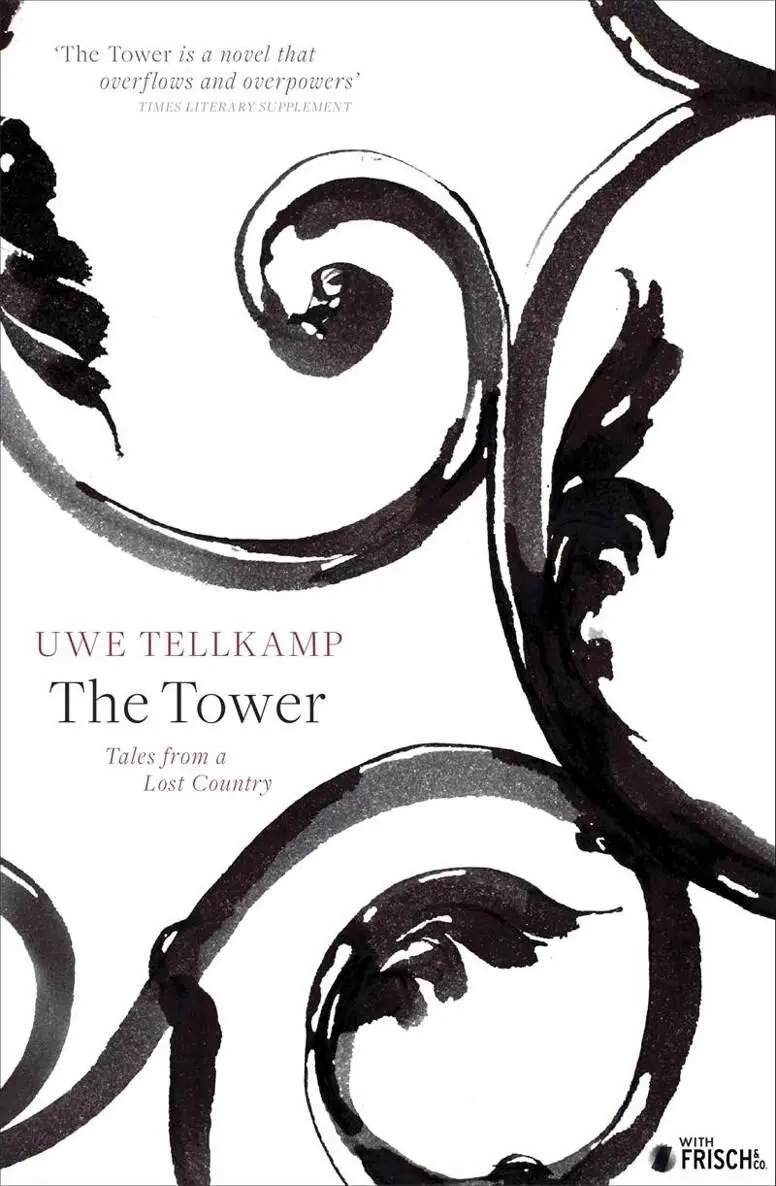
Uwe Tellkamp - The Tower
Здесь есть возможность читать онлайн «Uwe Tellkamp - The Tower» весь текст электронной книги совершенно бесплатно (целиком полную версию без сокращений). В некоторых случаях можно слушать аудио, скачать через торрент в формате fb2 и присутствует краткое содержание. Год выпуска: 2014, Издательство: Penguin, Жанр: Современная проза, на английском языке. Описание произведения, (предисловие) а так же отзывы посетителей доступны на портале библиотеки ЛибКат.
- Название:The Tower
- Автор:
- Издательство:Penguin
- Жанр:
- Год:2014
- ISBN:нет данных
- Рейтинг книги:5 / 5. Голосов: 1
-
Избранное:Добавить в избранное
- Отзывы:
-
Ваша оценка:
The Tower: краткое содержание, описание и аннотация
Предлагаем к чтению аннотацию, описание, краткое содержание или предисловие (зависит от того, что написал сам автор книги «The Tower»). Если вы не нашли необходимую информацию о книге — напишите в комментариях, мы постараемся отыскать её.
The Tower — читать онлайн бесплатно полную книгу (весь текст) целиком
Ниже представлен текст книги, разбитый по страницам. Система сохранения места последней прочитанной страницы, позволяет с удобством читать онлайн бесплатно книгу «The Tower», без необходимости каждый раз заново искать на чём Вы остановились. Поставьте закладку, и сможете в любой момент перейти на страницу, на которой закончили чтение.
Интервал:
Закладка:
‘Thank you, Herr …’
‘Kittwitz. I work at the Institute for Flow Research. And don’t worry, they’ll find you soon enough, Herr Rohde. I enjoyed your talk. The way the garden spider makes its nest — remarkable parallels to the buffet-encirclement behaviour at physics conferences … But I’ll leave you in peace now.’
Rohde went to the edge of the balcony. The cool air did him good, his face was burning and he was glad that Kittwitz’s friendly gesture had enabled him to have a few moments to himself. He was shaken by hot and cold shivers alternately, the excitement was gradually dying down, for a few seconds he was in a state between profound tiredness and cool alertness, like a clock spring, he thought, that is being squeezed tight by the fingers of a clockmaker but can slip out and fly open at any moment; this blasted stage fright, I didn’t speak well. In his mind’s eye he saw the face of his ex-father-in-law, bright, with the expression of concentrated listening that he knew and in which his lower lip drooped and was drawn up with a start at regular intervals, then Londoner became aware that he was being or could be observed; he would grasp his chin between index and middle finger and clear his throat; those nails that were always too long, Meno thought, the thick signet ring — master’s ring, Londoner used to say — like a yellow frog on the bottom joint of his index finger: one of those tropical amphibians with warning colours; but this one seemed to be asleep in a state of metamorphosis, especially when Londoner, as during his talk, let his hand dangle down and crossed his legs, kept his heavy eyelids closed and his nose — Hanna’s nose, too small for his full-fleshed face — became covered in drops of sweat. Arbogast’s introduction; Schiffner’s eyes, unfathomable under his white bushy brows, variable: sometimes cool, sometimes concerned, sometimes with a kind of fatherly benevolence that fascinated and oppressed Meno in equal measure; and Madame — in his thoughts he used that instead of the ‘Fräulein’ that seemed inappropriate — Schevola, cold, head proudly thrown back: Do you think what you have to say is of any interest to me? Get it out of your system, Meno told himself, and that strange television room …
He searched for his cigarettes, Arbogast wouldn’t see that he smoked, but even if he did, he was presumably allowed one now. He hadn’t brought any with him and remembered that he had left the yellow packet of Orient at home, between his typewriter and an issue of Sinn und Form that Schiffner had given him to have a look at. The city lay dark below him, with sparse lights scattered round the edges, Kleinzschachwitz and Pillnitz upstream, above them, near Pappritz, the television tower with faintly phosphorescent antennae; the Elbe water meadows and the hills towards the Czech border mere inky-black surfaces; farther downstream the Johannstadt suburb with its prefabricated tenements; directly below him the continuation of the slope of Arbogast’s garden cocooned in marshy darkness, the Blue Marvel with its filigree double tent stretching so elegantly across the river, a number 4 tram was crossing it, Meno could see the conductor as a patch of shadow in the yellowish light of the carriage. A white smudge was dangling from the power cable over Schillerplatz, a fraying banner hanging down limply like a dead squid preserved in formaldehyde. When there was some movement in the air, bringing back currents of stench, he thought he could smell the decay away over Körnerplatz and the wooded slopes of the district on the edge of which Arbogast’s property stood. It was the smell of ash from the Mitte and Löbtau combined heat and power stations by the Brücke der Jugend, the chimneys of which looked down on the city with red Cyclops eyes. He heard the babble of voices from the conference room, he also had the feeling his name was being called. His tiredness increased, at the same time he felt a strong desire for a cigarette. He watched, saw the Elbe like a spine of tar below him, the houses a gangrenous black, like decomposing flesh, shimmering movements in it, as if gleaming white trichinae had bored into the rotting stone flesh, ready to lay their eggs. There was a play of searchlight beams on the Käthe-Kollwitz-Ufer, fleecy arms of light feeling their way, with the movements of helpless swimmers, over the dark-lying cellular systems of the buildings in the sector of the workers’ housing cooperative; sometimes they were struck, as if by an indignant, hostile glance, by the gleam of a distant window, so there must still be life there. What kind of life, Meno wondered, what is life like down there? A ship with an orchestra on board could run aground, the cracks of light along the curtains wouldn’t get any wider. The Blue Miracle was deserted, only the Schillergarten restaurant on the opposite bank of the Elbe seemed to still be open. There, too, the curtains were drawn but a door opened now and then and a customer staggered out into the fresh air, either to go off in the direction of the bus stops on Schillerplatz or to disappear behind the restaurant. It was not the only such establishment to have problems with the sewerage system, Meno remembered the Bodega in Leipzig, a favourite meeting place during the book fair that possessed no conveniences, one had to use the back yard there as well … Now the Elbe was a bluish shade, then sea creatures seemed to crawl past, milky, misshapen beings made to look leprous by the water. The stench came, rolled up the slopes, Meno knew it from his tongue, it was the taste of a match that has been chewed too long, to which something like a dash of sauerkraut was added: the effluent from the Heidenau cellulose works that was let out into the water at night.
‘Do you smoke? There’s a hell of a stink again.’ Judith Schevola tapped a few cigarettes out of a Duett packet and offered them to Meno when he nodded. ‘Impressive the way you described the ways these venomous tropical spiders have of killing. I must read that again later. I bought your Old German Poems . The Old Man of the Mountain spoke to me about it just now. I think he has a pretty high regard for you. Although immediately afterwards he told me you’d rejected one of his projects.’
‘That wasn’t me, that was the publishing section in the Ministry. I hope he told you that as well.’
‘I understand. How stupid. I’ve no matches on me.’ Schevola went through her pockets, the cigarette stuck between her lips.
‘Just a minute.’ Meno lit a match. She bent over his hand that was shielding the flame. He lit one for himself as well, took a deep pull, blew out the smoke with relish. ‘Oh, wonderful. Thanks. I left mine at home.’
‘I hope you like it. What do you usually smoke, when your memory doesn’t fail you?’
‘A pipe. Orient when I’m outside.’
‘My grandfather used to smoke a pipe … I’ve always liked the smell. — In the afterword to your book you twice omitted the subjunctive; as far as I know “as if” is followed by the past subjunctive so you should have written “as if it were” and “as if it were to start”.’
‘Oh dear.’
‘Yes,’ Schevola said cheerfully, ‘it was a pleasure to pick out those mistakes after you pointed out that kind of nonsense in my first manuscript that I sent to Dresdner Edition. You rejected it because of those minor slips!’
‘Just a minute, that must be a mistake.’
‘But your name was the one at the bottom of the letter of rejection.’
‘Oh, I see. That does happen. Let me explain. We have pre-printed letters we sometimes have to use for that kind of communication because we’re short of normal writing paper. It can then happen that someone will sign without correcting the name on the pre-printed letter. In your case it was probably Herr Redlich, our senior editor.’
Читать дальшеИнтервал:
Закладка:
Похожие книги на «The Tower»
Представляем Вашему вниманию похожие книги на «The Tower» списком для выбора. Мы отобрали схожую по названию и смыслу литературу в надежде предоставить читателям больше вариантов отыскать новые, интересные, ещё непрочитанные произведения.


Обсуждение, отзывы о книге «The Tower» и просто собственные мнения читателей. Оставьте ваши комментарии, напишите, что Вы думаете о произведении, его смысле или главных героях. Укажите что конкретно понравилось, а что нет, и почему Вы так считаете.