Jonathan Levi - Septimania
Здесь есть возможность читать онлайн «Jonathan Levi - Septimania» весь текст электронной книги совершенно бесплатно (целиком полную версию без сокращений). В некоторых случаях можно слушать аудио, скачать через торрент в формате fb2 и присутствует краткое содержание. Год выпуска: 2016, Издательство: The Overlook Press, Жанр: Современная проза, на английском языке. Описание произведения, (предисловие) а так же отзывы посетителей доступны на портале библиотеки ЛибКат.
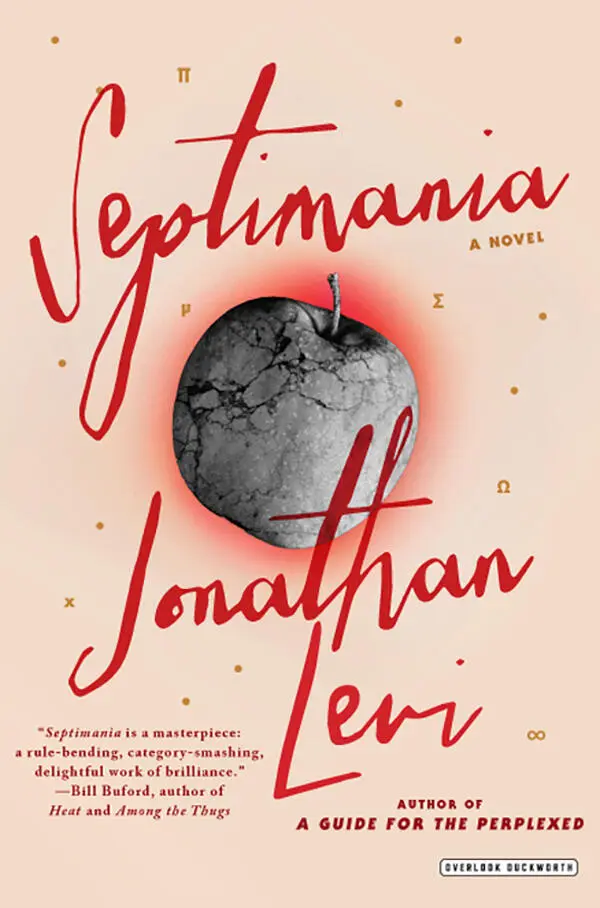
- Название:Septimania
- Автор:
- Издательство:The Overlook Press
- Жанр:
- Год:2016
- ISBN:нет данных
- Рейтинг книги:4 / 5. Голосов: 1
-
Избранное:Добавить в избранное
- Отзывы:
-
Ваша оценка:
Septimania: краткое содержание, описание и аннотация
Предлагаем к чтению аннотацию, описание, краткое содержание или предисловие (зависит от того, что написал сам автор книги «Septimania»). Если вы не нашли необходимую информацию о книге — напишите в комментариях, мы постараемся отыскать её.
Over the next fifty years, Malory’s search for Louiza leads to encounters with Pope John Paul II, a band of lost Romanians, a magical Bernini statue, Haroun al Rashid of Arabian Nights fame, an elephant that changes color, a shadowy U.S. spy agency and one of the 9/11 bombers, an appleseed from the original Tree of Knowledge, and the secret history of Isaac Newton and his discovery of a Grand Unified Theory that explains everything. It is the quest of a Candide for love and knowledge, and the ultimate discovery that they may be unified after all.
Septimania — читать онлайн бесплатно полную книгу (весь текст) целиком
Ниже представлен текст книги, разбитый по страницам. Система сохранения места последней прочитанной страницы, позволяет с удобством читать онлайн бесплатно книгу «Septimania», без необходимости каждый раз заново искать на чём Вы остановились. Поставьте закладку, и сможете в любой момент перейти на страницу, на которой закончили чтение.
Интервал:
Закладка:
2/6
 HE MORNING OF MY TENTH BIRTHDAY — OR AT LEAST ON THE morning of the tenth anniversary of my arrival at the baby hatch of Santa Sabina — Sister Francesca Splendida asked me if I wanted to be an angel.”
A girl. A girl stood beside the Bernini statue, speaking to Malory.
He had awakened to a brilliant late-summer morning. He had walked, as he had for more than twenty years of mornings, down the corridor, through the foyer, and into the dining room for his scones and tea, and had discovered Settimio and the girl beside the apple tossers.
“I found her in the Sanctum Sanctorum,” Settimio said, “half an hour ago, asleep on the desk. When she opened her eyes, she asked for you.”
The girl was even smaller than him, hair cropped in a golden helmet, almost as young as Louiza, or as young as Louiza had been twenty-three years before. Jeans, leather jacket over a white T-shirt, blue trainers — she must have been like many other girls on the streets of Rome. But Malory had met very few girls in recent years. In fact, none.
“Tibor said, ‘Malory will understand.’” The girl spoke English. But the words buckled Malory’s knees. He sat. The girl sat across from him. Settimio brought a cup and a plate. The girl continued her story.
A FAMOUS THEATER DIRECTOR WAS COMING TO ROME FROM AMERICA to stage a tenth birthday of his own — a revival of the Divine Comedy that had catapulted him to fame. He needed young things — a dozen young things — to play angels. For us damaged girls from Santa Sabina, Santa Chiara, Santa Cecilia, and elsewhere, it was a chance to run around the Circo Massimo dressed in something other than our daily uniform. And run around most of us did. I, alone among the dozen, followed directions. It was what I had been trained to do for as long as I could remember. And because I was so good at following directions and knowing where and when to go, at the end of the week Tibor and Cristina took me for a gelato in Testaccio.
They asked me questions — about my family, which I didn’t know, about my schoolwork. They were impressed by my Italian and my Latin, my history and my geography. Most of all they were impressed by my mathematical ability, which had already outstripped what the Dominican Sisters were able to teach in Santa Sabina.
When the Dante was over and the rest of the girls went back to the convent, Sister Francesca Splendida took me aside and told me I was being sent to a school in Switzerland. It wasn’t until I turned thirteen in a girls’ grammar outside Lucerne that I saw Tibor and Cristina again and realized — even if they didn’t say so explicitly — that they had been paying for my education and my escape from Santa Sabina. I thought Cristina was the most beautiful woman I had ever seen, a real princess — I believed it when I heard Tibor order “ thé au citron for La Principessa ”—so I allowed each of them to take one of my hands and lead me down to the Lake of Lucerne, buy me a stuffed zebra, feed me a cream bun as if I were Paddington Bear and deposit me back at the school before supper. Later, at the English school above Nice, Tibor and Cristina came to visit every year on Family Day when no other family came for me. And even at the A-Level crammer outside Inverness, where my only friend was a flannel-covered hot-water bottle, I answered Cristina’s questions about my knowledge and Tibor’s about my dreams without asking why and kept a secret scrapbook with reviews and photos of all of Tibor’s productions in the bottom of a steamer trunk. “Cope-able,” was what one headmistress called me; I can’t remember if she was Swiss, French, or Scots — the word existed in none of the languages. “Ottavia is able to cope,” she wrote, “with anything.”
It wasn’t until I was on the cusp of graduating from Trinity that Rix the Porter rang up to say that a Miss Cristina was calling for me at the lodge. I was a week away from receiving my degree so hadn’t expected a visit. And it was immediately clear that there was something improvised about Cristina’s appearance. She was in a taxi. She needed to talk with me. She had been crying.
I suggested the Orchard, just a few miles outside of town, where I used to go when I was in search of a quiet place to contemplate Fourier Series and Eigenvectors. The next week it would be full of proud parents and cream teas and jam-sotted bees. But Cristina and I had no trouble finding a trestle table in a quiet corner of apple trees with the church rising up on the other side of the road.
“Ottavia,” Cristina began, dark glasses still firmly in place over the gray eyes that had first seduced me into a schoolgirl crush twelve years before. “You are old enough now that I think it is time to tell you a few things.”
My scrapbook of clippings memorializing Tibor’s successes also included photo features on Cristina. From the moment she strolled out of the maternity ward of Fatebenefratelli on that astonishing October evening in 1978, Cristina had found herself surrounded by a magnetic field that didn’t so much open doors for her as blow them off their hinges. A job scrubbing floors for a Reuters functionary at the Vatican led to an invitation to be a sound editor in New York and a pair of green cards for her and Tibor. Within a year she was reporting traffic on the radio. Within two, isobars and satellite radar on the Today Show . As tanks rolled through Tiananmen Square and heads rolled over six of the seven continents, no palace leader or rainforest revolutionary was safe from the charms of Cristina. Here was one page from Time, Cristina at the siege of Sarajevo, here in a firefight in Hebron. There were stories from Darfur, New Orleans, Nagorno-Karabakh, Praia da Luz, Casale, Gori, Wasilla, Garoowe where, for ten days that she would be happy to forget, she was the property of the Somali warlord Jama Abduk Boosaaso. Not to mention the dinners and interviews with Clinton, Blair, Havel, Prince Bandar, and Bishop Tutu. Cristina didn’t stop long enough to count, but her producers told her that she had filed more stories and won more Peabodys than Christiane Amanpour by a factor of three, not to mention a Pulitzer. And even now that she was approaching the age when correspondents with creaking knees and spreading posteriors were shunted behind studio desks in New York or London or Atlanta, Cristina not only remained in the field, but consistently placed in the Top Ten Sexiest Woman on TV. And not in the Grandma Class. Top Ten. Punto.
“Why did I come today to talk to you?” Cristina asked. She hadn’t touched her tea, nor removed her glasses. Leaning back, her helmet of gray hair lying just past her ears against the canvas of the lawn chair, black linen blouse without sleeves, black linen trousers without calves, and toenails that needed no paint shining out from within her espadrilles, she seemed like a runway astronaut about to eject into the ether. “Because I may be your mother. And a mother’s duty is to warn her daughter.”
Even though mathematics was my strongest suit, I had, of course, created plenty of fantasies featuring Cristina and Tibor as my parents, although we couldn’t have looked less alike. Where Cristina and Tibor were tall, I barely broke five feet and struggled to get my weight up to a hundred pounds. There had been a time in my first year at Cambridge when I brought cutouts of Cristina’s head from People and Time to Cropper’s across from the Trinity gate and asked the hairdresser to perform the impossible with my thin, disembodied hair. I tried to smoke, since I never saw either of them without a cigarette, but found it easier to imitate Cristina’s preference for thé au citron. I had no desire to become a director like Tibor or an investigative journalist like Cristina. But they had clearly spent a lifetime coping with one thing or another. And maybe, just maybe, they were the biological origin of what the headmistress had called my copeability.
Читать дальшеИнтервал:
Закладка:
Похожие книги на «Septimania»
Представляем Вашему вниманию похожие книги на «Septimania» списком для выбора. Мы отобрали схожую по названию и смыслу литературу в надежде предоставить читателям больше вариантов отыскать новые, интересные, ещё непрочитанные произведения.











Обсуждение, отзывы о книге «Septimania» и просто собственные мнения читателей. Оставьте ваши комментарии, напишите, что Вы думаете о произведении, его смысле или главных героях. Укажите что конкретно понравилось, а что нет, и почему Вы так считаете.