Jonathan Levi - Septimania
Здесь есть возможность читать онлайн «Jonathan Levi - Septimania» весь текст электронной книги совершенно бесплатно (целиком полную версию без сокращений). В некоторых случаях можно слушать аудио, скачать через торрент в формате fb2 и присутствует краткое содержание. Год выпуска: 2016, Издательство: The Overlook Press, Жанр: Современная проза, на английском языке. Описание произведения, (предисловие) а так же отзывы посетителей доступны на портале библиотеки ЛибКат.
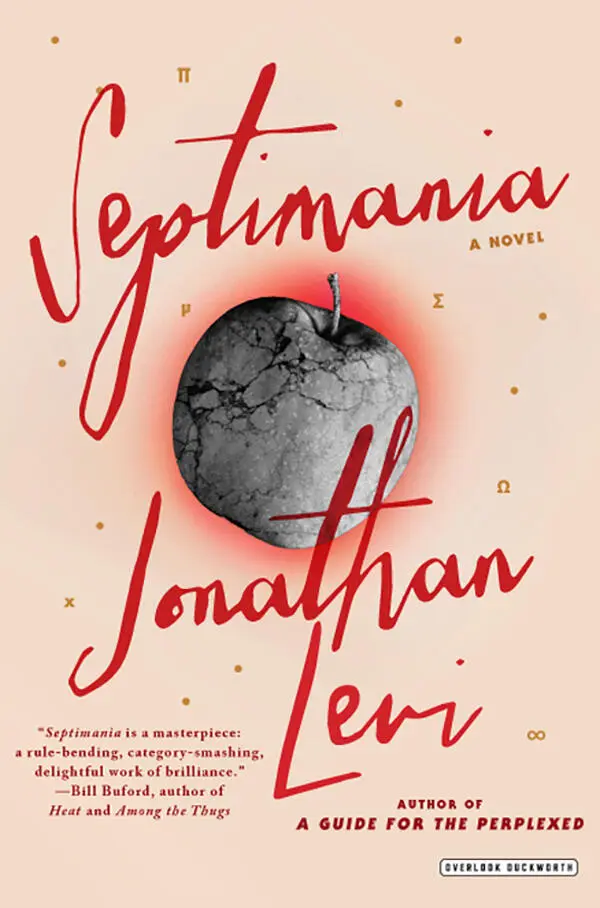
- Название:Septimania
- Автор:
- Издательство:The Overlook Press
- Жанр:
- Год:2016
- ISBN:нет данных
- Рейтинг книги:4 / 5. Голосов: 1
-
Избранное:Добавить в избранное
- Отзывы:
-
Ваша оценка:
Septimania: краткое содержание, описание и аннотация
Предлагаем к чтению аннотацию, описание, краткое содержание или предисловие (зависит от того, что написал сам автор книги «Septimania»). Если вы не нашли необходимую информацию о книге — напишите в комментариях, мы постараемся отыскать её.
Over the next fifty years, Malory’s search for Louiza leads to encounters with Pope John Paul II, a band of lost Romanians, a magical Bernini statue, Haroun al Rashid of Arabian Nights fame, an elephant that changes color, a shadowy U.S. spy agency and one of the 9/11 bombers, an appleseed from the original Tree of Knowledge, and the secret history of Isaac Newton and his discovery of a Grand Unified Theory that explains everything. It is the quest of a Candide for love and knowledge, and the ultimate discovery that they may be unified after all.
Septimania — читать онлайн бесплатно полную книгу (весь текст) целиком
Ниже представлен текст книги, разбитый по страницам. Система сохранения места последней прочитанной страницы, позволяет с удобством читать онлайн бесплатно книгу «Septimania», без необходимости каждый раз заново искать на чём Вы остановились. Поставьте закладку, и сможете в любой момент перейти на страницу, на которой закончили чтение.
Интервал:
Закладка:
“You are wondering,” Isaac asked, “if the Sympathy is strong enough, what is stopping a man from sculpting an apple suspended in mid-air?”
“Suspended between the tree and the outstretched hand,” I answered. “Yes.”
“I prithee,” he said. “Let’s talk of Nature and not wax mystical.”
“I live in a world of mystery,” I replied. “Every discovery I make leads irrevocably to another mystery.”
“One does well, therefore,” Isaac said, “to choose one’s mysteries with care.”
“Do we choose our mysteries?”
“Perhaps they choose us.” Isaac sat down next to me on the bench, his nightshirt hiked up to expose one pale, chilblained knee. “I was born on a Christmas morning …”
“You’ve told me the story many times.” It was my turn to interrupt. “Methinks it is you who is waxing mystical.”
“Perhaps these questions of Sympathy are best left to chance.”
And at that moment, I reached down, past the exposed knee and between the legs of my giant and felt Isaac rising against the pull of nature, a force that had more to do with the attraction of two bodies than the force of gravity, an obelisk rising away from knowledge. He groaned, I am forced to say, and his great eyebrows relaxed until his face took on the look of that tiny Christmas-born babe too small to fit in a pint pot.
And it was then that his own hands made an equal and opposite reaction. His hands, the hands of my Isaac, slipped down between my legs and began a search, first up, then down. A search for something that reason told him should be there, but experiment proved was not. And since our experiment was too far advanced to admit retreat, I removed my trousers, showing him that not finding the expected is sometimes the greatest triumph of Science. In recompense, I then undid my blouse, removed the pins from the bandage around my breasts and let loose the abundant secret that only Settimio and now Isaac knew — that I am as much a nymph as Bernini’s Daphne. I am a woman: not the King but fully the Queen of Septimania. And since the rules that guide the attraction of two bodies are absolute, there was no stopping the congress that had been guiding me in blindness since I first set foot for Cambridge and Woolsthorpe.
And, as many as the fireflies a peasant sees on a summer’s evening, so many were the Pips that rushed into me from my apple tree love in unimaginable multiplication.
Malory set the Chapbook down on his lap. He looked out into the cortile , full now with the casualties of Christmas night. But what he saw was the statue in the dining room of the Villa Septimania of Newton and the woman and the apple. The Queen of Septimania. Newton’s friend was not the King but the Queen of Septimania in disguise. If I am descended from this Queen of Septimania, Malory thought, then I am descended from — is it possible? — from the other statue as well. I am the grandson of the man born 309 years to the day before me. I am of the seed of Newton.
Malory thought about Newton and his Queen. He thought about the red-haired Aldana. But he also thought about another red-haired woman. He thought about her faith in him, her devotion, her arm locked in his, her zabaione lips. Perhaps Antonella had been in disguise all this time, in front of his eyes. Perhaps it was time to search no more. Like the Queen of Septimania with her Newton, Malory had to take action if Septimania were to survive.
Malory walked out the front door of Fatebenefratelli without a glance up to the room where he had last seen Louiza. Night was fully advanced, the new day just clearing its throat at the horizon. He crossed the river at the Ponte Cestio and hugged the still-dark parapet of the river. As he descended the steps to Regina Coeli, the yellow walls of the prison were just beginning to catch the morning light. He turned down the Via della Penitenza and saw Cristina, La Principessa , her hair wrapped up in a kerchief, gliding towards the bus stop, on her way to the first of her three jobs — mopping up the butt ends of Christmas 1978. He opened the gate to the Dacia quietly. The courtyard, the broken-down Dacia were both empty. He walked through the front door into the living room. There was a body on each of the sofas, another curled up in front of the fireplace. None of them was Antonella. Malory climbed the stairs to the two bedrooms.
He was the great-grandson to the power of seven of Isaac Newton. He was not only King of the Jews and King of the Christians but a direct descendant of the King of Science.
And yet, as Tibor had warned him, he was also a Holy Roman Fool.
He hadn’t meant to open any box, but the box was there, open to him, open to the world at the end of the corridor. In the sleepless dawn, at first Malory thought that he had found Tibor and Antonella deep in conversation about the glorious new future of their friend Malory — a new future, if he could admit the possibility, of a Roman Empire of Malory and Antonella, Tibor and Cristina.
But the cold light of morning broke the scene into other motion. The curls above were red, the tangled mat of hair and beard below was black. Together they moved with a frantic rhythm in the key of F-sharp that shook Malory and stopped his breath. Tibor had kept his promise. He had guided Malory into the depths of Hell.
Malory turned. He may have been King of Septimania, but he was no King Shahryar. He would not hack Tibor and Antonella in two. He would not vent his wrath on a host of virgins. Malory simply turned, turned downstairs, turned back across the river, up the Clivo, back into the Villa Septimania. And like Haroun al Rashid, like the djinns of a thousand and one other deceived cats and credulous fools, Malory climbed down the spout of his lamp, climbed back into his box, and pulled the top closed.
2/5
 KNOCK.
Louiza opened her eyes.
A tree.
Louiza closed her eyes.
A knock.
Open again, a tree. A tree inside, a single pine tree standing inside a house. Above, a ceiling painted white, planks crisscrossed by whitewashed beams. One cobweb, another. A long thread of dust bobbing in the breath of the room, although it could have been just another cobweb, abandoned.
Louiza turned her head.
The back of a sofa. Soft, smelling of dust and sun. A yellow cushion embraced by passionflowers, faded, all faded.
A knock.
She turned towards the sound. A wood fire, fresh, three logs propped up like Guy Fawkes. The tree, a smell of pine.
A third knock, not the fire. Louiza sat up.
She was in a dining room — at least, there was a round table covered by a lace cloth, half a dozen willow library chairs, an open folder, sheets of paper, a pencil. Next to the table in a bay window shielded by lace curtains, a piano, a small piano. More lace on the piano, and resting on the lace a vase. Flowers. The sofa, the sofa she was sitting on, had yellow cushions. Passionflowers. The fire. Above the fire, a mantle. Marble. A pair of crystal candlesticks, old. Two plaster busts, small. On the wall above, a portrait. A man, a man from long ago, looking down on her. Not unkind.
She had no idea where she was. She had no idea why there was a pine tree inside the house. She knew something was missing.
“Lou! Lou, honey!” Three knocks. Outside. There must be a door.
Louiza stood. The heat of the fire nudged her back in the direction of the knock. She walked towards the sound, out of the dining room and into the hall. She turned the doorknob.
A man.
“Lou! Honey! Were you sleeping?”
Читать дальшеИнтервал:
Закладка:
Похожие книги на «Septimania»
Представляем Вашему вниманию похожие книги на «Septimania» списком для выбора. Мы отобрали схожую по названию и смыслу литературу в надежде предоставить читателям больше вариантов отыскать новые, интересные, ещё непрочитанные произведения.










Обсуждение, отзывы о книге «Septimania» и просто собственные мнения читателей. Оставьте ваши комментарии, напишите, что Вы думаете о произведении, его смысле или главных героях. Укажите что конкретно понравилось, а что нет, и почему Вы так считаете.