Jonathan Levi - Septimania
Здесь есть возможность читать онлайн «Jonathan Levi - Septimania» весь текст электронной книги совершенно бесплатно (целиком полную версию без сокращений). В некоторых случаях можно слушать аудио, скачать через торрент в формате fb2 и присутствует краткое содержание. Год выпуска: 2016, Издательство: The Overlook Press, Жанр: Современная проза, на английском языке. Описание произведения, (предисловие) а так же отзывы посетителей доступны на портале библиотеки ЛибКат.
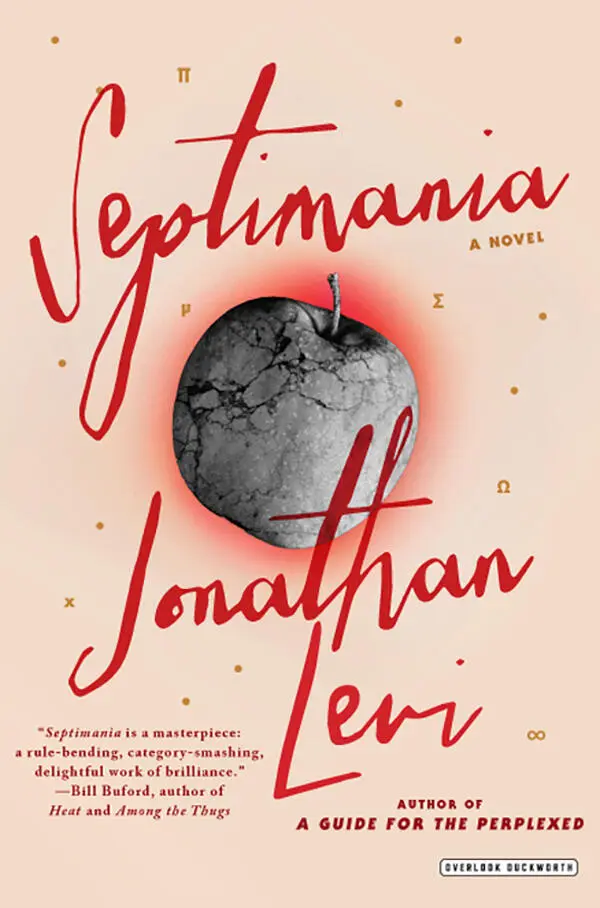
- Название:Septimania
- Автор:
- Издательство:The Overlook Press
- Жанр:
- Год:2016
- ISBN:нет данных
- Рейтинг книги:4 / 5. Голосов: 1
-
Избранное:Добавить в избранное
- Отзывы:
-
Ваша оценка:
Septimania: краткое содержание, описание и аннотация
Предлагаем к чтению аннотацию, описание, краткое содержание или предисловие (зависит от того, что написал сам автор книги «Septimania»). Если вы не нашли необходимую информацию о книге — напишите в комментариях, мы постараемся отыскать её.
Over the next fifty years, Malory’s search for Louiza leads to encounters with Pope John Paul II, a band of lost Romanians, a magical Bernini statue, Haroun al Rashid of Arabian Nights fame, an elephant that changes color, a shadowy U.S. spy agency and one of the 9/11 bombers, an appleseed from the original Tree of Knowledge, and the secret history of Isaac Newton and his discovery of a Grand Unified Theory that explains everything. It is the quest of a Candide for love and knowledge, and the ultimate discovery that they may be unified after all.
Septimania — читать онлайн бесплатно полную книгу (весь текст) целиком
Ниже представлен текст книги, разбитый по страницам. Система сохранения места последней прочитанной страницы, позволяет с удобством читать онлайн бесплатно книгу «Septimania», без необходимости каждый раз заново искать на чём Вы остановились. Поставьте закладку, и сможете в любой момент перейти на страницу, на которой закончили чтение.
Интервал:
Закладка:
Radu took off his glasses and wiped them on a pocket of his anorak. “I can’t believe Tibor didn’t tell you,” he mumbled into the pitted asphalt at his feet.
“Tell me what? Where is she? How is she? Is she okay? And the baby?”
“We didn’t find her,” Radu said.
“Oh,” Malory said. Okay, he thought. The usual daily regret. A little more disappointment than usual. “But you will keep looking?”
“No,” Radu said, “we won’t.”
“What do you mean?”
“She isn’t here. Not in Rome, not in Italy, not in Europe.”
“You know?”
“We know.”
“Then where?” Malory was shaking Radu again. The sun was fully risen on the waters of the Tevere. The river was moving fast, swollen with the flood.
Radu shrugged. “The Bomb Squad has failed.”
“But,” Malory said.
“It is the first time. I’m sorry.”
Malory’s hand slid from Radu’s shoulder.
“You better come talk to Tibor. At the party.”
Malory stared out at the water.
“Let’s go.” Radu took Malory’s elbow. But Malory had turned into a stone as rigid as the statue of Newton. He felt Radu try. He felt Radu give up and leave. He felt the eddies of the crowd from St. Peter’s part around him as they headed home for Christmas lunch. When he finally began to move again, it was without compass or sense of propulsion, but only with the force of his pain now that the sedative on his lips had worn off. It drew him downriver, past the steps to Regina Coeli and the Dacia. It drew him across the Ponte Cestio to the Isola Tiberina, to the mini Albert Memorial with the Ospedale Israelite on his right and the Ospedale Fatebenefratelli on his left. The tide pulled him portside into the cortile, the cortile he had crossed countless times, where Tibor had smoked and waited for Cristina. It was there that gravity proved stronger than pain and Malory sat down on a bench, all hope abandoned.
There was a sound at his feet. Malory looked. A bag. From Heffers in Cambridge. He picked up the bag, looked inside. A binder. The binder, heavy and black, that he had been carrying all night — Antonella’s translation of the Newton Chapbook. It had become such a part of Malory as he followed Tibor’s production for eighteen hours that he had completely forgotten its existence.
Malory opened the cover where it lay by his feet in the cortile. One tree, one garden , he read again. He read to the bottom of the first page. And then the second. By the tenth page, he had picked up the binder and settled himself onto the bench. Noon passed. Malory read on. Oblivious to noise, oblivious to tranquility, Malory read the account of Newton’s friend. He read of the travels of the pair from Cambridge to Rome, their meetings with Leibniz and a variety of princesses and abbesses.
As he read, it became clear to him that Newton’s friend was not only aware of Septimania, but was himself the King. This was the journal of the King of Septimania, circa 1666, a man who had disguised himself as a student — the way Haroun had disguised himself as his own envoy — in order to travel to Cambridge to study. There he had met Newton, recognized his intellect, and encouraged him to travel abroad during the forced sabbatical of 1666. The Chapbook that his grandmother had given him in St. George’s, Whistler Abbey, Malory realized, was written by one of his own ancestors, someone close enough to his Sir Isaac that Newton had felt comfortable enough to scrawl a discovery — perhaps the most important discovery in the history of science — in a margin. Antonella might be waiting for him at the party in the Dacia, but Malory had to read — it was her translation, after all.
Malory read. He read of Newton’s arrival in Rome, his visit to the Church of Santa Maria sopra Minerva, his introduction to the sculptor Gian Lorenzo Bernini. As he read, he turned back and forth, searching within the daily notes for the identity of the woman in the Bernini sculpture with the floating apple. Was it the sister of the King of Septimania, his mother perhaps, a daughter of the Settimio of the time?
And then the truth walked out of the smoke, like a djinni from a Baghdadi lamp.
“Here are the facts,” the King wrote one late night. And Malory read on:
Here are the facts, presented with a desire to bring Reason to a human act, far from cold marble.
We returned from our visit with Bernini and took our supper without conversation. Isaac repaired to his room and I to mine. My custom was to bathe and be in bed by midnight. But this evening, I sent Settimio away and took myself into the Sanctum Sanctorum, where the silence of my books, the books of Septimania, might give my mind the tranquility to listen to the beating of my heart.
And so it was in the deepest hours of the night — the clock had struck three times but I was so entwined with the words on the page that I literally defied Gravity — that I felt Isaac’s hand on my shoulder. I had left the door ajar from the vestibule down the passage to the Sanctum Sanctorum, thinking none would enter but — I ask my older self — was I not nurturing an unconscious hope?
“You have kept a secret,” Isaac said to me, looking around the room in admiration. He was wearing only a nightshirt. His feet were bare.
“There are secrets I must keep,” I said. “It is part of my duty to Septimania.”
“This room,” he began.
“I can tell you a few things about this room,” I said softly. “It contains seven catalogues. Grammar, Rhetoric, Logic, Arithmetic, Geometry, Music, Astronomy. Each contains seven drawers. Each drawer in turn is divided into seven sections. Each catalogue leads to a separate library, entered through one of the seven doors, although many of the volumes are not here within this building — don’t ask me, please, I am not at liberty to tell you where. But make no mistake,” I added quickly. “There is no special meaning to the number seven. None, at least, that I have uncovered.”
“These books”—Isaac motioned to a stack upon a leather desk.
“Have only just arrived,” I said. “It is part of Settimio’s employ to assist me with the catalogue, although he has trusted minions to do the actual labor.”
“ Artephius His Secret Book ,” Isaac read. “ The Epistle of John Pontanus, Nicholas Flamel, his Exposition of the Hieroglyphical Figures which he caused to be painted upon an Arch in St Innocents Churchyard in Paris. Containing both the Theoricke and the Practicke of the Philosophers Stone, Lazarus Zetzner’s Theatrum Chemicum . Are you searching,” Isaac asked me, “in earnest through these books for a recipe for the Philosopher’s Stone?”
“Ah,” I said. “I have been pondering the properties of stone, following this afternoon’s visit to Bernini. His Apollo and Daphne. That moment when the nymph turned to laurel just as the god was about to capture her, her feet taking root, branches sprouting around her girdle, fingers blossoming into leaf.”
“I too was thinking of Bernini,” said Isaac.
“You spoke this afternoon of the attraction of two bodies at a distance. What the Stoics called Sympathy. I wonder,” I continued, “whether Bernini could sculpt another particular moment. A moment of three bodies. The moment when the attraction of the apple to the scientist, or the desire of the scientist for wisdom, proves greater than the power of the tree over its fruit. Surely,” I added, as Isaac’s eyebrows rose on his forehead, “if the Earth can remain suspended above the Sun, and the Moon can remain suspended above the Earth, and the Comets above all else, an apple and a genius can pull off the trick.”
Читать дальшеИнтервал:
Закладка:
Похожие книги на «Septimania»
Представляем Вашему вниманию похожие книги на «Septimania» списком для выбора. Мы отобрали схожую по названию и смыслу литературу в надежде предоставить читателям больше вариантов отыскать новые, интересные, ещё непрочитанные произведения.











Обсуждение, отзывы о книге «Septimania» и просто собственные мнения читателей. Оставьте ваши комментарии, напишите, что Вы думаете о произведении, его смысле или главных героях. Укажите что конкретно понравилось, а что нет, и почему Вы так считаете.