Jonathan Levi - Septimania
Здесь есть возможность читать онлайн «Jonathan Levi - Septimania» весь текст электронной книги совершенно бесплатно (целиком полную версию без сокращений). В некоторых случаях можно слушать аудио, скачать через торрент в формате fb2 и присутствует краткое содержание. Год выпуска: 2016, Издательство: The Overlook Press, Жанр: Современная проза, на английском языке. Описание произведения, (предисловие) а так же отзывы посетителей доступны на портале библиотеки ЛибКат.
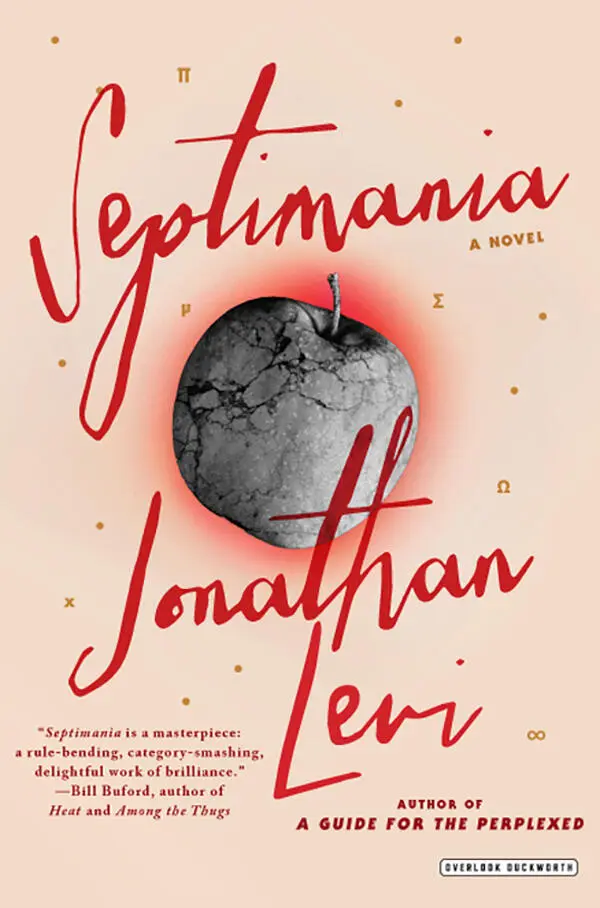
- Название:Septimania
- Автор:
- Издательство:The Overlook Press
- Жанр:
- Год:2016
- ISBN:нет данных
- Рейтинг книги:4 / 5. Голосов: 1
-
Избранное:Добавить в избранное
- Отзывы:
-
Ваша оценка:
Septimania: краткое содержание, описание и аннотация
Предлагаем к чтению аннотацию, описание, краткое содержание или предисловие (зависит от того, что написал сам автор книги «Septimania»). Если вы не нашли необходимую информацию о книге — напишите в комментариях, мы постараемся отыскать её.
Over the next fifty years, Malory’s search for Louiza leads to encounters with Pope John Paul II, a band of lost Romanians, a magical Bernini statue, Haroun al Rashid of Arabian Nights fame, an elephant that changes color, a shadowy U.S. spy agency and one of the 9/11 bombers, an appleseed from the original Tree of Knowledge, and the secret history of Isaac Newton and his discovery of a Grand Unified Theory that explains everything. It is the quest of a Candide for love and knowledge, and the ultimate discovery that they may be unified after all.
Septimania — читать онлайн бесплатно полную книгу (весь текст) целиком
Ниже представлен текст книги, разбитый по страницам. Система сохранения места последней прочитанной страницы, позволяет с удобством читать онлайн бесплатно книгу «Septimania», без необходимости каждый раз заново искать на чём Вы остановились. Поставьте закладку, и сможете в любой момент перейти на страницу, на которой закончили чтение.
Интервал:
Закладка:
And as she rocked, she began to hear a sound. A guitar. An electric guitar, a low note, a slow trill, approaching from a distance, like a motorcycle along the Grantchester Road, or the first notes of “Foxey Lady.” She had heard the sound before. But it had always receded, always driven away as soon as she turned her head. Now, though, the sound grew louder, closer. And as it grew closer, it was joined by the treble tattoo of a light stick against a ride cymbal, tinsel and sparks. And then a pulse — not too fast, slower than a heart, but insistent, warming. An electric bass pushing rhythm into song.
It was a group. Not a Galois Group, or a Langlands Group, or any of the groups of higher mathematics she had played with in Cambridge that looked only like Greek letters and played only a tune of pencil scratching on paper. But a group of human performers, four of them, standing around the table — four girls. They were Una and Dodo, Terri and Quatro — their names were as clear as their costumes. Una wore a jasmine PVC mini-dirndl over a black-and-white, horizontal-striped rugby shirt topped by a Funkadelic corduroy cap, and she played a Gibson Flying V electric guitar in shades of cardamom and curry. Terri was more conservative — pinstriped Carnaby Street suit (flared trousers, of course) with a ruffled cream shirt open past her cleavage, just above her left-handed McCartney bass. Quatro was the schoolgirl, which meant she kicked her bass drum and tickled her cymbals in a no-nonsense, Scottish-knee-sock-and-tartan-skirt kind of a way, light years from Japanese anime porn.
And then there was Dodo. From the start, Dodo was Louiza’s favorite. Dodo was the lead singer of the group, camouflaged to the nines in bulletproof Gore-Tex, seven-league boots, and a Kiwi Ranger’s hat that disguised a meter-long plait of raven hair bound up in a double-helix with a jackknife and a bungee stick.
“Unimaginable …” Dodo sang, or said, or said and sang in a way that Patti Smith was beginning to insinuate into the universe. “More than imaginary. Unimaginable …”
“Yes,” Louiza said, stopping rocking, but not moving, except for her head as she looked from Una to Terri to Quatro and back to Dodo. “My loss. My baby. Unimaginable.”
“One over zero,” Una sang.
“Unimaginable!” the other three joined in.
“Two over zero,” Terri now.
“Unimaginable!”
“Three over zero, four over zero-o!” Dodo cried.
Add me to zero
Subtract me from zero
Multiply me by zero
Divide, divide, divide me by zero-o-o.
Ever since she was a small girl, Louiza had listened to teachers tell her, You can’t divide by zero. You just can’t. One divided by zero, they said, just made no sense.
“Six divided by two,” one tall, rock-star of a junior teacher told the class, “equals three. And three times two equals six. There is at least one solution to the problem, therefore the problem makes sense. But six divided by zero equals?”
“Zero?” one small hand suggested.
“But zero times zero?” the teacher asked.
“Also zero.”
“And not six. Therefore, not the answer.” In fact, the teacher stated, there was no answer, no number which, when multiplied times zero equaled six. Therefore six divided by zero, any number divided by zero, made no sense.
And yet, Louiza remembered thinking, and yet — there it is. There is six divided by zero, right up there on the chalkboard, and seven divided by zero next to it — not just a trick of the light. And in later years, ≠ divided by zero and i divided by zero joined their sisters in the very real world of Louiza’s imagination and refused to disappear just because they did not make sense. If the Imaginary System was based on the square root of –1, now she had a new system, a new group of friends. If someone could call the square root of –1 i , then Louiza could baptize one divided by zero as Una, and two divided by zero as Dodo. Una times zero equaled one, Dodo times zero equaled two. Simple. The Unimaginables — in vinyl miniskirts and knee-high boots — and quicker than they could kung fu a dozen gangbangers they divided by zero and multiplied times zero and came up with a whole number and rocked, far better than any junior maths teacher.
Louiza picked up her pencil and opened the folder of new problems MacPhearson had left her. She divided by zero and solved the problems, one and then another and then another. The Unimaginables, her sisters, saving her from the unimaginable.
And Malory.
“Standing on the shoulders of giants”—isn’t that what he said when she opened her eyes in the organ loft? Malory told her that Isaac Newton said if he saw further than others it was because he was standing on the shoulders of giants. “I’m lucky,” Malory told her, “if I even get a peek between their legs.” She thought of Malory when the Unimaginables first began practicing their particular music in her brain. That March afternoon, waking up in the organ loft of the church with Malory, the infinite was in the air. “When I was a boy,” Malory started, “just when my mother took ill, I had a great need to see things, to stand with the giants. I remember the day Mrs. Bogatay told us about infinity. I asked her, ‘What does infinity look like?’ And she answered, ‘It’s bigger than any other number.’ And I asked, ‘Is it bigger than a quadrillion?’—I was the only nine-year-old in school who knew the word, and it became my signature number. Mrs. Bogatay invited me up to the chalkboard and had me write out a quadrillion — one with fifteen zeroes after it. And then, as simple as cutting off my penis, she erased the final zero and replaced it with a one. She had found a larger number.
“Well,” Malory continued — and Louiza remembered his excitement, the way he propped himself up on one elbow, but made sure to leave a leg lying over hers, “the challenge was on. I was going to write even bigger numbers. I was going to do what she said was impossible. I was going to write infinity. I wrote my quadrillion and then, with the daring of sailing off the edge of the earth, I added a comma and three more zeroes. And then another comma and three more zeroes. I refused to do any other work in maths that morning. Or any other work during my other lessons. I kept at it with my notebook. After two days of writing commas and zeroes, I came up with a genius of an idea. Instead of writing three little zeroes, I wrote one big one. And then I substituted a zero with a diagonal slash for ten groups of three, and then a horizontal slash for a hundred groups of three.
“And so on. Three weeks of substitution, a fever of filling up notebooks, ignoring my lessons, the other boys, barely eating, ignoring the world around me. Until finally Mrs. Bogatay took pity on me and showed me the ultimate substitution. The sideways eight. °. Infinity.
“I was furious, of course, and I fought back. ° + 1, I wrote in temporary triumph.
“‘Equals infinity,’ she said, writing it out: ° +1 = °.
“° + °, I wrote. ° x °!
“‘Equals infinity,’ she said, ‘I’m sorry to say.’
“That was the day,” Malory said, putting his head back down on Louiza’s chest, “that I returned home after school and found the vicar waiting for me. Two days later they buried my mother. Monday I found myself at a new school. Every hour became an infinity of seconds, every day an infinity of hours. And every night, I curled up into the sideways eight of my best, my only friend.”
The Unimaginables began to play. The pine tree inside the house disappeared, the snow melted. Vince came, Vince went. Louiza solved the problems. And still there remained the pulse, the beat, the infinite, the unimaginable loss of her baby.
Читать дальшеИнтервал:
Закладка:
Похожие книги на «Septimania»
Представляем Вашему вниманию похожие книги на «Septimania» списком для выбора. Мы отобрали схожую по названию и смыслу литературу в надежде предоставить читателям больше вариантов отыскать новые, интересные, ещё непрочитанные произведения.










Обсуждение, отзывы о книге «Septimania» и просто собственные мнения читателей. Оставьте ваши комментарии, напишите, что Вы думаете о произведении, его смысле или главных героях. Укажите что конкретно понравилось, а что нет, и почему Вы так считаете.