Jonathan Levi - Septimania
Здесь есть возможность читать онлайн «Jonathan Levi - Septimania» весь текст электронной книги совершенно бесплатно (целиком полную версию без сокращений). В некоторых случаях можно слушать аудио, скачать через торрент в формате fb2 и присутствует краткое содержание. Год выпуска: 2016, Издательство: The Overlook Press, Жанр: Современная проза, на английском языке. Описание произведения, (предисловие) а так же отзывы посетителей доступны на портале библиотеки ЛибКат.
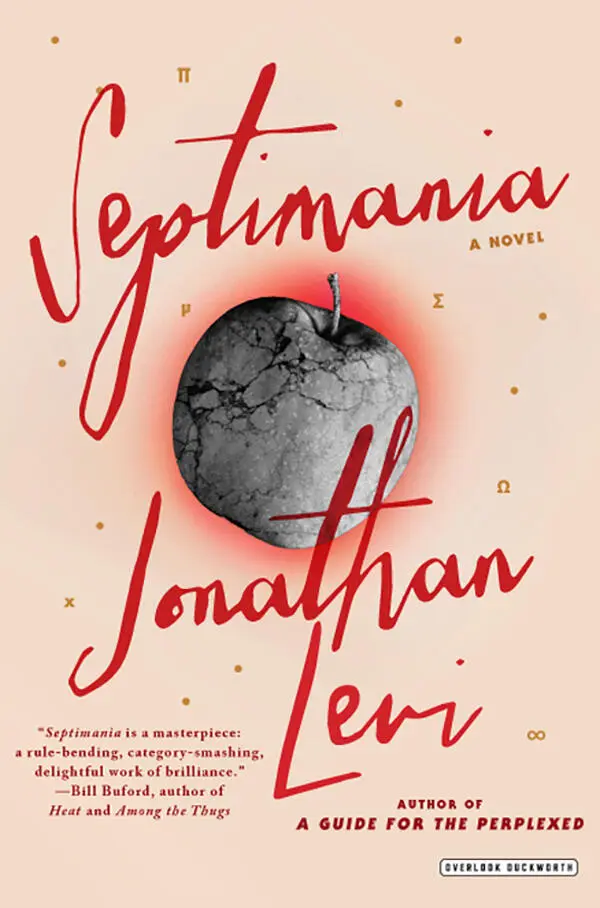
- Название:Septimania
- Автор:
- Издательство:The Overlook Press
- Жанр:
- Год:2016
- ISBN:нет данных
- Рейтинг книги:4 / 5. Голосов: 1
-
Избранное:Добавить в избранное
- Отзывы:
-
Ваша оценка:
Septimania: краткое содержание, описание и аннотация
Предлагаем к чтению аннотацию, описание, краткое содержание или предисловие (зависит от того, что написал сам автор книги «Septimania»). Если вы не нашли необходимую информацию о книге — напишите в комментариях, мы постараемся отыскать её.
Over the next fifty years, Malory’s search for Louiza leads to encounters with Pope John Paul II, a band of lost Romanians, a magical Bernini statue, Haroun al Rashid of Arabian Nights fame, an elephant that changes color, a shadowy U.S. spy agency and one of the 9/11 bombers, an appleseed from the original Tree of Knowledge, and the secret history of Isaac Newton and his discovery of a Grand Unified Theory that explains everything. It is the quest of a Candide for love and knowledge, and the ultimate discovery that they may be unified after all.
Septimania — читать онлайн бесплатно полную книгу (весь текст) целиком
Ниже представлен текст книги, разбитый по страницам. Система сохранения места последней прочитанной страницы, позволяет с удобством читать онлайн бесплатно книгу «Septimania», без необходимости каждый раз заново искать на чём Вы остановились. Поставьте закладку, и сможете в любой момент перейти на страницу, на которой закончили чтение.
Интервал:
Закладка:
But the word maybe and its verbal cousin may awakened the part of my mathematical brain that dealt in probabilities. I may be your mother, Cristina had said. I could understand the uncertainty of Tibor’s paternity, but with mothers … isn’t there a higher level of probability, reaching almost to absolute certainty?
“There was confusion,” Cristina went on. “Tibor and I were very poor in those days and we had just arrived in Rome.” That much I knew from the articles in Il Messaggero and Oggi that celebrated Tibor’s 1988 return to the Eternal City and the dinners and drinks in expensive restaurants by the Pantheon or the Palazzo Farnese that featured Tibor’s face next to Laura Morante or Valeria Golino. “I was pregnant. I gave birth in Fatebenefratelli. But then …”
“I know,” I said, wanting to save Cristina the pain of saying it but also keen to try out my pet theories, “but you didn’t have enough money, the Italians were going to send you back, you had to give me up. Santa Sabina …”
“No,” she said. “It wasn’t that.” Cristina looked up to the church across the road, the steeple cradled in the cleavage of the afternoon sun. “The room in the maternity ward of Fatebenefratelli was very beautiful — white light, the river just past the windows on both sides. I was there for a whole day — very quiet, very tranquil, floating on a white bed between contractions, twenty-four hours at least, totally alone. More than alone — well,” she stopped and realized that she was speaking to me. “While Tibor …”
I waited. Behind me, I heard the rattle of a bicycle chain on the towpath by the river, a shuffling breeze through the apple trees. I tried to imagine Cristina, my mother, with the proto-me inside her, the two of us riding the raft of Fatebenefratelli down the Tevere, waving up to the girls of Santa Sabina looking down on us from the Giardino degli Aranci.
“Tibor finally arrived on the second day. He was with a strange little English man and his strange little English wife — a girl really — very pale, very blonde, very pregnant. I saw them come in. I saw them lay the girl on the bed. I wanted to speak with Tibor. But then both of us, the English girl and I, went into serious labor, and the doctor shooed everyone else from the room. When I woke up enough to focus, I was in the room again, alone. Or, to be more precise, Tibor was gone. The English girl was gone, the strange little English man was gone, the doctor was gone. The light from outside was sulfur and cold. It was all I could do to pull the blanket up to my chin. I don’t know when the nurse came in, it could have been two minutes or two hours later. She put me in a wheelchair — the pain was, well, pain. She wheeled me down to where Tibor was sitting on a bench, smoking a cigarette. I was in no shape to understand much except that there was a problem. Everything was in Italian, and my Italian was still new. But what I understood, what Tibor and I understood at the time was like this:
“The English girl and I both gave birth. Both babies were taken away in a single cradle, to be weighed and measured and registered. But when the Sister went to bring the babies back to us, she opened the cradle and it was empty. Not two babies. Not one. Empty.” Cristina paused to light a fresh cigarette. The sound of her lighter shocked me.
“And one of the babies that wasn’t there was me?”
“I screamed for a long time, I think,” Cristina continued. “Or maybe I just think I screamed.” She exhaled, smoke rose into the branches of the apple trees — had she even heard me? “Then I stopped. Tibor smoked. I smoked. It grew dark outside. We went home. Tibor didn’t say anything. I didn’t say anything. Tibor made up a story for our friends, about the authorities — I don’t know exactly what, we never discussed it. All I had to do was smoke and accept their sympathies. Somehow — and I don’t expect this will make you happy, Ottavia — we both came to believe that this was the best solution, whatever happened to you was better. I would be lying to you if I said we hadn’t thought about giving up the baby every day of the nine months of my pregnancy. We spent enough of our childhood in Rumania fighting against the dictator who was calling on our patriotic souls to climb on top of each other and have children. It felt like we’d be giving in, selling out, if we actually had a child.”
But there had been the anniversary production of the Divine Comedy, I thought, when Sister Francesca Splendida sent me down to meet Tibor with eleven other girls, and something in the way that I did something — my sense of space, of direction, the way I could find things — reminded Tibor of his own early days with the Bomb Squad and his unerring ability to sniff out the mines along the delta of the Danube that the Soviets, the Germans, or maybe the Emperor Trajan had left during one war or another. And Tibor and Cristina were convinced that one of those two babies who had disappeared from Fatebenefratelli ten years earlier was me. Maybe. Tibor had become a successful director in America. Cristina was climbing up the ladder of television journalism. They had enough money to pretend. I could be a toy, a cat they took out once or twice a year, to pet and play with when they weren’t otherwise engaged. It was in nobody’s interest to check DNA, to open the lid of the genetic box too wide — except mine. Maybe.
“Cristina,” I asked, since the word mother had never gained much of a flavor, “why are you telling me this now?”
“Because Tibor — because your father — needs you to help him.” She let the cigarette drop next to a forgotten crabapple. “And I don’t think you should.”
Cristina returned to Cambridge for my graduation a week later. Tibor too. He was playful, in manic high spirits. All my friends thought that I was the luckiest girl in the quad to have such a fantasy close at hand. The hint of a bald spot on Tibor’s crown had widened into permanence. But the rest of his hair was thick and cut and shaped in a way that spoke of financial health as much as art. He had no idea that Cristina had come up the week before, that we had driven out to the Orchard and spoken. But that evening, after half a duck and two bottles of Merlot at Midsummer House, after I’d walked them back to the University Arms, Tibor stopped me under a sulfur lamp on St. Andrew’s Street. The National had signed him to direct a production of Sophocles’ Antigone. He had a concept that he knew could be extra ordinary but required the kind of diplomacy and organization and sense of direction that he believed only I possessed. Might I come work as his assistant? Immediately? This clearly was the help that Cristina warned me about. But Tibor, my father! The National — how and for what reason could I say no?
Even though the National ran with strict union rules regulating hour and place, everyone involved in Tibor’s Antigone had signed a waiver to accommodate Tibor’s particular method. Every day, the entire company met in a large rehearsal room just before noon. Not just actors but designers, carpenters, seamstresses, the occasional executive, and a smattering of ushers and other front-of-house personnel. At the stroke of twelve, Tibor would appear to give a benediction to the company — a sermon that riffed on Sophocles, Dante, Winston Churchill, the changing politics of Eastern Europe, or sometimes just a comment on the hairstyle of one of the actors in the company. Eventually, the road led back to Antigone . And with that, Tibor would declare the workday begun. A couple of trestle tables were laden with food and drink. Most of the company would grab a salad or a Scotch egg and a coffee to fortify themselves for the day’s surprises. Tibor never made a plan in advance. He might begin by gathering a covey of actors into a corner to discuss context and character, or he might spend two hours drilling a speech with the Creon in the middle of the hall while the others looked on. Or he might just huddle with the costume designer, even though everything had been sifted and sorted, for the entire afternoon.
Читать дальшеИнтервал:
Закладка:
Похожие книги на «Septimania»
Представляем Вашему вниманию похожие книги на «Septimania» списком для выбора. Мы отобрали схожую по названию и смыслу литературу в надежде предоставить читателям больше вариантов отыскать новые, интересные, ещё непрочитанные произведения.











Обсуждение, отзывы о книге «Septimania» и просто собственные мнения читателей. Оставьте ваши комментарии, напишите, что Вы думаете о произведении, его смысле или главных героях. Укажите что конкретно понравилось, а что нет, и почему Вы так считаете.