Jonathan Levi - Septimania
Здесь есть возможность читать онлайн «Jonathan Levi - Septimania» весь текст электронной книги совершенно бесплатно (целиком полную версию без сокращений). В некоторых случаях можно слушать аудио, скачать через торрент в формате fb2 и присутствует краткое содержание. Год выпуска: 2016, Издательство: The Overlook Press, Жанр: Современная проза, на английском языке. Описание произведения, (предисловие) а так же отзывы посетителей доступны на портале библиотеки ЛибКат.
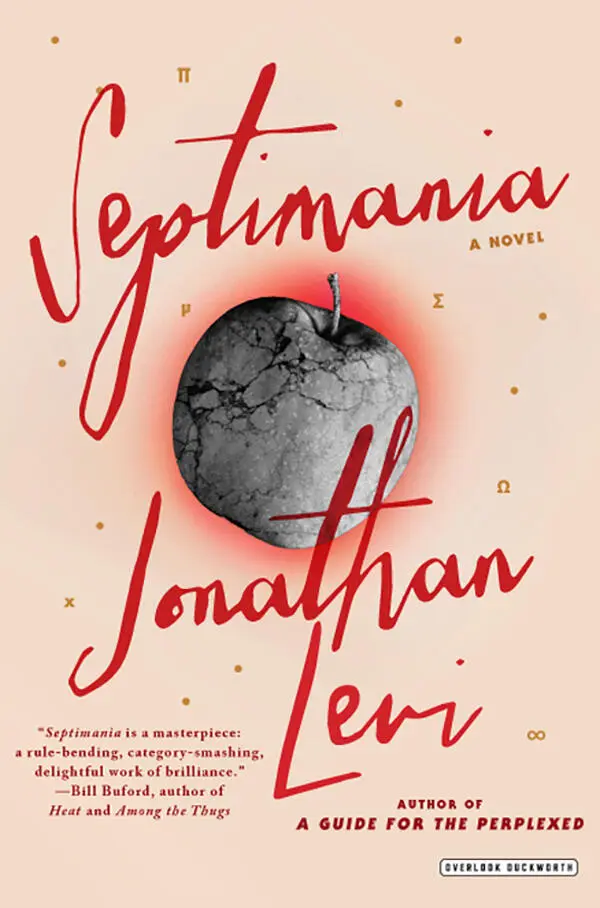
- Название:Septimania
- Автор:
- Издательство:The Overlook Press
- Жанр:
- Год:2016
- ISBN:нет данных
- Рейтинг книги:4 / 5. Голосов: 1
-
Избранное:Добавить в избранное
- Отзывы:
-
Ваша оценка:
Septimania: краткое содержание, описание и аннотация
Предлагаем к чтению аннотацию, описание, краткое содержание или предисловие (зависит от того, что написал сам автор книги «Septimania»). Если вы не нашли необходимую информацию о книге — напишите в комментариях, мы постараемся отыскать её.
Over the next fifty years, Malory’s search for Louiza leads to encounters with Pope John Paul II, a band of lost Romanians, a magical Bernini statue, Haroun al Rashid of Arabian Nights fame, an elephant that changes color, a shadowy U.S. spy agency and one of the 9/11 bombers, an appleseed from the original Tree of Knowledge, and the secret history of Isaac Newton and his discovery of a Grand Unified Theory that explains everything. It is the quest of a Candide for love and knowledge, and the ultimate discovery that they may be unified after all.
Septimania — читать онлайн бесплатно полную книгу (весь текст) целиком
Ниже представлен текст книги, разбитый по страницам. Система сохранения места последней прочитанной страницы, позволяет с удобством читать онлайн бесплатно книгу «Septimania», без необходимости каждый раз заново искать на чём Вы остановились. Поставьте закладку, и сможете в любой момент перейти на страницу, на которой закончили чтение.
Интервал:
Закладка:
He looked up at me again and blinked. Twice. Thrice. I don’t know if Cristina ever got that look from him. But I understood her warning.
In the morning, Tibor was downstairs in the lobby of the hotel waiting for me. There were no signs of the previous day’s adventure. If anything, he seemed more energized than he had a week earlier before the first rehearsal. As we walked through Trafalgar Square and across Hungerford Bridge to the South Bank, he talked about how the time had come to begin to unveil the new concept for Antigone. It was a concept he had been considering for over twenty years, since his first days in Rome.
And that’s when he mentioned your name.
“Malory will understand.”
I had no idea who you were, or whether the name Malory referred to a man, a woman, or a Rumanian experimental theater company. I didn’t ask. But then, I didn’t ask a lot of things on that late-morning walk to the Studio, and if I had, a clarification of the name Malory would have been low on the list. I was glad that Tibor was mobile. I wanted to forget our lost Monday. It was Tuesday, the beginning of a new week. We would show our passes at the stage door, take the lift to our well-lighted rehearsal room, listen to our week-two benediction from our glorious leader, and set off on the next episode of our journey towards genius.
“Oc-TAY-vya!”
It wasn’t just the sight of Reshma outside the stage door. It was the sight of Reshma and five other women — Asian, Latin, African, Polynesian, and Eskimo — all yoo-hooing Tibor in ways that told me one thing. Monday hadn’t been the product of Tibor unwinding at the end of a long week by drinking a bottle of Absolut and picking up an Indian prostitute. Tibor had been doing this every night since we began rehearsal. He had been going out in London with a bottle of Absolut and looking for women. A new bottle every night, a new woman every night.
“My concept,” Tibor said, as he stirred the six new women into the murmuring mix that was his disconcerted company, “is that Antigone will be played not by one woman, but by seven women. Antigone is not just white, not just black or yellow or …” I could have supplied Tibor with the names of the seven colors of the rainbow more easily than figured out the reasoning behind his coalition.
“But why?” It was the Welsh girl, the original Antigone who asked the question. Entirely reasonable. Entirely within character, both as a Welsh girl and as Antigone.
“You should know, Antigone.” Tibor smiled a dangerous smile, the warning of imminent attack. “Your Uncle Creon thinks there is only one right side to any battle, one right answer to any question, one nephew, one hero who can be buried. But you …”—and Tibor laid a comforting palm on her shoulder—“know that sometimes there is more than one answer, more than one hero, more than one heroine.”
“Perhaps …” she began.
“Tell me,” he said, smiling again. “How many boys have you fucked in your life?” Before the Galahads in the company could raise their voices in defense of the poor girl, Tibor held up his hand. “I don’t really want to know. I suspect the number is more than one. But I’m sure you’re looking for the one guy to settle down with, the one man — or maybe woman, I’m easy — to spend the rest of your life with. Aren’t we all?”
The murmur dwindled to the silence of general confusion.
“On the Other Side, where I was born, One was the only number. One party, one president, one way of living, of thinking, of eating, drinking, shitting, and, when it came down to it, one missionary position for making love. I have been fighting a battle against One since I escaped from the Other Side. It is a battle I have tried to describe and explain. And now all of you — and I include our six new, professional colleagues — are here to give life to that battle. To prove once and for all that life is full of answers and origins. There are more Big Bangs, more explanations, more ways to tell where we’ve come from, where we’re going, and why we’re taking the trouble. As many, Dante would say, as the fireflies a peasant sees on a summer’s evening, when he lies on his back on a grassy hill after his work is done. And you, my pilgrims, are going to bring the light of all these fireflies to the world!”
The company was made up of professionals, people who had been in the business, some of them for more than forty years. I was impressed how many of them followed Tibor’s concept for the first day or so. Many of them had worked in the political sixties and seventies with non-professional actors — Kentish farmers and farriers in reenactments of Wat Tyler’s Rebellion or Hackney undertakers reliving the Great Plague of 1666. And they all had grown up in the ecclesiastical hierarchy of the theater where the Director was the One.
The problem was not the National Theatre. The problem was not Reshma and her international friends — for whom I acted as agent and intermediary with staff, and secured a pretty tidy compensation package. I suspect that at least one Antigone was keeping the Director company on St. Martin’s Lane. The problem was Tibor. He was drinking — at least that one bottle of Absolut a night. And even though every morning when I picked him up, he was showered, shaved, and stable enough to walk the twenty minutes to the Studio, it was clear that he was stumbling in rehearsal. I became both lightning rod and the handkerchief for the individual and collective anxieties. As I waited in the lobby for Tibor on the morning of the sixth day of the second week, I rehearsed again the speech of concern I had been writing all night.
Tibor didn’t come down. I rang up to his room. No answer. I convinced the front desk to come up with me to the room and knock, and when there was still no answer, persuaded security to let me in.
Tibor was there. Sitting on the edge of his bed, fully dressed. Not one but three empty bottles — empty liter bottles of Absolut — stood on the console next to the TV. BBC News was playing, without the sound thankfully, and equally thankfully with no sign of either Cristina or Anna Ford on the screen. But Tibor was absent — clearly alive in body, dressed, and ready for rehearsal, but absent in mind.
I asked security to call for a doctor.
“No,” Tibor whispered, from a great distance — more distant than a Tom Waits rasp. I thanked the hotel staff and assured them I’d be all right. They left and closed the door. I sat next to Tibor on the bed and took his right hand. It was huge and heavy.
“Something’s missing,” Tibor said. “The box is empty.”
“What box?” I asked him, thinking about the vacant bassinet in Fatebenefratelli.
“Seven isn’t working,” Tibor said. “I was so certain!”
“Perhaps,” I suggested, “we should go to rehearsal?”
He said nothing.
“Perhaps you should slow down on your drinking.”
Tibor turned his face to me and gave me a look of such infernal hatred. “You are your mother’s daughter,” he said, with an accent on every bitter word. “You stand on my shoulders and press me down with your heels.” I couldn’t make much sense of what he was saying. But his hand was still in mine, my father’s hand.
“What do you need?” I asked him, and stroked that hand with my other.
“The Pip,” he said.
“The Pip?”
“Once upon a time, little girl, my friend Malory told me that I was out of tune. Maybe he was wrong then. He is right now.”
That was the second time I’d heard your name.
“Malory will know. Malory will give me the Pip to put me back in tune. Then Cristina, maybe she will hear me.”
I put Tibor to bed and stepped out into the hallway. I called Cristina in New York. I called the National. Both had contingency plans in place. So when on the third day, Tibor was still unable and unwilling to go to rehearsal, the National quietly let it be known he was being replaced. Cristina arrived that morning on a private jet loaned by someone grateful. Heels on his shoulders or no, Tibor let us guide him down to a cab and the airport. I rode with them to the airport, holding Tibor’s big right hand. But when he saw the plane, he balked.
Читать дальшеИнтервал:
Закладка:
Похожие книги на «Septimania»
Представляем Вашему вниманию похожие книги на «Septimania» списком для выбора. Мы отобрали схожую по названию и смыслу литературу в надежде предоставить читателям больше вариантов отыскать новые, интересные, ещё непрочитанные произведения.











Обсуждение, отзывы о книге «Septimania» и просто собственные мнения читателей. Оставьте ваши комментарии, напишите, что Вы думаете о произведении, его смысле или главных героях. Укажите что конкретно понравилось, а что нет, и почему Вы так считаете.