Jonathan Levi - Septimania
Здесь есть возможность читать онлайн «Jonathan Levi - Septimania» весь текст электронной книги совершенно бесплатно (целиком полную версию без сокращений). В некоторых случаях можно слушать аудио, скачать через торрент в формате fb2 и присутствует краткое содержание. Год выпуска: 2016, Издательство: The Overlook Press, Жанр: Современная проза, на английском языке. Описание произведения, (предисловие) а так же отзывы посетителей доступны на портале библиотеки ЛибКат.
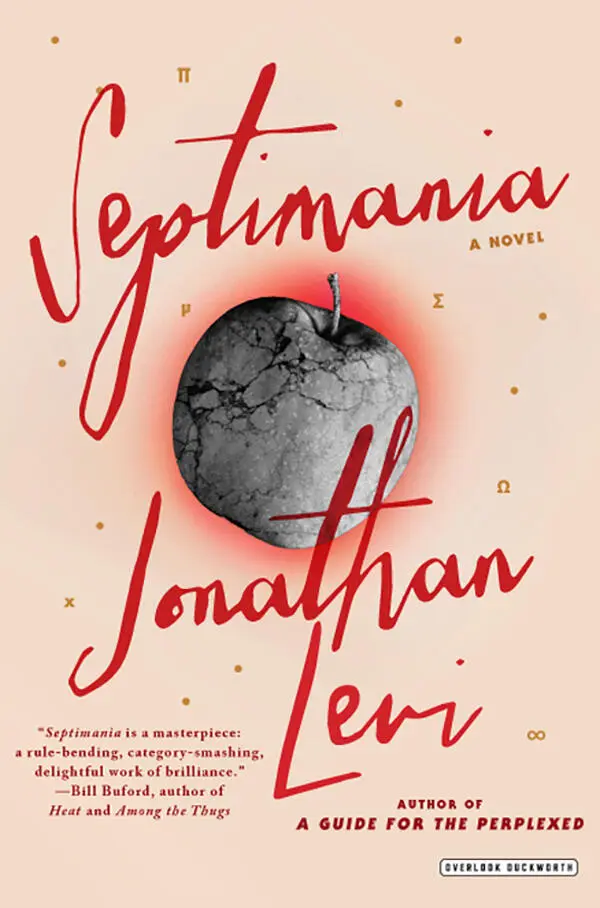
- Название:Septimania
- Автор:
- Издательство:The Overlook Press
- Жанр:
- Год:2016
- ISBN:нет данных
- Рейтинг книги:4 / 5. Голосов: 1
-
Избранное:Добавить в избранное
- Отзывы:
-
Ваша оценка:
Septimania: краткое содержание, описание и аннотация
Предлагаем к чтению аннотацию, описание, краткое содержание или предисловие (зависит от того, что написал сам автор книги «Septimania»). Если вы не нашли необходимую информацию о книге — напишите в комментариях, мы постараемся отыскать её.
Over the next fifty years, Malory’s search for Louiza leads to encounters with Pope John Paul II, a band of lost Romanians, a magical Bernini statue, Haroun al Rashid of Arabian Nights fame, an elephant that changes color, a shadowy U.S. spy agency and one of the 9/11 bombers, an appleseed from the original Tree of Knowledge, and the secret history of Isaac Newton and his discovery of a Grand Unified Theory that explains everything. It is the quest of a Candide for love and knowledge, and the ultimate discovery that they may be unified after all.
Septimania — читать онлайн бесплатно полную книгу (весь текст) целиком
Ниже представлен текст книги, разбитый по страницам. Система сохранения места последней прочитанной страницы, позволяет с удобством читать онлайн бесплатно книгу «Septimania», без необходимости каждый раз заново искать на чём Вы остановились. Поставьте закладку, и сможете в любой момент перейти на страницу, на которой закончили чтение.
Интервал:
Закладка:
In the week since his return from London, Tibor hadn’t spoken — not to Cristina, Ottavia, Nurse, Bomb Squadder, or anyone. It didn’t matter. No one really wanted to hear what he had to say. College Girl was no different. Tibor sat on a stool. The bartender, who was at some kind of college himself, studying communication, reached down into the well for the bottle of Absolut. Tibor waved him away with an index finger and pointed to the soda siphon and a lime. The bartender shrugged. Tibor set his plastic bag of clams down on the bar and lowered his mouth to the straw.
“Hey, Tibor,” College Girl called to him. Tibor looked up at the mirror in the bar, but the image of the bottom of the girl’s stilettos crisscrossing behind the bourbon was too vertiginous. He turned. “This guy’s a foreigner too. Where’d you say you were from?” Tibor looked over to his left. There was a man, the only other customer in the Seven Veils, sitting two stools away. He was sipping on a vodka and tonic and staring intently as the girl’s legs exposed then hid then exposed again, as if he was studying for a final exam.
“Jed-dah …” the man said.
“Jed-dah!” the girl repeated. “They got dollar bills in Jed-dah?”
The man didn’t understand. Tibor took out his wallet and handed him a five, making it clear with a thrust of the chin that he should carry the bill directly to the girl on the towel as Tibor had in years of defending his belief in the multiplicity of pleasure. The man hesitated. He had a bag on his lap. There was a bit of delicate negotiation before he could place the V&T and the bag on the bar and trot the bill over to the stage. He was compact — that was Tibor’s thought — Malory-sized, although his hair was cropped in short Arabian curls. Tibor had cast an Algerian in his first Dante production back in Rome — as the homosexual Brunetto Latini, if he remembered correctly. The Algerian was a Muslim, Tibor recalled that much. He’d come back to the Dacia once or twice, had a perfectly good time, Tibor thought, even without drinking the vodka or eating the prosciutto. Dora, or was it Brendushka, had taken pity on the guy — Tibor couldn’t remember the rest. The Seven Veils was a long way from Jeddah, so maybe College Girl would take pity on this poor schmuck.
“Wanna dance?” She’d raised herself up to a standing position on the stage and was lazily scratching an itch on her left shoulder blade with her rolled-up towel. On stage, in stilettos, she towered over the man from Jeddah, who held Tibor’s five in embarrassed supplication. “Whaddya doin in the Seven Veils if you don’t wanna dance?”
“Give him a dance, Rache,” the Bartender called out. “I saw his wallet. Full of Benjies.”
“Aha!” Rache — was that really a name? Tibor wondered — said. “A rich guy from Jed-dah! Where is that? Somewhere in Es-PA-ña?” She stepped off the stage and nudged the man with a practiced fingernail back onto his stool.
“Saudi,” Mr. Jeddah said, still wondering what to do with the five.
“Live around here?” She nudged his knees apart with both of hers.
“Boston,” the man said.
Tibor turned back to his water. He knew that in seven and a half minutes, College Girl would have the guy’s passport number and two, if not three of the hundred-dollar bills the Bartender had so expertly spied. Except for the Algerian, Tibor couldn’t remember knowing any other Arabs, any other Muslims. Rumania in the days of the Sheikh and Sheika Ceauşescu wasn’t comfortable with any show of obeisance except to the holy couple. There had been a few Iranian refugees in Rome before he and Cristina left, but then, they weren’t really Arabs, were they? He had been happy in Rome, hadn’t he? Cristina had been happy too, even with her mopping and dusting and burping babies that belonged to other people. And she had been happy again when he’d discovered Ottavia in the godforsaken icebox of Santa Sabina. There had been chances — even after he had run off to an organ loft to hide from a terror worse than any he’d felt searching for mines in the delta of the Danube. There had been chances, even after Fatebenefratelli, even after the red-bearded doctor lost their child and disappeared. Malory would bring another chance. After all this time, maybe Malory was right and he was wrong. Malory would bring the Pip. The Pip would show him the answer.
“We Muslims believe,” Mr. Jeddah said, with a muffled sound that told Tibor exactly where his mouth was. “We believe there is a body and there is a soul.”
“Really?” Rache said, and Tibor could hear her voice descend in pitch and placement. But the man continued.
“The soul is connected to the body in four different ways: as a fetus in his mother’s womb.”
“Ah …”
“After birth.”
“Mmm …”
“When a person is asleep.”
“That’s three …”
“And …”
“And …?” Tibor could hear the rustle of money exchanging hands.
“And on the Day of Resurrection, soon to come, insha’allah , after the Caliph of all Islam reveals himself.”
“But tell me, Mister Jed-dah,” Rache went on, “in case I missed something. If I’m not mistaken, at this moment, you aren’t being born or sleeping. And the Mahdi isn’t hanging around this joint. Am I right?”
“Yes,” the man said, with a glance over his right shoulder at Tibor. “That is correct.”
“So while the soul is AWOL, whaddya say we take a trip back into the VIP room and check out the body?”
Tibor continued to stare at the water. But he could tell that the man was standing, the man was walking.
“Let me just clear out the mop,” the Bartender said, and ran down the far end of the bar and out the back.
Tibor looked down the bar. Rache had locked her arm in Mr. Jeddah’s — these may have been the first V&Ts in his life — and was whispering something in his ear that Tibor was sure signaled the exchange of a few more hundred dollars.
And then Tibor saw the bag.
The man had left his bag on the bar, the plastic bag he had been cradling in his lap until College Girl came along and began her dance. And through the opening of the bag, Tibor could see a barrel, a handle, a trigger. Mr. Jeddah had a gun. Tibor thought of saying something — to the Bartender, to Rache, to Mr. Jeddah himself. But that would involve speaking.
He also thought about taking the gun.
He looked back at his water glass and up to the bottles of liquor ranged along the mirror at the back of the empty bar. He looked up into the mirror. And that’s when he heard the music change.
A guitar. An electric guitar, a low note, a slow trill, approaching from a distance, like a Ducati along the Lungotevere, or the first notes of “Foxey Lady.” As it grew closer, the guitar was joined by the treble tattoo of a light stick against a ride cymbal, tinsel and sparks. And then a pulse — not too fast, slower than a heart, but insistent, warming. An electric bass pushing rhythm into song. Tibor looked up into the mirror.
There were four of them, on the stage where Rache has been crossing and uncrossing her legs, four girls. The guitarist was a very young Charlotte Rampling starring in The Sound of Music— all dirndl and translucent eyes. The bass player was a female David Hemmings — Carnaby Street cream shirt open past her delicate cleavage. The drummer was knee socks down to the bass pedal and tartans past the snare — the kind of Japanese anime porn outfit that always made Tibor’s visits to Ottavia’s Scottish academy more interesting.
And then there was the bulletproof lead singer of the group, Ramboed to the nines, booted to the max, with a hat from a lost Ark big enough to disguise a meter-long plait of raven hair bound up in a double-helix with a jackknife and a bungee stick.
Читать дальшеИнтервал:
Закладка:
Похожие книги на «Septimania»
Представляем Вашему вниманию похожие книги на «Septimania» списком для выбора. Мы отобрали схожую по названию и смыслу литературу в надежде предоставить читателям больше вариантов отыскать новые, интересные, ещё непрочитанные произведения.











Обсуждение, отзывы о книге «Septimania» и просто собственные мнения читателей. Оставьте ваши комментарии, напишите, что Вы думаете о произведении, его смысле или главных героях. Укажите что конкретно понравилось, а что нет, и почему Вы так считаете.