Jonathan Levi - Septimania
Здесь есть возможность читать онлайн «Jonathan Levi - Septimania» весь текст электронной книги совершенно бесплатно (целиком полную версию без сокращений). В некоторых случаях можно слушать аудио, скачать через торрент в формате fb2 и присутствует краткое содержание. Год выпуска: 2016, Издательство: The Overlook Press, Жанр: Современная проза, на английском языке. Описание произведения, (предисловие) а так же отзывы посетителей доступны на портале библиотеки ЛибКат.
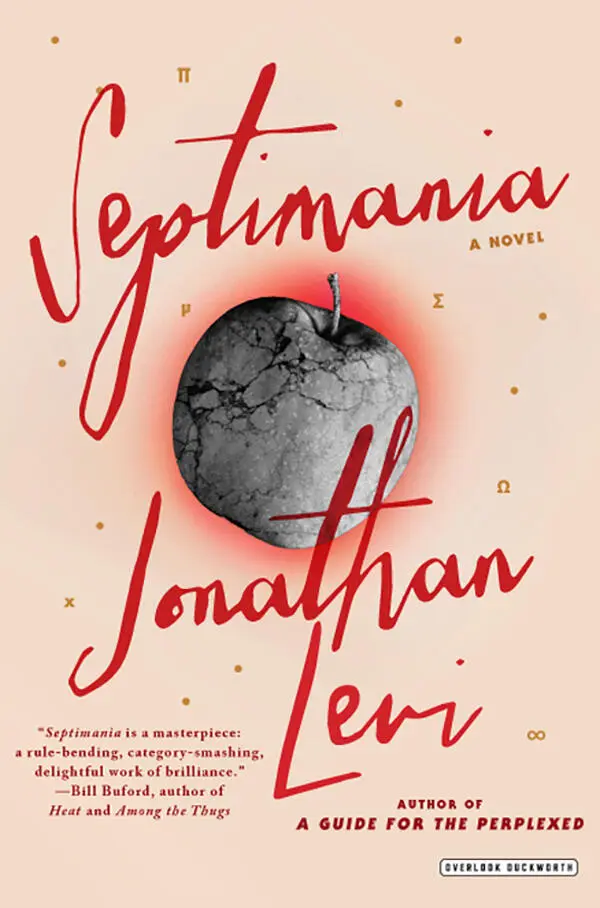
- Название:Septimania
- Автор:
- Издательство:The Overlook Press
- Жанр:
- Год:2016
- ISBN:нет данных
- Рейтинг книги:4 / 5. Голосов: 1
-
Избранное:Добавить в избранное
- Отзывы:
-
Ваша оценка:
Septimania: краткое содержание, описание и аннотация
Предлагаем к чтению аннотацию, описание, краткое содержание или предисловие (зависит от того, что написал сам автор книги «Septimania»). Если вы не нашли необходимую информацию о книге — напишите в комментариях, мы постараемся отыскать её.
Over the next fifty years, Malory’s search for Louiza leads to encounters with Pope John Paul II, a band of lost Romanians, a magical Bernini statue, Haroun al Rashid of Arabian Nights fame, an elephant that changes color, a shadowy U.S. spy agency and one of the 9/11 bombers, an appleseed from the original Tree of Knowledge, and the secret history of Isaac Newton and his discovery of a Grand Unified Theory that explains everything. It is the quest of a Candide for love and knowledge, and the ultimate discovery that they may be unified after all.
Septimania — читать онлайн бесплатно полную книгу (весь текст) целиком
Ниже представлен текст книги, разбитый по страницам. Система сохранения места последней прочитанной страницы, позволяет с удобством читать онлайн бесплатно книгу «Septimania», без необходимости каждый раз заново искать на чём Вы остановились. Поставьте закладку, и сможете в любой момент перейти на страницу, на которой закончили чтение.
Интервал:
Закладка:
Louiza couldn’t resist. She looked into the paper bag. There was something on top, not an apple. A slip of paper, a phone number, a name. She looked. TiborTina.
“TIBOR!” OTTAVIA HAD NEVER BEEN INSIDE THE SEVEN VEILS, NOR IN any place resembling the Seven Veils. But it was quickly apparent to her that there was a man at the far end of the bar who was very angry with Tibor, and another man with him who was equally determined to keep the first man from attacking Tibor. Much closer, Tibor was sitting on a bar stool staring at a glass of water, while a girl — possibly the same age as Ottavia but wearing considerably less — was whispering something in a consoling tone of voice in his ear and trying to encourage him to stand. “Tibor,” Ottavia said again, and everyone stopped for a moment.
Tibor swiveled his head to the left.
“Tibor, it’s all right.” Ottavia touched his wrist.
Tibor picked up his clams and walked out the door and into the light. It took a moment for his glasses to darken. He saw the Yukon. He followed Ottavia across the street. He climbed into the passenger seat and placed the plastic bag next to him, buckled his seat belt. Ottavia opened the driver’s-side door, threw a paper bag from the Farmers’ Market and a plastic bag onto the seat between them, and then jumped up behind the wheel. She sniffed the air.
“Clams,” she said, somewhat mollified. “Water?” she said, sniffing Tibor’s face, “with a piece of lime? Well, now I expect Cristina will only half kill me.”
Ottavia pulled out and past the Mobil station, the culvert. Tibor looked forward through the windscreen as a late-model BMW did a U-turn and headed south on 9D. A roar of noise — music maybe — came out of the back seat or the exhaust pipe of the car. Behind the BMW, another College Girl followed on a red Vespa, a guitar strapped across her back. And then another, in a vinyl minidress on a lime-green Vespa, and then a third, a fourth — the entire band from the Seven Veils. The music was coming from the band, not the BMW. But when Tibor swiveled to follow their progress, they had disappeared, and the music was gone.
He swiveled back and looked down at the little girl, Ottavia, behind the wheel. Ottavia felt his look and turned to him. She smiled, she couldn’t help it, and looked back at the road. Tibor looked down at the seat — the paper bag of corn and apples, the plastic bag of clams. And another plastic bag. Ottavia must have taken the man from Jeddah’s plastic bag. Tibor raised his chin to look down beneath his glasses inside the bag. Squeezing the top of the bag closed, he placed it slowly into his jacket pocket. And for the first time in more than a week, in perhaps a month, he smiled.
WHEN MALORY SHOWED INTEREST IN CRISTINA’S INVITATION, SETTIMIO — ancient though he was — took on a tone that reminded Malory of their first meeting, twenty-three years earlier, in the corridors of the Ospedale Fatebenefratelli.
“There has been chatter, mio Principe. ”
“Chatter?”
“Conversation, both vocal and electronic, across the Internet.” Over the phone lines, in cafés and airports and docks and markets and ice cream parlors around the world. It was chatter that grew louder over the summer, chatter reported by Settimio’s channels of contacts who owed allegiance to Septimania in ways that Malory happily kept beyond his learning. “They say that the United States is a prime target for attack. No one knows precisely where, no one knows who or how or why. But might I advise,” Settimio said to Malory on the afternoon of Ottavia’s visit, “that the Principe avoid public celebrations and pass the autumn here in Rome?”
Malory had to acknowledge Settimio’s clarity. And his own reluctance.
“You might recall what His Holiness told you, early in your reign. Anonymity is a blessing.” Both men were right. No one recognized Malory, no one knew who he was. No one came at him with a baby to kiss, a car to bless, or a gun to discharge. Leaving Rome, leaving the Villa Septimania was putting that anonymity at risk.
Settimio insisted — and Malory didn’t object too strenuously — that the Driver accompany Malory to the United States. The three of them rode together in a simple Lancia, driven by the Driver’s twenty-three-year-old son, to Ciampino, where Settimio had arranged for a private jet. Although a Saharan wind was blowing into Rome from the south, Settimio was wearing a winter overcoat of midnight blue. It had been twenty-three years since he had first accosted Malory in the corridors of Fatebenefratelli. Malory then thought he had been old, but now age was showing its conquest.
“Will you be all right, Settimio?”
“Excuse me, mio Principe ?”
“While we are away?”
“No one is searching for me,” Settimio said. “No one is searching for Septimania.”
“No chatter?” Malory smiled.
“No one sees Septimania for what it is,” Settimio smiled back at him. “It is a trick of the light.” The Driver’s son pulled the Lancia up to the curb and left the engine running. The Driver jumped out and retrieved Malory’s bag and his own and held the door for Malory.
“Hercule!” Settimio rolled down his window, and Malory walked around the car. It was the first time Settimio had called him by name.
“Be careful, Hercule,” Settimio said. “Discretion.”
“Thank you,” Malory said. And then Settimio reached up, the way Suor Miriam had reached up to him all those years before. Settimio reached up with his gloved hands to Malory’s shoulders, and Malory bent so Settimio could kiss him, on one cheek and then the other.
IT WAS PLEASANT TO LAND IN A PRIVATE AIRPORT IN THE NEW YORK countryside. The view from the chartered jet as they bisected New York Harbor between the Twin Towers and the Statue of Liberty and headed up the Hudson — Malory had flown only two or three times in his life and then only to France so had little to compare — was extraordinary. The walk directly from the airplane into a comfortable and discreet vehicle with the friendly face of the Driver at the wheel felt as comfortable as crossing the Ponte Palatino. They crossed a bridge, they crossed a river, the Hudson he believed, although he wasn’t certain whether they were crossing from New Jersey to New York, New York to New Jersey, or none of the above. Both banks of the river were dripping the bacchic green of late summer into the water. There were boats, a sun. Malory had seen the sun, every day for the past twenty-three years, from the garden of the Villa Septimania. But with all the time he’d spent down in the Sanctum Sanctorum, all the time he’d spent reading and then thinking and then reading and thinking some more, he’d forgotten almost completely about the horizon, about the curvature of the Earth, about nature.
The Driver made a left turn onto River Road. At the crossroads, a bar, a few shops. On the other side, a round barn was set back from the road down a dirt drive. In front, a host of young girls in overalls were selling corn and pumpkins and apples and pies and ragdolls. Past the market, low fieldstone walls in brown and off-brown flanked the road. To the left, a man jumped a horse over a pair of crossed timbers. There was nothing Italian about it. Nor English, nor Rumanian.
“ Mio Principe .” The Driver turned left onto a dirt road, marked by yet another pair of fieldstone fences, then downhill to a creek, and stopped the car by a gate. “ Eccoci qua .” A woman approached the car, raised her sunglasses.
“ Buona sera ,” Malory heard her give a few instructions to the Driver. She opened the rear door and climbed in next to Malory. “Hello, Malory,” she said, with a kiss on either cheek. And then, for reasons more complex than Malory could follow, she grabbed Malory tight away from his seatbelt and held onto him. “Thank you,” Ottavia said. “I’m so glad you are here. You have no idea.”
Читать дальшеИнтервал:
Закладка:
Похожие книги на «Septimania»
Представляем Вашему вниманию похожие книги на «Septimania» списком для выбора. Мы отобрали схожую по названию и смыслу литературу в надежде предоставить читателям больше вариантов отыскать новые, интересные, ещё непрочитанные произведения.










Обсуждение, отзывы о книге «Septimania» и просто собственные мнения читателей. Оставьте ваши комментарии, напишите, что Вы думаете о произведении, его смысле или главных героях. Укажите что конкретно понравилось, а что нет, и почему Вы так считаете.