Jonathan Levi - Septimania
Здесь есть возможность читать онлайн «Jonathan Levi - Septimania» весь текст электронной книги совершенно бесплатно (целиком полную версию без сокращений). В некоторых случаях можно слушать аудио, скачать через торрент в формате fb2 и присутствует краткое содержание. Год выпуска: 2016, Издательство: The Overlook Press, Жанр: Современная проза, на английском языке. Описание произведения, (предисловие) а так же отзывы посетителей доступны на портале библиотеки ЛибКат.
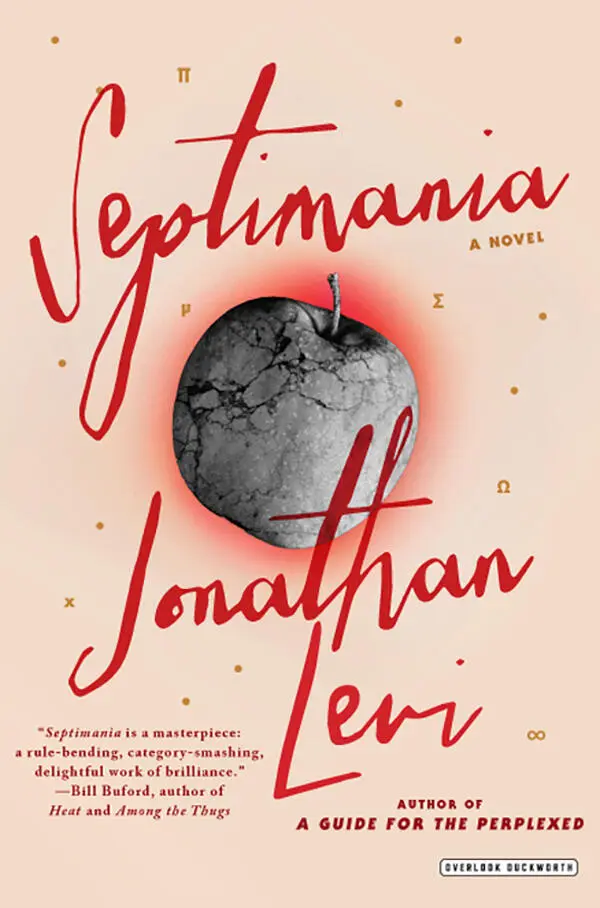
- Название:Septimania
- Автор:
- Издательство:The Overlook Press
- Жанр:
- Год:2016
- ISBN:нет данных
- Рейтинг книги:4 / 5. Голосов: 1
-
Избранное:Добавить в избранное
- Отзывы:
-
Ваша оценка:
Septimania: краткое содержание, описание и аннотация
Предлагаем к чтению аннотацию, описание, краткое содержание или предисловие (зависит от того, что написал сам автор книги «Septimania»). Если вы не нашли необходимую информацию о книге — напишите в комментариях, мы постараемся отыскать её.
Over the next fifty years, Malory’s search for Louiza leads to encounters with Pope John Paul II, a band of lost Romanians, a magical Bernini statue, Haroun al Rashid of Arabian Nights fame, an elephant that changes color, a shadowy U.S. spy agency and one of the 9/11 bombers, an appleseed from the original Tree of Knowledge, and the secret history of Isaac Newton and his discovery of a Grand Unified Theory that explains everything. It is the quest of a Candide for love and knowledge, and the ultimate discovery that they may be unified after all.
Septimania — читать онлайн бесплатно полную книгу (весь текст) целиком
Ниже представлен текст книги, разбитый по страницам. Система сохранения места последней прочитанной страницы, позволяет с удобством читать онлайн бесплатно книгу «Septimania», без необходимости каждый раз заново искать на чём Вы остановились. Поставьте закладку, и сможете в любой момент перейти на страницу, на которой закончили чтение.
Интервал:
Закладка:
“Unimaginable …” she sang, or said, or said and sang in a way that sounded like Patti Smith cynicism. “More than imaginary. Unimaginable …”
ACROSS RIVER ROAD, IN THE FARMERS’ MARKET, LOUIZA SAW THE GIRL and something gave out inside her. Or maybe something gave out even before she saw the girl, something that made her just want to fold her knees and settle on the hard earth of the round barn. Louiza steadied herself by one of the six poles that held up the roof of the shed and focused her eyes on what she was certain had sent a wave, a field, a beam of particles, a message of some sort to her and caused her to lose balance. She saw the girl from her right side. The girl was in profile, short fair hair hanging straight down to her earlobes, cut in a saw-tooth fringe at the forehead. She was filling a paper bushel sack with apples. She was wearing linen in a canvas color, a long-sleeved smock over rope-colored moccasins, no jewelry, no makeup. The canvas, against the yellows and greens and spotted browns of the late summer apples, was almost mathematical in the way it divided what the girl was examining from what was behind. Louiza stared.
“Hello,” the girl said. Louiza said nothing, but continued to stare. “Hello,” the girl said again. Other people turned to look. This was Louiza’s cue that she was back in the real world and that she could safely speak without being taken for a madwoman. The Unimaginables had been playing louder in recent months. Vince came to her more and more frequently with problems to solve. Mr. MacPhearson spoke to Vince in a way that Louiza wasn’t supposed to hear. There had been an exponential rise in the chatter on the Internet, on mobile phones, and even hidden within the print of major newspapers. With the help of the Unimaginables, Louiza was taking the chatter from all these key sources and from a significant number of insignificant ones as well, and with her elegant method of dividing by zero, focusing the messages into a lyric that Dodo could sing in her crystalline voice. Only Louiza could hear Dodo, of course, since Dodo was Unimaginable. But the woman speaking to her now was very real.
“Hello,” Louiza said. “Do I know you?”
“That depends,” the girl said. “Have you ever been to England?”
England? Louiza thought. What an odd thing to ask.
“No, I guess not,” the girl said. She smiled. Imperfect teeth, Louiza noticed, but a perfect smile. “Do I know you?” the girl asked. She lowered her sunglasses — Louiza realized that the girl was wearing sunglasses, very large sunglasses — and looked at Louiza. Her eyebrows were straw, almost canvas-colored themselves, but her eyes were a pale blue that … yes, perhaps Louiza did know her. The accent. The girl was a foreigner like her, but not from one nation in particular, an equation with more than one solution.
Unimaginable, she thought. Was this girl one of her Unimaginables? Louiza had lived alone with her girl band of zero-dividers for so long that she was less than completely surprised to find one of them buying Granny Smiths at the Farmers’ Market on River Road. She tried to make sense of the girl’s pale blue eyes, match them with the appropriate electric instrument, match the sound of the girl’s voice with the Unas and Dodos of the Unimaginable world. But it wasn’t the name of a girl that came out of her mouth but, unbidden, the name of a city in which she had once experienced, or so she thought she remem bered, the unimaginable.
“Rome,” Louiza said. “I know you from Rome.”
Now it was the girl’s turn to stare. It didn’t bother Louiza. It had been years since she had a chance to look at anybody. The one photograph she had of her mother among the sugar beets on the farm in Norfolk had long since stopped looking back at her.
“I grew up in Rome,” the girl said, “on the Aventino.”
“Malory,” Louiza said. “Malory,” she repeated. “Do you know someone named Malory?”
“Lou, honey?”
“Malory?” the girl said. And suddenly something in the entire shape of the girl aligned itself into an equation that Louiza recognized.
“Lou?”
Louiza felt the grip on her arm. She closed her eyes and opened them again, hoping the nightmare wasn’t real. But it was Vince and the smell of his aftershave and the pitted hollows of his cheeks.
“You’ll excuse us,” Vince said to the girl, “we have to get home.”
“Please,” the girl said. “We were having a very nice conversation.”
“I’m sorry,” Vince said, with his military politeness that ended all conversation. “But my wife hasn’t been well, and we’re pressed for time.” And quickly the world turned and River Road was in front of Louiza and they were walking to the car.
“Wait!” Vince was just buckling Louiza into the passenger seat when the girl ran up, sunglasses back in place. “You forgot your apples.” She handed Louiza the bag. Vince smiled and closed the door. Louiza couldn’t tell what the girl was thinking on the other side of the glasses. But Louiza was as certain it had something to do with Malory as she was certain that she hadn’t bought any apples.
Poor Malory, Louiza thought, as Vince turned the car and headed back up River Road. It was a combination of words that often came to her even after all these years, remembering how touched she had been, waking to the Vespers bells with her head on his chest, remembering how he’d carried her in his arms from that cold church down the streets of Rome, yes Rome! The more that Louiza lived with Una and Dodo and Terri and Quatro and all the Unimaginables, the more she began to imagine another universe in which, strangely enough, Malory continued to appear. Not as her husband, per se, although she had only the vaguest idea — no fault of Vince’s — of what a husband might be. But as a presence, a presence not always separate from her. She held conversations with the Malory in her mind, not just about Schrödinger and not just about cats, but about bare feet and snow and catching fireflies in an empty jam jar. There were long periods of the day, long days, maybe long weeks, when she heard organ music — not just faint, imagined music, the way just the buzz of electricity in the walls can make one imagine a little bit of Bach — but full-throated St. George’s, Whistler Abbey, organ music with stops out and pedals blazing and Louiza giggling, giggling — something she hadn’t done in years — with the Pip in her hand.
Louiza could barely remember Malory’s face. She could remember Malory’s number, –78, identical to hers. She could remember the sound of Malory’s voice, curled on her chest, resonating inside her like a sideways eight with its infinite regret — the regret of not saying goodbye after that day in the organ loft of St. George’s, not turning back to explain why she was leaving, why she was accepting the invitation of the Americans, why she was taking that red hand with the red hairs and stepping into that car, stepping into that Morris Minor, and then onto a plane, first to Rome — she was certain of it — and then across the Atlantic to this only imaginable world where everyone, from the beige-suited men to Vince, Mr. Kolodney, herself, and all the cats, were half-dead and half-alive.
Vince walked Louiza from the car across the porch and into the kitchen before returning outside. She heard voices. Vince was scolding somebody, many somebodies. Louiza took off her cardigan and hung it on the hook. She reached into the bag the woman gave her and bit into an apple. Uninvited, her hand began to stroke her belly. It was true what she remembered, she thought as she chewed. Her belly had once been bigger. There had been a time — she wiped the apple juice from her chin. There must have been. Rome. The woman with the gray eyes on the other bed. The giant with the beard and the strange accent. And life. There had been life — she took another bite — there had been a child growing in her, a child born, unimaginable if not. There had been Malory, –78, carrying her across the river, over the bridge, up the stairway of the hospital. And a child, their child, her child, Malory’s child, no other possibility, but a girl? A boy? What was it Malory had said about cats? Don’t look, they told her in Rome. A girl? A boy? Don’t look!
Читать дальшеИнтервал:
Закладка:
Похожие книги на «Septimania»
Представляем Вашему вниманию похожие книги на «Septimania» списком для выбора. Мы отобрали схожую по названию и смыслу литературу в надежде предоставить читателям больше вариантов отыскать новые, интересные, ещё непрочитанные произведения.











Обсуждение, отзывы о книге «Septimania» и просто собственные мнения читателей. Оставьте ваши комментарии, напишите, что Вы думаете о произведении, его смысле или главных героях. Укажите что конкретно понравилось, а что нет, и почему Вы так считаете.