Jonathan Levi - Septimania
Здесь есть возможность читать онлайн «Jonathan Levi - Septimania» весь текст электронной книги совершенно бесплатно (целиком полную версию без сокращений). В некоторых случаях можно слушать аудио, скачать через торрент в формате fb2 и присутствует краткое содержание. Год выпуска: 2016, Издательство: The Overlook Press, Жанр: Современная проза, на английском языке. Описание произведения, (предисловие) а так же отзывы посетителей доступны на портале библиотеки ЛибКат.
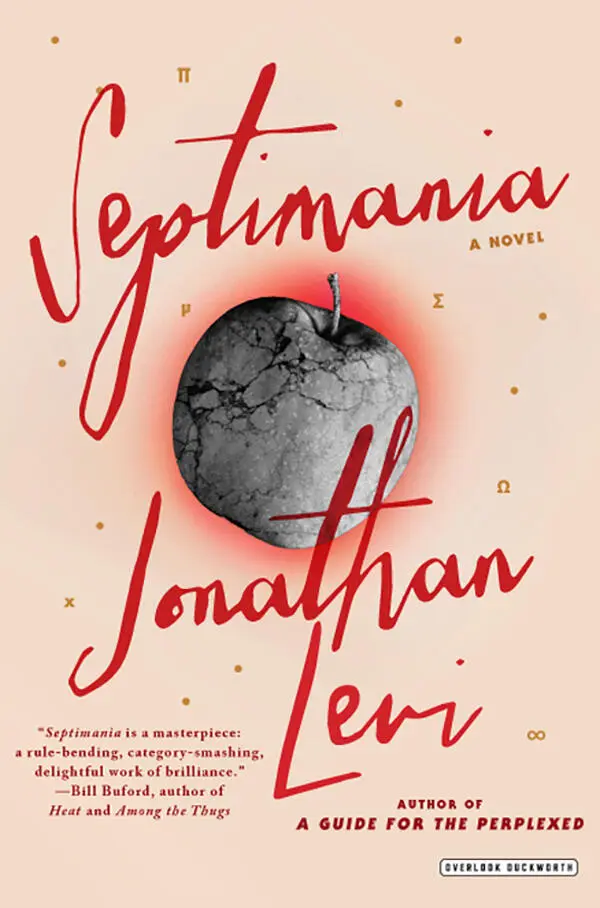
- Название:Septimania
- Автор:
- Издательство:The Overlook Press
- Жанр:
- Год:2016
- ISBN:нет данных
- Рейтинг книги:4 / 5. Голосов: 1
-
Избранное:Добавить в избранное
- Отзывы:
-
Ваша оценка:
Septimania: краткое содержание, описание и аннотация
Предлагаем к чтению аннотацию, описание, краткое содержание или предисловие (зависит от того, что написал сам автор книги «Septimania»). Если вы не нашли необходимую информацию о книге — напишите в комментариях, мы постараемся отыскать её.
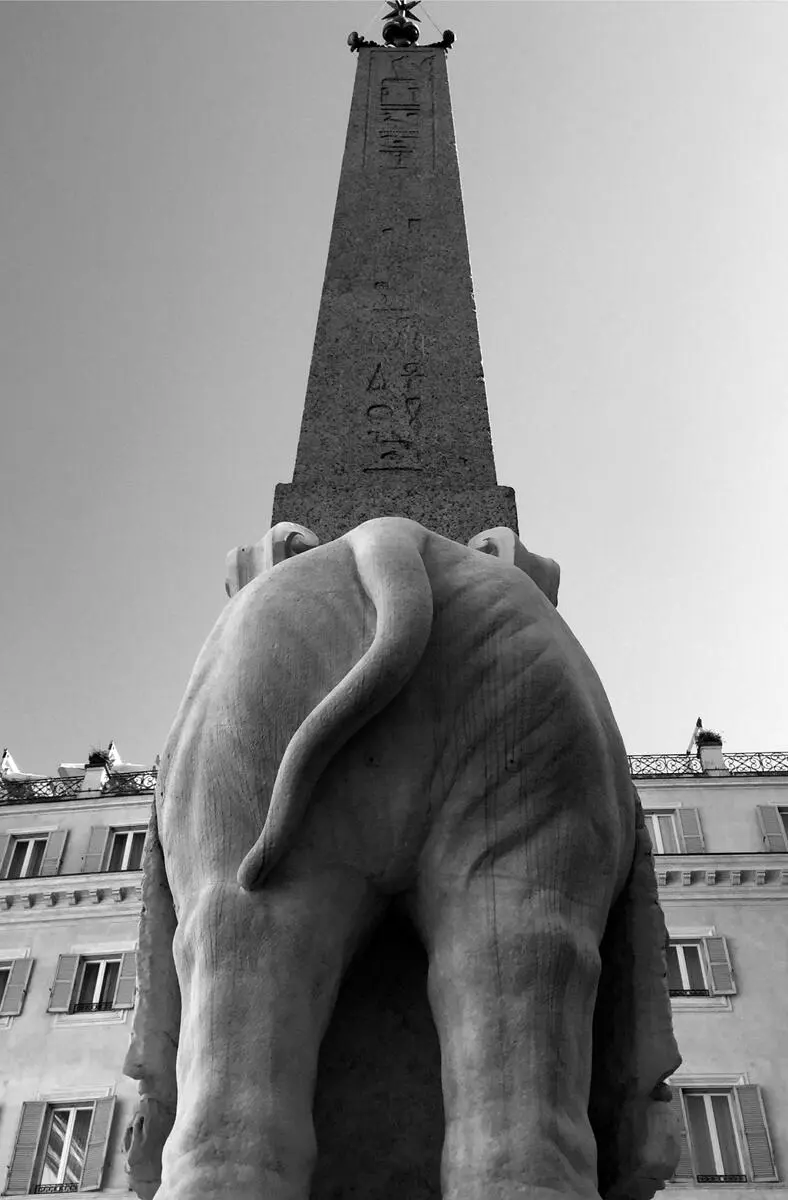
Over the next fifty years, Malory’s search for Louiza leads to encounters with Pope John Paul II, a band of lost Romanians, a magical Bernini statue, Haroun al Rashid of Arabian Nights fame, an elephant that changes color, a shadowy U.S. spy agency and one of the 9/11 bombers, an appleseed from the original Tree of Knowledge, and the secret history of Isaac Newton and his discovery of a Grand Unified Theory that explains everything. It is the quest of a Candide for love and knowledge, and the ultimate discovery that they may be unified after all.
Septimania — читать онлайн бесплатно полную книгу (весь текст) целиком
Ниже представлен текст книги, разбитый по страницам. Система сохранения места последней прочитанной страницы, позволяет с удобством читать онлайн бесплатно книгу «Septimania», без необходимости каждый раз заново искать на чём Вы остановились. Поставьте закладку, и сможете в любой момент перейти на страницу, на которой закончили чтение.
Интервал:
Закладка:
When Malory had finished writing, when he’d followed the alpha bet in the negative path of Louiza from the bricked-up arches of the omega back to the alpha of the apple of that first Pip, Malory laid down his pen and took up the box with Antonella’s ashes. In the fading light of the Roman evening, the two women approached the bench. Malory looked down into the box. What he saw was alive and it was dead, it was life and death, lives and deaths, Antonella and Louiza, Ottavia and Cristina, Tibor and Mrs. Emery, his Mother and Father, and as many as the fireflies that a Tuscan peasant saw in the imagination of a Florentine poet on a summer’s evening so many more years ago.
Malory looked up. The women sat on the bench beside him, Louiza on his left, Ottavia on his right, Antonella in the blue marbled box before him.
“Hello, Malory,” Louiza said.
“Hello, Father,” Ottavia said, “may we come up?”
And Malory felt that he had grown. In the fading light, he looked down at the uplifted faces of Louiza and Ottavia. Had he risen from the bench, or floated up like Bernini’s apple, balanced by the force of the two women — the scientist on one side and the Queen on the other? In the deepening dark, it was impossible to say whether the old man with the faded red beard and the tartan flannel across his lap might roll in his wheelchair towards Malory and break the ascension. But for a moment, all laws, all rules were suspended. Sometime very soon, perhaps, others would stand on his shoulders. Ottavia, her daughter, others would straddle a Vespa and ride into their own Septimanias, away from their Louizas, towards their Louizas. But for now, he was on the topmost layer with no need of religion or science. Malory, his world, his universe, were in tune.
Acknowledgments
 EPTIMANIA TOOK ROOT AT THE BEAUTIFUL ROCKEFELLER FOUNDATION villa above Bellagio, Italy, where I spent a month of tranquility and creation with ten other fellows in late 2007. Down the hill, the Foundation was simultaneously hosting a conference on developing low-cost drugs to battle African diseases. One evening, our two groups came together for cocktails, and I spoke with a young doctor — a genuine hero from a small village in Mozambique — who had traveled out of Africa, out of his country for the first time in his life. He told me why he was in Bellagio; I told him why I was there. But even after I had told him twice, he couldn’t believe that I was being housed and fed and supported in order to write a story.
It is extraordinary. And I have received extraordinary support from many sources. My editor Allyson Rudolph championed my book to Overlook Press and its celebrated owner Peter Mayer. My agent Ayesha Pande guided me with elegance and acumen through a marathon of rewrites in unerring belief and affection for Septimania . The poet Robert Pinsky not only introduced me to The Inferno of Dante, but also generously gave me permission to incorporate freely his extraordinary translation.
But it is the unquestioning belief of my family — of my children, Rebecca, Gabriel, and Mimi, of my wife, Stephanie, and my parents, Judith and Isaac, who have followed the changing fortunes of Malory and Louiza with patience and the advice of their wider lives — that has sustained me the most and has taught me the true meaning of copeability.
~ ~ ~
About the Author

JONATHAN LEVIis an American writer and producer, and author of A Guide for the Perplexed . His short stories and articles have also appeared in many magazines including Granta, GQ, Terra Nova, The Nation, Condé Nast Traveler , and The New York Times . Born in New York, he currently lives in Rome, Italy.
Интервал:
Закладка:
Похожие книги на «Septimania»
Представляем Вашему вниманию похожие книги на «Septimania» списком для выбора. Мы отобрали схожую по названию и смыслу литературу в надежде предоставить читателям больше вариантов отыскать новые, интересные, ещё непрочитанные произведения.











Обсуждение, отзывы о книге «Septimania» и просто собственные мнения читателей. Оставьте ваши комментарии, напишите, что Вы думаете о произведении, его смысле или главных героях. Укажите что конкретно понравилось, а что нет, и почему Вы так считаете.