Jonathan Levi - Septimania
Здесь есть возможность читать онлайн «Jonathan Levi - Septimania» весь текст электронной книги совершенно бесплатно (целиком полную версию без сокращений). В некоторых случаях можно слушать аудио, скачать через торрент в формате fb2 и присутствует краткое содержание. Год выпуска: 2016, Издательство: The Overlook Press, Жанр: Современная проза, на английском языке. Описание произведения, (предисловие) а так же отзывы посетителей доступны на портале библиотеки ЛибКат.
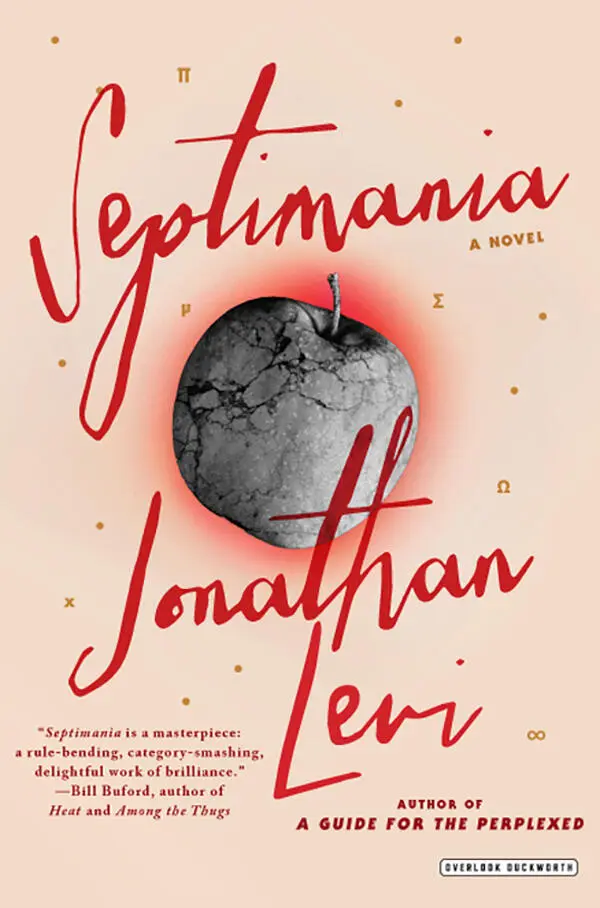
- Название:Septimania
- Автор:
- Издательство:The Overlook Press
- Жанр:
- Год:2016
- ISBN:нет данных
- Рейтинг книги:4 / 5. Голосов: 1
-
Избранное:Добавить в избранное
- Отзывы:
-
Ваша оценка:
Septimania: краткое содержание, описание и аннотация
Предлагаем к чтению аннотацию, описание, краткое содержание или предисловие (зависит от того, что написал сам автор книги «Septimania»). Если вы не нашли необходимую информацию о книге — напишите в комментариях, мы постараемся отыскать её.
Over the next fifty years, Malory’s search for Louiza leads to encounters with Pope John Paul II, a band of lost Romanians, a magical Bernini statue, Haroun al Rashid of Arabian Nights fame, an elephant that changes color, a shadowy U.S. spy agency and one of the 9/11 bombers, an appleseed from the original Tree of Knowledge, and the secret history of Isaac Newton and his discovery of a Grand Unified Theory that explains everything. It is the quest of a Candide for love and knowledge, and the ultimate discovery that they may be unified after all.
Septimania — читать онлайн бесплатно полную книгу (весь текст) целиком
Ниже представлен текст книги, разбитый по страницам. Система сохранения места последней прочитанной страницы, позволяет с удобством читать онлайн бесплатно книгу «Septimania», без необходимости каждый раз заново искать на чём Вы остановились. Поставьте закладку, и сможете в любой момент перейти на страницу, на которой закончили чтение.
Интервал:
Закладка:
Still, for Malory the world of Cambridge was encapsulated in a crazed and greasy globe of Perspex. There was a film over all his senses, and trying to rub it away only moved the streaks from one quadrant to another. He began to tune organs at two churches, then a dozen. He ate two, sometimes three meals a day with Antonella and watched the Nine O’Clock News with her on an ever-renewing range of television sets. He spoke, he heard, he saw. But he made little attempt to pop his ears or adjust the aperture of his telescope. And on the few occasions he did — when he found himself by the front gate of Trinity College, or on the towpath by the river — a sharp tweak of the lens only brought his pain into focus with the force of a light from a distant galaxy and warned him away from even thinking about Louiza, for her own safety.
From time to time, Malory believed that people were watching him. Occasionally he thought he recognized one or two of the Americans from The Gables. But no one was stopping him from doing anything, perhaps because he was doing nothing. No one came for Malory — on a Vespa, in a police car, or with the stealth and ingenuity that followed the marriage of technology and suspicion in the new century. Whether Malory’s interest in the world died before the world’s interest in Malory, or whether both died from the removal of whatever had nurtured their ambitions, it was impossible to say. But to all appearances, Malory returned to the same unremarkable counting of time that had preceded the afternoon when Louiza found him in the organ loft of St. George’s Church, Whistler Abbey, with little left of his ambition to tune the world.
From time to time, Antonella persuaded Malory to climb into her car — an updated cream-colored Cinquecento — to drive for an after noon, to walk in the gardens of Anglesey Abbey, or shop for a skirt in Bishops Stortford or a jumper in Saffron Walden, or eat cakes at the Old Fire Engine House across a damp field from the isolated Norman pile of Ely Cathedral. Occasionally Antonella would invite a pair of undergraduates home for Sunday dinner, and occasionally one would get into conversation with Malory about Newton which would, on rare occasions, lead to more teas and lunches and a semi-official advisory capacity for Malory over the student’s studies, with the benediction of the Maths Faculty. It was Antonella’s way of bringing Malory back into the world.
The world assumed that Malory and Antonella were married or, even better, living in the presumed excitement of sin at an age when mystery existed only in sixty-minute segments on television. They kept their separate bedrooms, although Antonella was convinced that, if she had climbed into Malory’s bed with the red-haired fullness that had lost nothing to the birth of her two children and gained something with widowhood, Malory would have done whatever she asked of him. But the thought — the one or two times she allowed it — filled her with a horror: not that she would be making Malory do something unpleasant, but that the patience of all those years of waiting for Malory to come to her would be shot as full of holes as that poor Aldo Moro in the boot of the Renault 4.
It was enough to bring Malory into the world, to return him into the tuning, the tutoring, the Saturday morning organ lessons at Impington Village College for the children of the fens. More than to her bed, she craved to take Malory back to Rome, or rather have Malory take her. They had walked there only once, the night of the Divine Comedy . She wanted to walk through the Christmas fun fair at Piazza Navona and eat roasted chestnuts and lentils at New Year. She wanted to take him down to the open-air cinema along the river in July, to the Celimontana, to Villa Ada with its smell of citronella and cardamom, for jazz and reggae and bad Italian pop stars at the PalaLottomatica. Antonella wanted to feed cacio e pepe to Malory at Felice’s in Testaccio and to watch him eat chocolate cake with panna in the driveway of Augustarello, where the plastic chairs and tables migrated every summer in flight from the oven. Most of all, she wanted to take him up to the Giardino degli Aranci, the Garden of the Oranges, where, as a young convent girl, she had first developed a love of mathematics, counting the fallen fruit and measuring it against the future harvest. Antonella was convinced with the smattering of maths she’d picked up in her years of service at the Faculty, that more than any theoretical notion of forgiveness or forgetting, a positive Roman Holiday was needed to cancel out the negative of that Christmas Roman mistake.
Even without Rome, Antonella was more than content with each new year to have Malory in her life, in her flat, at her table, even if much of the day he pedaled away from her bay window out the Coton footpath to nowhere in particular. She was hardly a victim of the centrifugal motion of the Earth. But similarly she never pretended that anything she might do would sway its course or align it into more perfect motion.
On the day that the Times announced Cristina’s death on page five, Antonella made no attempt to hide the news from Malory.
“The paper mentions Tibor,” Malory said — and Antonella noticed, with mixed emotions that he didn’t look over at her with either censure or memory—“but it doesn’t mention her daughter.”
“There was a daughter?” Antonella asked. “Back in Rumania or later?”
“In Rome,” Malory said, eyes still on the photo of Cristina. “They gave her up for adoption, but then found her again later. Nice girl. Read maths at Cambridge, I think. Maybe you ran into her. Must have been twenty years ago.”
“Militaru?” Antonella didn’t remember any Militarus. Although the Johnsons and Davidsons and Georges and Wilkinsons passed through her mind without leaving a trace, the foreign names — the Selasis and Szegeds and Algaríns and of course the Antonellis — remained with imported postcards and stories of distant relatives who couldn’t understand why their children thought they could feed a family with the study of mathematics.
“I don’t know what surname she used,” Malory said. “She was brought up by nuns in Rome. Santa Sabina, I think.”
“Ottavia?” The name came out of Antonella’s mouth uncalled by memory.
“Yes, Ottavia,” Malory said, looking up. “Did you know her?”
“Santa Sabina,” Antonella said. “Of course my Malory remembers nothing about his Antonella. But that is where I went to school, although of course I had a home to return to at the end of every day.” And indeed, Cranmer Road had served as an occasional home for Ottavia during her studies, so thirsty was Antonella for any news of her Rome that didn’t come over the television, even though Ottavia’s news was removed by a generation from her own childhood. Antonella put away the tea and biscuits and served Ottavia espresso and baked her a crostata and listened to her problems with boys and England, even as she wished her own son might take interest in this underfed girl.
“Ottavia is Cristina’s daughter,” Malory said.
“That’s impossible,” Antonella said. “Look at Cristina, Malory. Ottavia was a little mouse, not this high-cheekboned, gray-haired movie star! Who told you she was Cristina’s daughter? Tibor?”
It was that red-haired old man. The one who had asked him all those questions the day after. The one who had been in the Ospedale Fatebenefratelli, who might even have been at the Orchard. Malory couldn’t remember his name. But he remembered something he had told Malory, something Malory had stored in a box he had been afraid to open for twenty years.
“She’s your daughter,” the red-bearded man had told him. “But she’s also Tibor’s.”
Читать дальшеИнтервал:
Закладка:
Похожие книги на «Septimania»
Представляем Вашему вниманию похожие книги на «Septimania» списком для выбора. Мы отобрали схожую по названию и смыслу литературу в надежде предоставить читателям больше вариантов отыскать новые, интересные, ещё непрочитанные произведения.











Обсуждение, отзывы о книге «Septimania» и просто собственные мнения читателей. Оставьте ваши комментарии, напишите, что Вы думаете о произведении, его смысле или главных героях. Укажите что конкретно понравилось, а что нет, и почему Вы так считаете.