Jonathan Levi - Septimania
Здесь есть возможность читать онлайн «Jonathan Levi - Septimania» весь текст электронной книги совершенно бесплатно (целиком полную версию без сокращений). В некоторых случаях можно слушать аудио, скачать через торрент в формате fb2 и присутствует краткое содержание. Год выпуска: 2016, Издательство: The Overlook Press, Жанр: Современная проза, на английском языке. Описание произведения, (предисловие) а так же отзывы посетителей доступны на портале библиотеки ЛибКат.
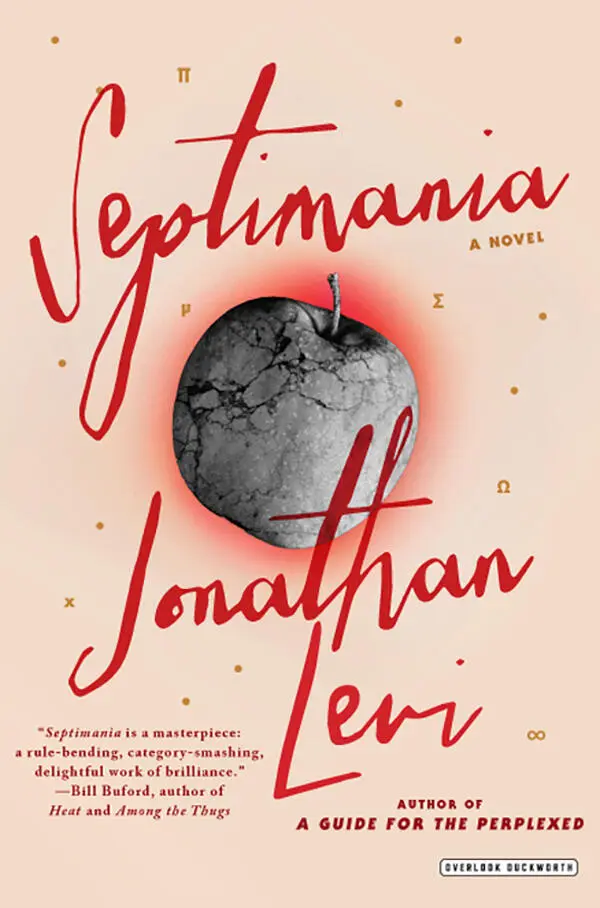
- Название:Septimania
- Автор:
- Издательство:The Overlook Press
- Жанр:
- Год:2016
- ISBN:нет данных
- Рейтинг книги:4 / 5. Голосов: 1
-
Избранное:Добавить в избранное
- Отзывы:
-
Ваша оценка:
Septimania: краткое содержание, описание и аннотация
Предлагаем к чтению аннотацию, описание, краткое содержание или предисловие (зависит от того, что написал сам автор книги «Septimania»). Если вы не нашли необходимую информацию о книге — напишите в комментариях, мы постараемся отыскать её.
Over the next fifty years, Malory’s search for Louiza leads to encounters with Pope John Paul II, a band of lost Romanians, a magical Bernini statue, Haroun al Rashid of Arabian Nights fame, an elephant that changes color, a shadowy U.S. spy agency and one of the 9/11 bombers, an appleseed from the original Tree of Knowledge, and the secret history of Isaac Newton and his discovery of a Grand Unified Theory that explains everything. It is the quest of a Candide for love and knowledge, and the ultimate discovery that they may be unified after all.
Septimania — читать онлайн бесплатно полную книгу (весь текст) целиком
Ниже представлен текст книги, разбитый по страницам. Система сохранения места последней прочитанной страницы, позволяет с удобством читать онлайн бесплатно книгу «Septimania», без необходимости каждый раз заново искать на чём Вы остановились. Поставьте закладку, и сможете в любой момент перейти на страницу, на которой закончили чтение.
Интервал:
Закладка:
And then?
And then, of course, Ottavia came back. Without her man. I stood up. We went back out into the snow.
Without Malory?
Don’t you understand, Cristina? Newton found the equation to describe the attraction between two moving bodies at a distance. But three bodies in motion — that was too much for his mathematics. For anyone’s mathematics.
What does that have to do with Malory?
I met Malory the day that I was awarded my PhD. It wasn’t much, my thesis, just a simple equation: i = u , an identity, a relationship of two bodies. Ottavia and her young physicist pointed their equipment at the Pip, believing, in this digital century, that we can be quantified, boiled down into numbers that are the sum totals of all the little packets of information of the things we Google or Like or the keys we touch when we send the private messages of our unconscious wishes as we shop on Amazon or flirt on our cell phones. But that’s not why i = u is so powerful. That’s not why we aren’t with Malory.
What happened?
A third element entered the equation.
Ottavia, Malory, and me. It’s a Three-Body Problem. There is so much to tell Malory, so much I want to tell him, waking up after all these years. But Malory has to open his eyes, listen to the music. Malory has to follow the unimaginable.
3/6
 HYSICISTS, MATHEMATICIANS, AND A HANDFUL OF ARTISTS MAY have the luxury to dream about alternate universes of dead cats and live cats and ten-dimensional cats of many colors. But Antonella returned to Cambridge in the middle of January 1979 with a job that was balancing on the precarious edge of her visa. She had dreamed about Malory, she had boiled kettles and asked impertinent questions to porters and junior faculty. She had traveled on her infrequent holiday and scanty budget to Rome for Malory. But she had blinked. She had blinked when Tibor confused her one Christmas morning. And although that blink spawned many tears, eventually her eyes opened back onto the damp on the skirting of her bedsit and a series of days measured out more in chocolate biscuits than in mathematical units.
For her own preservation, she succumbed to one of the up-and-comers in the Faculty — a willowy, insinuating statistician who wore his confidence in orange and honey patterns of tweed and persisted in following Antonella with a patience not dissimilar from her own with Malory. Antonella gave in. The two children she bore him gave in. And by the time the willowy cad succumbed to a shoddy death, hushed up during a conference on fractals in Málaga, the boy had escaped to study trees in Zambia and the girl to parts unknown — which Antonella believed to be the cottage of a gardener on an estate just outside of Newmarket. She was alone in the flat she had dreamed into being on Cranmer Road, with souvenirs of a family and the Times of London on her doorstep.
The flat on Cranmer Road was the garden level of one side of a freestanding two-story building, with a semi-circle gravel drive in front guarded by two stone lions and a gardener’s shed in the back that her late husband had imagined stocking with wines and their associated machinery if he ever won the Fields Medal. As English as the garden flat was, Antonella over the years filled the vacuum of her family’s negligence with strings of garlic and pepperoncino, fruit bowls from Deruta, and five-liter drums of olive oil. And she continued to be useful. Organizing guest socials for the Maths Faculty, teaching romantic Italian conversation to ambitious Girton girls intent on trading their sensible cardigans for a Palermo fling with the Alain Delons or Vittorio Gassmen they were certain were pining for a pale British hand.
Old Rix, the Head Porter of Trinity, adopted her, both after Malory’s initial disappearance from Cambridge and especially upon her return from Rome. When Sybil Rix returned from her own failed marriage to her father’s home, she and Antonella took it in turns to prop up the old man as age fought with his sense of duty and decorum. There was nothing surprising about Antonella’s presence at Rix’s funeral, and indeed something natural about her rescue of Malory, frozen on the bench of the organ in Trinity Chapel.
The current Organ Scholar had stepped in and played the service as Antonella, with the aid of a junior porter, escorted Malory down the steps from the loft and to a folding chair in the antechapel. Malory let her lead him, let her bring him a glass of water. After the service, Antonella sat with Sybil and Sybil sat with Malory, touched by the depth of feeling she assumed had overwhelmed Malory at the shock of her father’s death. Yet as they walked under the Wren Library and across the Trinity Bridge, the first autumn acers in the Clare Gardens beginning to turn, there was no sign that Malory knew who Antonella was. And when they’d pulled Malory’s suitcase up Burrell’s Lane past the familiar bulk of the University Library and the unfamiliar wall of Robinson College, when they’d turned into the house at the end of Cranmer Road and Antonella had sat Malory down at her kitchen table, not even a cup of tea broke through the cuirass and buckler and greaves and helmet of resignation that Malory had donned in that single moment of commune with Newton in the organ loft of the Trinity Chapel.
Sybil rang at nine that evening to see how Antonella was getting on. Malory was unchanged. He sat where Antonella led him. He ate the carbonara she placed in front of him. He followed her to her son’s bedroom — or at least the bedroom she had reserved for her son if he ever decided to come home to a Cambridge that was free of the sarcasms of his father if not the memories of childhood. He sat contentedly, or at least without complaint, at the edge of her son’s bed as she opened up Malory’s suitcase and laid out his toiletries and took away the dirty laundry of his journey. She would put him up for the night, she told Sybil. In the morning, she was certain he would be fine.
But the morning was the same. Antonella opened the bedroom door at 8 a.m. and found Malory lying on his back with the covers pulled up to his chin, eyes open and fixed on the infinite space between his nose and the ceiling. She spoke to him, asked how he had slept, what he wanted for breakfast. Without an answer, she left the door half open and went into the kitchen. She put a flame under the macchinetta , scrambled some eggs, toasted some bread, set out butter and jam — she hadn’t been prepared for a guest, after all. When she went to find Malory, she found him dressed — clearly he had lain down the night before without removing a single piece of clothing. She led him to the bathroom. He knew enough to stand, to sit, to unzip and relieve himself. She put soap in his hand, toothpaste on a fresh toothbrush she kept because she had more hope than company, and made certain that whatever part of Malory’s brain was still functioning knew how to brush teeth. The eggs and the toast were cold, but that didn’t bother Malory. He ate, he drank tea. He sat.
Antonella cleared the dishes, washed them in the sink, set them in the rack. She was just drying her hands on a Florentine dishtowel — there had, in the past, been family trips, presents, affection once bottled if long uncorked — when he spoke.
“Biscuit?”
“Excuse me?”
“Might you have a biscuit?” Malory asked. His voice sounded strange to Antonella, touched with an Italian precision; she would not have recognized it over the telephone. “A chocolate biscuit?” With each bite, with each dip of Antonella’s hand into the tin for another biscuit, and another, the old Malory returned, the Malory she had remembered loving in a time when she was very young and very foolish. And as the bites turned into days and the days into weeks, Malory, against the odds of Tibor, against the marble stare of Newton, turned fifty. And fifty-one. And two.
Читать дальшеИнтервал:
Закладка:
Похожие книги на «Septimania»
Представляем Вашему вниманию похожие книги на «Septimania» списком для выбора. Мы отобрали схожую по названию и смыслу литературу в надежде предоставить читателям больше вариантов отыскать новые, интересные, ещё непрочитанные произведения.






Обсуждение, отзывы о книге «Septimania» и просто собственные мнения читателей. Оставьте ваши комментарии, напишите, что Вы думаете о произведении, его смысле или главных героях. Укажите что конкретно понравилось, а что нет, и почему Вы так считаете.