Jonathan Levi - Septimania
Здесь есть возможность читать онлайн «Jonathan Levi - Septimania» весь текст электронной книги совершенно бесплатно (целиком полную версию без сокращений). В некоторых случаях можно слушать аудио, скачать через торрент в формате fb2 и присутствует краткое содержание. Год выпуска: 2016, Издательство: The Overlook Press, Жанр: Современная проза, на английском языке. Описание произведения, (предисловие) а так же отзывы посетителей доступны на портале библиотеки ЛибКат.
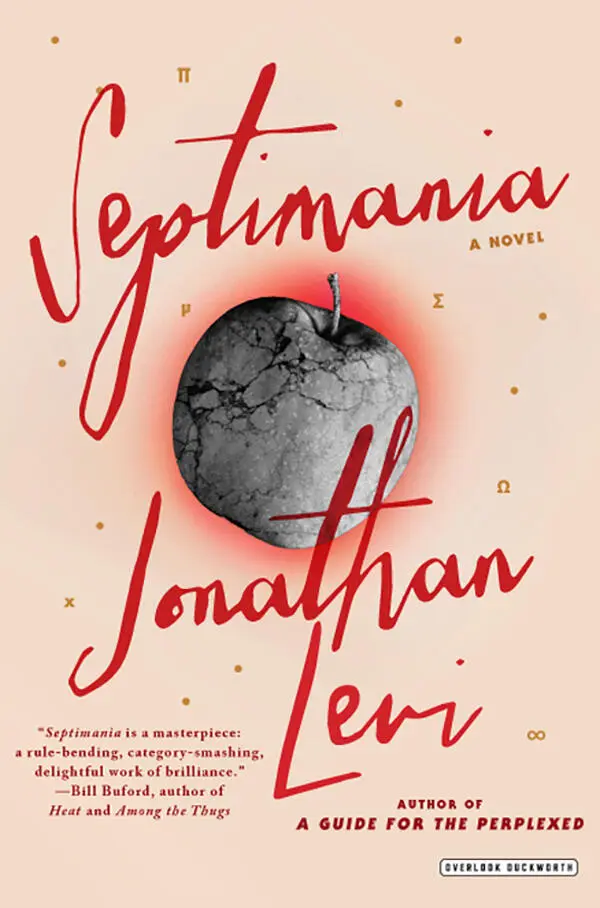
- Название:Septimania
- Автор:
- Издательство:The Overlook Press
- Жанр:
- Год:2016
- ISBN:нет данных
- Рейтинг книги:4 / 5. Голосов: 1
-
Избранное:Добавить в избранное
- Отзывы:
-
Ваша оценка:
Septimania: краткое содержание, описание и аннотация
Предлагаем к чтению аннотацию, описание, краткое содержание или предисловие (зависит от того, что написал сам автор книги «Septimania»). Если вы не нашли необходимую информацию о книге — напишите в комментариях, мы постараемся отыскать её.
Over the next fifty years, Malory’s search for Louiza leads to encounters with Pope John Paul II, a band of lost Romanians, a magical Bernini statue, Haroun al Rashid of Arabian Nights fame, an elephant that changes color, a shadowy U.S. spy agency and one of the 9/11 bombers, an appleseed from the original Tree of Knowledge, and the secret history of Isaac Newton and his discovery of a Grand Unified Theory that explains everything. It is the quest of a Candide for love and knowledge, and the ultimate discovery that they may be unified after all.
Septimania — читать онлайн бесплатно полную книгу (весь текст) целиком
Ниже представлен текст книги, разбитый по страницам. Система сохранения места последней прочитанной страницы, позволяет с удобством читать онлайн бесплатно книгу «Septimania», без необходимости каждый раз заново искать на чём Вы остановились. Поставьте закладку, и сможете в любой момент перейти на страницу, на которой закончили чтение.
Интервал:
Закладка:
But then there was Tibor’s palm. Malory descended the stairs, and Tibor’s palm landed on his shoulder. It pushed Malory up now, up the slope from the Blue House to the pond below the White House, the way the palm had guided him through the streets of Rome twenty-three years before. They walked in silence, slowly. But Tibor’s palm registered a real warmth. If the sum of the workings of Tibor’s brain no longer passed through his shaven and barren face, its heat still found its way somehow down a hidden channel in the neck and out the shoulder and arm to this one palm. Through this palm ran a trickle of confidence, a bond that had once been forged between them — if only to be fractured — twenty-three years ago.
“Tibor,” Malory began.
“Shh, shh,” Tibor waved the cigarette in front of his face, launching fireflies of ash and spark.
“Tibor,” Malory insisted. “How are you?”
Tibor stopped. He didn’t look at Malory, but he withdrew his palm.
“Is that a scientific question?”
“That morning,” Malory said, realizing that this might be his only chance to broach the inevitable subject. “That Christmas morning. Antonella.”
“Antonella?” Tibor repeated. “Who the fuck is Antonella?”
“My colleague from Cambridge? The Christmas party after the Dante? The redhead? The one you promised to protect, but instead …”
“The Pip, Malory,” Tibor said. “Did you bring the Pip?”
Malory stopped walking. And in one lung-squeezing moment of degutted breathlessness, Malory realized that what he had seen that Christmas morning — the image of Tibor making love to Antonella, an image of horror and beauty and infinite betrayal — didn’t exist, no longer existed, perhaps had never existed for Tibor. The stone that had lodged in the tightest corners of Malory’s intestines was rock of his own invention — or if not invention, then preservation. Tibor, or Tibor’s memory, or perhaps all the alcohol that Tibor had swallowed in the past twenty-three years, had excavated the memory of that night, that action, that betrayal as completely as ten thousand Dacian slaves had torn down a mountain of volcanic rock to create room for a column to the memory of their own defeat. Malory looked at Tibor’s face, a face that even in its bearded tangle once had a power and conviction that had made Malory feel safe and honored by its friendship. That face was blank, dry, begging for something from Malory. With the tip of his smallest fingernail, Malory poked the column of his twenty-three-year-old memory of betrayal, and it fell to the ground in ash and blew into the pines.
What it revealed was a light that shone back into his face.
“Stay,” Louiza had told him all those years ago as he left the maternity ward at Fatebenefratelli.
“Stay,” Antonella had told him as the Rumanians had carried her off to the Dacia.
Louiza had trusted him to return, Antonella had trusted him.
But Malory had been late. He had been curious. He had betrayed them both.
But that wasn’t it.
Gone was his anger at Tibor. Gone his disappointment with Antonella. Instead a vision rose up in front of him, behind him, refracted in all the shades of the rainbow as his memory fed freely on the months and the years. It was the vision of his own betrayal.
Malory had ignored the simple, he had slipped off the towpath. Malory had betrayed the obvious, the gift that had climbed the ladder to the steeple of St. George’s that March morning. Malory had betrayed the gift that Louiza had brought him, the vision of what he could become. He had committed that crime alone, without the help of Tibor, Antonella, or Settimio. He had hidden it behind a veil of red hair and Rumanian beard. And for that, he had served a sentence of twenty-three years in Septimania.
“The Pip, Malory,” Tibor repeated. “Did you bring the Pip?”
“Why?” Malory asked. The vision slunk away into the trees around the pond. The air grew light. Malory breathed. “It’s only an apple pip.”
“Then you won’t mind giving it to me?” Tibor asked. “If it’s only an apple pip.”
“Why the Pip?” Malory said.
“For a performance.” Tibor squeezed Malory’s shoulder with a pressure that seemed both kinder and more insistent than before. “A performance tonight. One show only, I promise. You’ll get it back.”
“Tibor”—Malory surprised Tibor with the shift of register and cadence—“there was a baby. Back then. In Rome.” Malory had one more question before he could feel entirely free. “A few years later, Settimio told me that the press, the public thought Cristina had a stillbirth in Rome, a miscarriage, uterus ravaged from Bucharest abortions. But that isn’t the truth, is it? Cristina had a baby. That day I met you. She did, didn’t she?” The Ospedale Fatebenefratelli. Louiza. Cristina. Images that hadn’t faded during his hermitage. “There was a baby. Is Ottavia that baby?”
“Has it occurred to you, Malory,” Tibor said, his hand dropping from Malory’s shoulder, “that maybe Ottavia is Louiza’s baby?”
“Louiza?” Malory repeated. Of course the thought had occurred to him, in that fraction of a moment when Ottavia first found him in the Villa Septimania. But he had filed it in the cabinet where he kept similar thoughts, like waking up one morning ten inches taller or with a PhD.
“Who had a baby in Fatebenefratelli, Malory? Cristina? Louiza? You? Me? Who are the fathers? Who are the mothers? ‘Oh the streets of Rome ,’ ” Tibor sang:
are filled with rubble,
Ancient footprints are everywhere .
Malory remembered Sasha and his guitar, the Dacia, the first warm night of Rumanian friendship in Rome. And Tibor’s voice, if not completely in tune, still closer than ten minutes before:
You could almost think that you’re seeing double
On a cold, dark night on the Spanish Stairs.
“And the baby?” Ottavia appeared. Had she been standing with them all along, hidden by her smallness? “Who was the baby?”
Tibor laughed — impossible to know what image from what Fellini that laughter hid. “You, Ottavia,” he said, “were the one we pretended was our daughter. When it was convenient.”
“On Family Days,” Ottavia said.
“And other days. Ones you didn’t see.”
“But not when I needed.”
“No,” Tibor said quietly, “maybe not. Maybe I have been wrong. Eternally wrong.”
“What’s the matter, Tibor?” Malory asked.
“I lack the Pip,” Tibor answered.
“Why the Pip?”
“You told me the story of how your Virgin Louiza, your mathematical Eve, found the Pip and not only tuned your organ, but tuned your organ!”
“Tibor, Ottavia is …”
“So … isn’t it possible that there is a power in that Pip? Isn’t it possible that, if you are descended from King David and Charlemagne and who knows how many other Grand Poo-Bahs, that your Pip is the great-grandson of that original apple from that original tree? That your Pip holds the sum of all human knowledge? And isn’t it just possible that if I swallowed the Pip with a glass of the purest rainwater, I will not only find out why I make La Principessa and Ottavia and everyone around me — and I’m including you, Malory — so unhappy? But maybe, as a bonus, the Pip will raise my pickled limp puli like Lazarus from the dead and I’ll get laid once more before I die?”
“Tibor,” Malory said, “it’s just an apple pip. If it had been able to solve anyone’s problems, don’t you think it would have solved mine?”
“The Pip, Malory. I need the Pip.” Tibor placed both his paws on Malory’s shoulders. There was such a frightening lack of harmony in his voice — not even close to the F-sharp of twenty-three years earlier, a far more desperate sound oozing from Tibor’s throat.
Читать дальшеИнтервал:
Закладка:
Похожие книги на «Septimania»
Представляем Вашему вниманию похожие книги на «Septimania» списком для выбора. Мы отобрали схожую по названию и смыслу литературу в надежде предоставить читателям больше вариантов отыскать новые, интересные, ещё непрочитанные произведения.











Обсуждение, отзывы о книге «Septimania» и просто собственные мнения читателей. Оставьте ваши комментарии, напишите, что Вы думаете о произведении, его смысле или главных героях. Укажите что конкретно понравилось, а что нет, и почему Вы так считаете.