Jonathan Levi - Septimania
Здесь есть возможность читать онлайн «Jonathan Levi - Septimania» весь текст электронной книги совершенно бесплатно (целиком полную версию без сокращений). В некоторых случаях можно слушать аудио, скачать через торрент в формате fb2 и присутствует краткое содержание. Год выпуска: 2016, Издательство: The Overlook Press, Жанр: Современная проза, на английском языке. Описание произведения, (предисловие) а так же отзывы посетителей доступны на портале библиотеки ЛибКат.
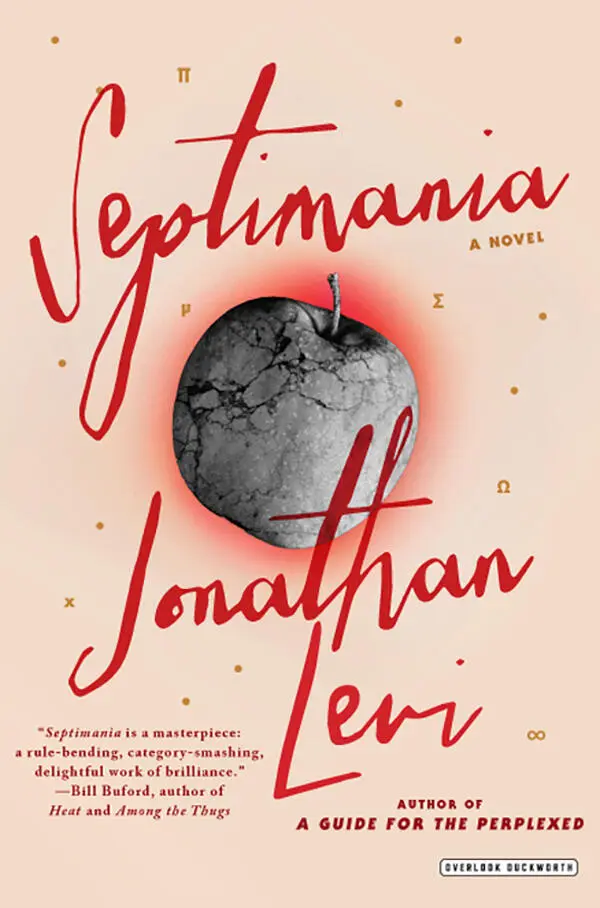
- Название:Septimania
- Автор:
- Издательство:The Overlook Press
- Жанр:
- Год:2016
- ISBN:нет данных
- Рейтинг книги:4 / 5. Голосов: 1
-
Избранное:Добавить в избранное
- Отзывы:
-
Ваша оценка:
Septimania: краткое содержание, описание и аннотация
Предлагаем к чтению аннотацию, описание, краткое содержание или предисловие (зависит от того, что написал сам автор книги «Septimania»). Если вы не нашли необходимую информацию о книге — напишите в комментариях, мы постараемся отыскать её.
Over the next fifty years, Malory’s search for Louiza leads to encounters with Pope John Paul II, a band of lost Romanians, a magical Bernini statue, Haroun al Rashid of Arabian Nights fame, an elephant that changes color, a shadowy U.S. spy agency and one of the 9/11 bombers, an appleseed from the original Tree of Knowledge, and the secret history of Isaac Newton and his discovery of a Grand Unified Theory that explains everything. It is the quest of a Candide for love and knowledge, and the ultimate discovery that they may be unified after all.
Septimania — читать онлайн бесплатно полную книгу (весь текст) целиком
Ниже представлен текст книги, разбитый по страницам. Система сохранения места последней прочитанной страницы, позволяет с удобством читать онлайн бесплатно книгу «Septimania», без необходимости каждый раз заново искать на чём Вы остановились. Поставьте закладку, и сможете в любой момент перейти на страницу, на которой закончили чтение.
Интервал:
Закладка:
What did he know?
He had heard a gunshot.
And after?
He had seen Louiza, alive thankfully, but in the grip of the brush cut.
He had seen Ottavia — yes, he was certain of it — running up the hill from the herb garden to the White House.
He hadn’t seen Cristina. He hadn’t seen Tibor.
Except in his dream in the Good Knight’s Inn. He had tied up Tibor in his dream. He had lifted him over his head and tossed him into the pond. And then an explosion.
And now he was awake at 5:34, sitting on the edge of the bed, bound in the vague motel smell of cigar and mold on an unwashed scrim of plastic and foam. His suitcase was open — had been opened by the Driver the night before. They had arrived — or, more precisely, the Driver had ceased his tour of the smaller roads of New York and New Jersey — well after midnight, many hours after the flight from TiborTina. A fresh pair of corduroys and a cotton dress shirt hung from the closet door. Malory’s toiletries — bypassing the Good Knight’s Inn bar soap and packet shampoo — had been neatly laid out on a towel covering the broken bathroom shelf. It was 5:34, and Malory was sitting at the edge of the bed. When the Driver knocked on Malory’s door, the digital alarm clock showed 7:30 and Malory still hadn’t moved.
“My lord,” the Driver said softly from outside. Malory stood and padded across the carpet to the door. The morning air was cool, the sun already risen, the car already humming. If the Driver was surprised at seeing Malory undressed, he had the grace not to show it. He merely guided Malory through the bathroom into his clothes and out into the car in under seven minutes. The ride to the airport was even shorter. And as the Driver had doubtless been in communication with Settimio, the private jet that had brought Malory from Rome to the United States the morning before was refueled, repiloted, and waiting for them. The Driver carried out whatever formalities were necessary to assure the U.S. government that Malory was a safe bet on a private plane. A flight attendant, a young Italian woman who identified herself as Maria Grazia, brought Malory a cup of tea with a choice of two scones — the Driver took only water — as the plane taxied towards takeoff. And at 9:15, Malory pulled his seatbelt tighter as the engines revved, or did whatever they were supposed to do, in preparation of takeoff.
Malory didn’t want to go.
What he wanted was to return to TiborTina. What he wanted was to find Louiza, to find Ottavia, to find out what he could about the explosion, about Tibor and Cristina. He had no cell phone himself, of course, and was barely aware to what extent Settimio or the Driver or anyone else might be able to find out what had happened at TiborTina the night before. The Driver and Settimio knew he was concerned. They were concerned. Everyone was concerned.
So when the engines on the plane suddenly revved down, or whatever they were not supposed to do, and Maria Grazia answered a call from the pilots over the intercom and then said to Malory in lightly accented English that she was very sorry but the flight would be delayed, that the pilot was turning the plane back to the terminal and would he like another cup of tea, Malory began to plot how he might drive, as quickly as possible, to TiborTina and find out what had happened.
It was easier than he’d thought. While he was pondering a strategy, the Driver and Maria Grazia chatted in a rapid, half-whispered Italian that was full of concern, but which Malory imagined had to do with liaisons either past or future and didn’t concern him. So when they returned to the terminal — although shortly thereafter things would be forever changed in airports public and private after this moment — it was only a matter of a quick trip to the bathroom and a mistaken turn to the left, and Malory was in a New Jersey taxicab heading north to River Road.
The cabdriver was a heavyset Kodiak bear of a man, who made no attempt to help Malory into the taxi. A full pelt of hair pressed his head onto his chin and his chin onto a chest wrapped in a multi-pocketed vest full of pens and pads and things covered in feathers and fur that Malory couldn’t begin to identify from the back seat. The cabdriver was playing a CD on his audio system— La Chanson de Roland by Louis Couperin — which meant that he and Malory could travel the roads up the Hudson unencumbered by knowledge of events only a few miles to the south.
“Like music?”
“Sorry?” Malory thought he had heard.
“I asked if you like music,” the cabdriver said again, with a punctuated crescendo on every syllable.
“Mmm,” Malory answered, since an explanation would be too long.
Malory not only knew the piece, he knew the recording — E. Power Biggs on the organ of Saint Sulpice in Paris. Baroque Biggs was one of the few treasures left behind by his mother, a gift for his ninth birthday. The Couperin was not a difficult piece — he had persuaded the organist in Narbonne to teach it to him that next summer. His favorite part was towards the end when Roland calls for help. He blows his horn of elephant tusk so hard — the young Malory had to stand up on the pedals and reach high with both his arms to produce the effect on the organ — that his brain explodes and he dies on the spot. But another memory struck Malory with greater force as the taxi headed up the river. When Haroun first met Aldana in the stables below the house of the Jewish shochet Yehoshua, he had spoken of the death of Roland, Charlemagne’s cousin and best friend. Roland had stayed at the rear of the retreat of the Franks from Spain. He had died in the Battle of Roncesvalles deep in the Pyrenees, cut off from the rest of the troops by the betrayal of one of his kinsmen. Was Malory himself guilty of such treachery? He had left his own friend behind, if not the night before, then twenty-three years of nights before. And if a large part of Malory knew that Tibor was already dead, an equally large part was determined to return to TiborTina and at least put the body to rest.
And find Louiza.
And Ottavia.
If not the Pip.
“I began to dig organ back in the Navy,” the cabdriver said.
“Mmm,” Malory said again, not convinced he understood but certain he would find out.
“Moms put me in Language School. Keep me from going to Vietnam. Spruce Cape. Alaska. Not much to do up there except throw rocks at seagulls and study Russian. One of the SEALs training for cold weather combat had a Nakamichi reel-to-reel and about a hundred hours of tape — Karl Richter, Olivier Messiaen, that showboat Virgil Fox and the blind Kraut Helmut Walcha. But my favorite was Edward George Power Biggs. Man, I couldn’t get enough of E. Power.”
Malory thought about telling the Driver that he had met Biggs once, had taken him on a tour of the Father Smith organ in Trinity, with its forty-two ranks refurbished by Metzler Söhne. One ear was listening to the Chanson de Roland and the other for clues as they drove onto the toll bridge across the Hudson.
“Listened to so much E. Power,” the cabdriver said, as he threw some change into the basket, “that I failed my language exams. They stuck me in a booth with a set of headphones and played a tape — a simulation of a couple or three Russian MiGs in attack mode. The back and forth of the voices, the hiss of the switches going on and off. Lots of Russian. And above everything, the sound of air, like a giant bellows. Something about the voices reminded me of E. Power’s recording of the Bach Toccata and Fugue in D minor , you know, the second section where everything goes haywire. And then suddenly — silence. ‘Hey’ I told the examiner, ‘your tape broke.’ ‘Nope’ the guy told me. ‘My tape didn’t break. Your fighter just got shot down.’” The cabdriver turned the wheel to the left by the round barn. Malory looked out through a window, greasy with New Jersey. Half a dozen people were gathered around a TV plugged into one of the lights in the parking lot. “So I came back here and started driving.”
Читать дальшеИнтервал:
Закладка:
Похожие книги на «Septimania»
Представляем Вашему вниманию похожие книги на «Septimania» списком для выбора. Мы отобрали схожую по названию и смыслу литературу в надежде предоставить читателям больше вариантов отыскать новые, интересные, ещё непрочитанные произведения.










Обсуждение, отзывы о книге «Septimania» и просто собственные мнения читателей. Оставьте ваши комментарии, напишите, что Вы думаете о произведении, его смысле или главных героях. Укажите что конкретно понравилось, а что нет, и почему Вы так считаете.