Jonathan Levi - Septimania
Здесь есть возможность читать онлайн «Jonathan Levi - Septimania» весь текст электронной книги совершенно бесплатно (целиком полную версию без сокращений). В некоторых случаях можно слушать аудио, скачать через торрент в формате fb2 и присутствует краткое содержание. Год выпуска: 2016, Издательство: The Overlook Press, Жанр: Современная проза, на английском языке. Описание произведения, (предисловие) а так же отзывы посетителей доступны на портале библиотеки ЛибКат.
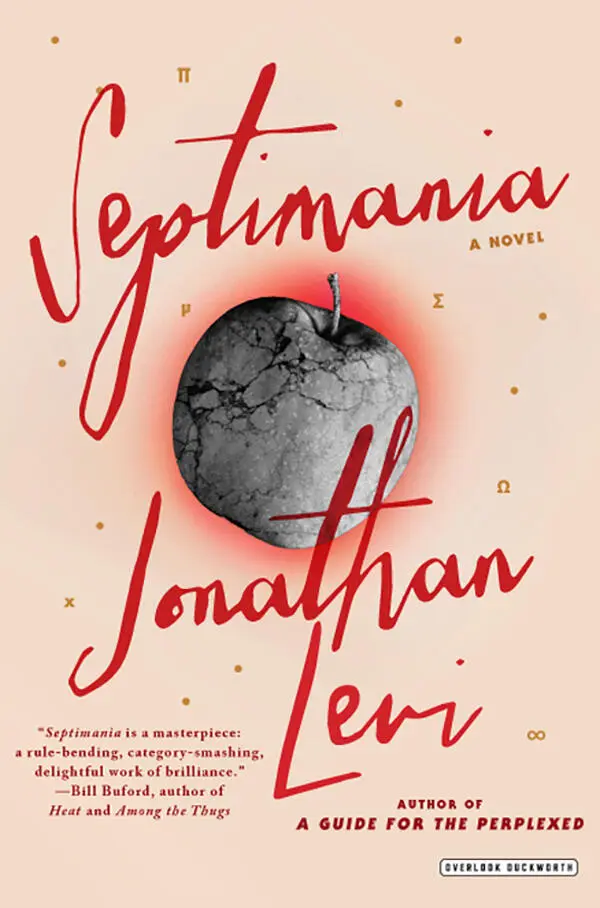
- Название:Septimania
- Автор:
- Издательство:The Overlook Press
- Жанр:
- Год:2016
- ISBN:нет данных
- Рейтинг книги:4 / 5. Голосов: 1
-
Избранное:Добавить в избранное
- Отзывы:
-
Ваша оценка:
Septimania: краткое содержание, описание и аннотация
Предлагаем к чтению аннотацию, описание, краткое содержание или предисловие (зависит от того, что написал сам автор книги «Septimania»). Если вы не нашли необходимую информацию о книге — напишите в комментариях, мы постараемся отыскать её.
Over the next fifty years, Malory’s search for Louiza leads to encounters with Pope John Paul II, a band of lost Romanians, a magical Bernini statue, Haroun al Rashid of Arabian Nights fame, an elephant that changes color, a shadowy U.S. spy agency and one of the 9/11 bombers, an appleseed from the original Tree of Knowledge, and the secret history of Isaac Newton and his discovery of a Grand Unified Theory that explains everything. It is the quest of a Candide for love and knowledge, and the ultimate discovery that they may be unified after all.
Septimania — читать онлайн бесплатно полную книгу (весь текст) целиком
Ниже представлен текст книги, разбитый по страницам. Система сохранения места последней прочитанной страницы, позволяет с удобством читать онлайн бесплатно книгу «Septimania», без необходимости каждый раз заново искать на чём Вы остановились. Поставьте закладку, и сможете в любой момент перейти на страницу, на которой закончили чтение.
Интервал:
Закладка:
They stopped at the fieldstone fence at the top of the dirt road that led down the hill to Ottavia’s yellow cabin by the creek. Malory handed the cabdriver his wallet, furnished by Settimio with enough American money and discreet identification to last him several days. It was almost noon, less than twenty-four hours after Malory first strolled with Ottavia down the road and up the tractor path to the Blue House. Malory was returning to TiborTina. For Louiza? Did he really expect she would be there? For Tibor? Did he really believe he was still alive? For Ottavia? She had spoken to Malory of Haroun and his own return to Rome for the coronation of Charlemagne. Haroun came back for Aldana, Ottavia told him, for the daughter of the Holy Roman Emperor, for love. The driver took what he needed and handed the wallet back to Malory. The Couperin had trickled down into a runnel of sixteenth notes, a soothing anesthetic for his arrival. The driver backed into the dirt road, turned the way he came, and drove off over the last of the organ.
It wasn’t until Malory crested the hill to the pond that he saw any signs of life. There were no cars parked by the Blue House, none by the Red Barn. The pond at noon was still and gray and nearly invisible. Whatever traces Louiza had left in the loam around the edges were merely the residue of his imagination. Malory turned. He hadn’t climbed up the terrace the evening before, hadn’t been invited yet up to the White House. Tibor had left him by the pond while he went to cook dinner, Ottavia had run off to pick herbs, and then there had been Louiza and the explosion and all that followed.
Had the explosion come from the White House?
Nothing was out of place. The potted pines or ferns or whatever Cristina had set in whitewashed uniformity on the steps of the terrace were as Malory remembered — as he remembered as Ottavia ran up the steps of the terrace to pick herbs for Tibor’s pasta. Only the gun was gone — the gun Tibor had handed to him and that Malory had placed back into the plastic bag and set on the table by the pond. And there was a yellow ribbon, barring the way up the first step of the terrace. A plastic yellow ribbon with writing.
When he thought back to the terrace — the lifting of the yellow ribbon, the walk up the steps, the arrival at the top, the discovery of the table holding the half-drunk glass of red wine, the wire-rimmed glasses he had first seen Tibor tweak over his ears twenty-three years earlier as he emerged from the organ case in the loft of Santa Maria sopra Minerva, the Adirondack chair that must have held Tibor in the final moment before he shot a bullet through the roof of his mouth and spattered the ceiling that overhung the terrace and parts of the deck with what had once been his divided mind — Malory couldn’t remember reading the writing on the yellow tape: its warning, its infernal admonition from the police to abandon hope all ye who cross this line. All he remembered was the pull, the pull up the steps. And the music, the noise, the hum, the buzz, the ascent and descent of thousands of flies from roof to deck, from deck to roof, thousands of tiny angels, like the Jacob’s ladder of dust motes he had seen in another organ loft in another lifetime. The message of the flies — this was clear, this he understood.
“Hey, Mac!”
“Hello?” Malory wasn’t certain where the sound came from. He turned to the pond, but the gray surface was level and quiet.
“Hey!” An American voice, followed by the squawk of something electronic. “What’re you doing here?”
Finally Malory saw it, saw the man. He was sitting in a car parked on the driveway just to the side, between the trees that screened the view down to the Blue House. It was a car painted black and white, with a light on the roof. And although the light was unilluminated, Malory was fairly certain that the man at the wheel of the car was a policeman.
“I’m sorry,” Malory said. “I just came back to look.”
The man opened the door to the car slowly and swung his legs and his belly and then the rest of his body out into the open. There was also a mustache and a hat and a badge and a uniform.
“C’mon down from there,” the policeman said, drawing his fingers into his palm as if he wanted Malory to throw him something. Malory looked back at the table with the wineglass and the spectacles, and up at the ceiling. He walked down the steps of the terrace empty-handed and over to the policeman by the patrol car. “Now,” the policeman said, “what were you doing up there?” And although Malory’s answer could have been what he told Louiza in the loft of St. George’s, Whistler Abbey, or what he told Tibor in the loft of Santa Maria, he decided against a frontal response and instead followed the advice of Settimio. Discretion. He was no Roland. TiborTina would not be his Roncesvalles.
“I’m sorry, officer,” Malory replied. “I came back. Yesterday, I was here as a guest. But then there was an accident and I had to leave.”
“Didn’t you see the tape?” the policeman asked.
“Sorry. I’m not from around here,” Malory said. “I don’t know the customs.”
The policeman spoke into his walkie-talkie and passed these bits of information, along with Malory’s name and vitals which he gleaned from items in Malory’s wallet, to someone far away, Malory imagined, someone perhaps with Cristina, perhaps not. Malory looked around in the silence between crackles. He saw that the driveway beyond the patrol car bore the impression of a caravan of tire prints. He tried to imagine what had gone on after the Driver had taken him from the scene of the accident. The ambulance, the police. Cristina in her Yukon, Ottavia he hoped with her. And how had Louiza gone? In another vehicle. How many other vehicles had come and gone in search, in delivery? When had this patrol car arrived to keep watch? To keep watch over what?
“Mr. Malory,” the policeman said to him after the last squawk, “would you mind coming with me? They’ve got a few questions for you.”
“Excuse me?” Malory said. “Who is they? Where do you want me to go?”
“Just get in the front. Don’t worry, you’re not under arrest, just a few questions.”
“But where?”
“Don’t worry,” the policeman said again, “I’ll bring you back for your car.”
“I don’t have a car,” Malory said. “I came by taxi.”
“Well then,” the policeman said, “that’ll make life a whole lot easier. Now if you don’t mind …” And the policeman lifted Malory’s arms and methodically searched him for weapons.
They drove through the Farmers’ Market intersection and turned off River Road into the woods above the Hudson. Malory thought about asking to call Settimio — he wasn’t entirely certain how to contact the Driver. But he was more curious than nervous — he wasn’t under arrest, after all, and that must mean something. He had run from his own Driver in order to find out what had happened to Louiza and Ottavia, and he was still not entirely clear what had happened to Tibor and Cristina, despite the passacaglia of the flies. The policeman claimed ignorance and disinterest. But the drive beneath the screen of American leaves was pleasant. The dappled light of noon wrapped him in a camouflage that felt — despite the discomfort of ignorance — coddled and warm.
The police car pulled up to an iron gate. Through the windshield, Malory saw a pair of men talking into more walkie-talkies. Behind them, a yellow house. Clapboard — that was the word that came to Malory’s mind as the gate opened and the policeman drove through. Clapboard, like the White House at TiborTina. This is America, Malory thought. Clapboard. I like it.
“Wait a minute here, Mac,” the policeman said.
“Of course,” Malory said, thinking, what a wonderful clapboard house.
Читать дальшеИнтервал:
Закладка:
Похожие книги на «Septimania»
Представляем Вашему вниманию похожие книги на «Septimania» списком для выбора. Мы отобрали схожую по названию и смыслу литературу в надежде предоставить читателям больше вариантов отыскать новые, интересные, ещё непрочитанные произведения.









Обсуждение, отзывы о книге «Septimania» и просто собственные мнения читателей. Оставьте ваши комментарии, напишите, что Вы думаете о произведении, его смысле или главных героях. Укажите что конкретно понравилось, а что нет, и почему Вы так считаете.