Jonathan Levi - Septimania
Здесь есть возможность читать онлайн «Jonathan Levi - Septimania» весь текст электронной книги совершенно бесплатно (целиком полную версию без сокращений). В некоторых случаях можно слушать аудио, скачать через торрент в формате fb2 и присутствует краткое содержание. Год выпуска: 2016, Издательство: The Overlook Press, Жанр: Современная проза, на английском языке. Описание произведения, (предисловие) а так же отзывы посетителей доступны на портале библиотеки ЛибКат.
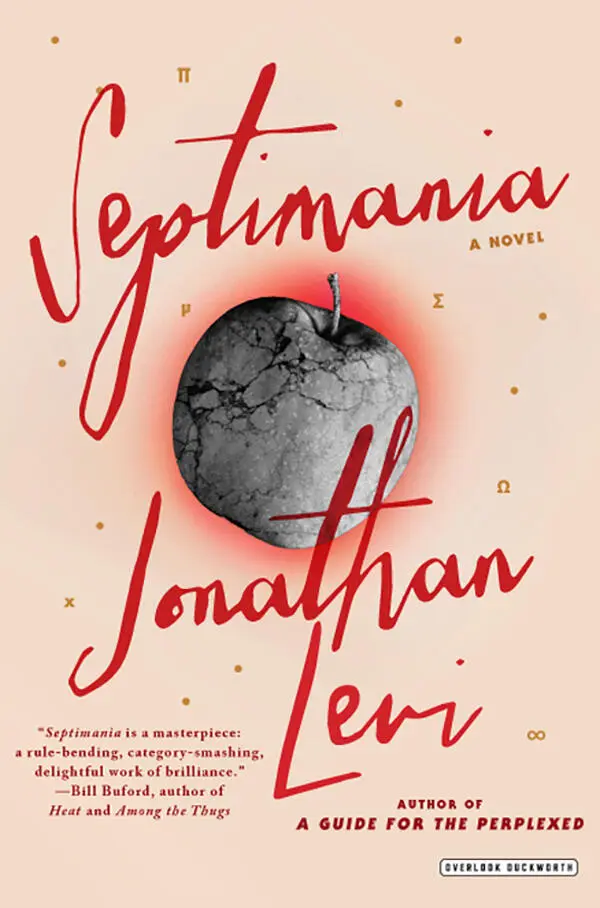
- Название:Septimania
- Автор:
- Издательство:The Overlook Press
- Жанр:
- Год:2016
- ISBN:нет данных
- Рейтинг книги:4 / 5. Голосов: 1
-
Избранное:Добавить в избранное
- Отзывы:
-
Ваша оценка:
Septimania: краткое содержание, описание и аннотация
Предлагаем к чтению аннотацию, описание, краткое содержание или предисловие (зависит от того, что написал сам автор книги «Septimania»). Если вы не нашли необходимую информацию о книге — напишите в комментариях, мы постараемся отыскать её.
Over the next fifty years, Malory’s search for Louiza leads to encounters with Pope John Paul II, a band of lost Romanians, a magical Bernini statue, Haroun al Rashid of Arabian Nights fame, an elephant that changes color, a shadowy U.S. spy agency and one of the 9/11 bombers, an appleseed from the original Tree of Knowledge, and the secret history of Isaac Newton and his discovery of a Grand Unified Theory that explains everything. It is the quest of a Candide for love and knowledge, and the ultimate discovery that they may be unified after all.
Septimania — читать онлайн бесплатно полную книгу (весь текст) целиком
Ниже представлен текст книги, разбитый по страницам. Система сохранения места последней прочитанной страницы, позволяет с удобством читать онлайн бесплатно книгу «Septimania», без необходимости каждый раз заново искать на чём Вы остановились. Поставьте закладку, и сможете в любой момент перейти на страницу, на которой закончили чтение.
Интервал:
Закладка:
The policeman closed his door and locked Malory in. Malory watched him walk up the steps to the veranda that led to a sheltered front door flanked by a window checkerboarded into wooden sashes. A cluster of dried flowers and variegated corn hung off one column. The front door opened and the policeman disappeared. Malory looked up: above, a second story window nestled beneath a peaked gable, a gentle wooden drapery imitating the lace curtain that sat patiently just behind the glass. Malory looked up to that window. He wanted to be there. He hoped, although he didn’t know why, that the policeman would reward his own patience and invite him inside and he could explore that room.
The front door opened again.
“Okay, Mac,” the policeman came around and unlocked Malory’s door. “C’mon in. You’re just in time for lunch.” With a hand on Malory’s elbow, persuasive but not in menace, he helped Malory up the steps of the veranda and served him through the front door.
“Thank you,” Malory said.
“Don’t thank me, Mac,” the policeman said, “I wasn’t invited,” and closed the door.
Malory found himself in a narrow corridor. At the far end stood what looked like a kitchen. There were a few hooks on the wall, jackets and scarves — a woman’s, he thought — hanging even though the day was warm. The corridor smelled of beeswax and sunshine. Malory didn’t know where to go, but for the moment he didn’t mind.
“You can come in here,” a voice called out. It was a male voice, not dissimilar from the policeman’s but with a tone that compromised Malory’s sense of contentment. “First on the left.”
A sofa with faded yellow cushions. A fireplace, unlit, and above it the portrait of a man who might have been a contemporary of Isaac Newton, perhaps another young scientist who had sat for the portraitist, Keller or Kneller — Malory had lived in the land of Bernini long enough to squeeze these Germanic names out of his memory.
“Over here.”
Malory turned away from the portrait. A man was sitting at a round dining table. Behind the man, the midday light set a lacy screen that made it difficult to separate the man’s features from his outline. Malory walked to the table. The man didn’t stand up to greet him, but there was a chair at Malory’s side of the table and a cup of tea and a plate. With a scone.
“Sit down, Mr. Malory.” At this distance, Malory guessed the man was no larger than him, perhaps his age, although with more nose and less hair, and what there was of it was as pale and flat as the midday light. The man had a folder open in front of him in place of tea and scone. Some type of pocket recording device sat at the center of the table. Malory wondered what local police force kept such detailed files that a brief call on a walkie-talkie could identify him as a tea-and-scones man. But he knew it was in Settimio’s nature to anticipate his needs. And he knew that the reach of Septimania was longer than he had interest or ability to understand. “Please,” the man said. “Sit.”
Malory pulled out his chair. And as he did, he saw the piano tucked next to the table in the bay window giving out to the veranda. A baby grand with a light cherry veneer, probably nothing important. But its very lack of importance gave Malory a feeling of security, of nestled comfort. Whatever he was about to learn, whatever had happened to Tibor, to Louiza, to Ottavia couldn’t be that bad if there was music nearby.
“First,” the man said, “let me offer my condolences on the death of your friend Mr. Militaru.”
Malory heard the name, Tibor’s surname, for perhaps only the second time in his life.
“From all appearances, Mr. Militaru died from a self-inflicted gunshot that separated the greater part of the upper half of his skull from the lower. Death was immediate. Please, try the scone. It’s from the Farmers’ Market. They tell me it’s fresh.”
Malory listened as if deciphering an equation in a foreign language. But it was enough to settle the question. Tibor had shot himself. Tibor was dead.
“Where?” Malory began, but the man held up a hand.
“That is all the information I have.”
“Surely,” Malory said, “you can tell me where I am, who you are.”
“You’ll have a chance,” the man replied, “to ask questions. And maybe there will even be someone who can answer them. Someone else. Right now, I’m the one asking. So drink your tea and eat your scone. And then you can tell me why you left Mr. Militaru’s house so quickly yesterday evening.”
“Of course,” Malory said. The man pressed a button on the recorder and waited. Malory spoke. He spoke of his friendship with Tibor, his invitation to Tibor’s birthday, his position in Rome — as the director of a private foundation — and the security requirements surrounding that. His hasty departure was not of his own volition, but company policy. But as Malory spoke, his explanation played back into his own ears as something entirely tuneless and unconvincing. Backlit as he was, the man’s face was impenetrable. Perhaps there was no need to plumb the man’s private reaction. Perhaps all was for the recorder. But as Malory spoke, Malory wondered. Who was listening to the recorder?
Malory finished speaking. The man turned a page in his folder. He turned another. Malory took a bite of the scone. Tasteless. A sip of tea, cold.
“Can you explain,” the man said, turning a third page, “why we found your fingerprints on the gun that killed your friend?”
Malory could explain. Of course he could explain. Tibor had handed him the gun. He had put it back in the plastic bag as quickly as he could and then left it on the table. But the memory of what he had done, or hadn’t done, what he hadn’t prevented, made explanation seem imprecise, perhaps even false, ultimately useless. So this time, Malory chose another option and said nothing.
“Can you explain why, Mr. Malory, in addition to your fingerprints and the fingerprints of your headless friend, we found another set of prints? A set of prints a whole lot smaller? Maybe a girl? Maybe you know of whom I speak?”
Of whom he spoke? Ottavia? Malory thought. Maybe the man knew and was just feeling Malory out. Discretion. He felt Settimio just out of sight behind his right ear, whispering the word. And he said nothing. But he wondered who was listening.
“And finally,” the man stood and walked to the piano by the bay window, unmoved by Malory’s silence, “can you explain why we found a fourth set of prints on the gun, a set that is a perfect match with a man who, at a quarter to nine this morning, flew an American Airlines 767 into the North Tower of the World Trade Center?”
“Excuse me?” Malory said, unable to say nothing to a sentence so foreign in tone and meaning. “Can you repeat your question?” And although, at the beginning, Malory’s disbelief was far greater than the man’s, as the man explained the events of the morning — the four planes, the attack, the collapse, and all that followed — ten minutes of back and forth was enough to transfer that incredulity across the table.
“You really don’t know?” The man — who Malory thought was incapable of surprise — was clearly thrown off balance. “You didn’t see the TV, didn’t hear the radio, run into people on the street?”
“I’m sorry,” Malory said finally, the sound of E. Power Biggs on the taxicab sound system loud in his memory, the soundtrack of his ignorance. “Nobody. I wasn’t.”
“Come with me,” the man said. And something in the atmosphere changed. Malory still didn’t know what the man was talking about. But as he followed the man up the narrow staircase off the front hall, he felt for the first time not only that the man believed him but the weight of his own ignorance.
Читать дальшеИнтервал:
Закладка:
Похожие книги на «Septimania»
Представляем Вашему вниманию похожие книги на «Septimania» списком для выбора. Мы отобрали схожую по названию и смыслу литературу в надежде предоставить читателям больше вариантов отыскать новые, интересные, ещё непрочитанные произведения.









Обсуждение, отзывы о книге «Septimania» и просто собственные мнения читателей. Оставьте ваши комментарии, напишите, что Вы думаете о произведении, его смысле или главных героях. Укажите что конкретно понравилось, а что нет, и почему Вы так считаете.