Jonathan Levi - Septimania
Здесь есть возможность читать онлайн «Jonathan Levi - Septimania» весь текст электронной книги совершенно бесплатно (целиком полную версию без сокращений). В некоторых случаях можно слушать аудио, скачать через торрент в формате fb2 и присутствует краткое содержание. Год выпуска: 2016, Издательство: The Overlook Press, Жанр: Современная проза, на английском языке. Описание произведения, (предисловие) а так же отзывы посетителей доступны на портале библиотеки ЛибКат.
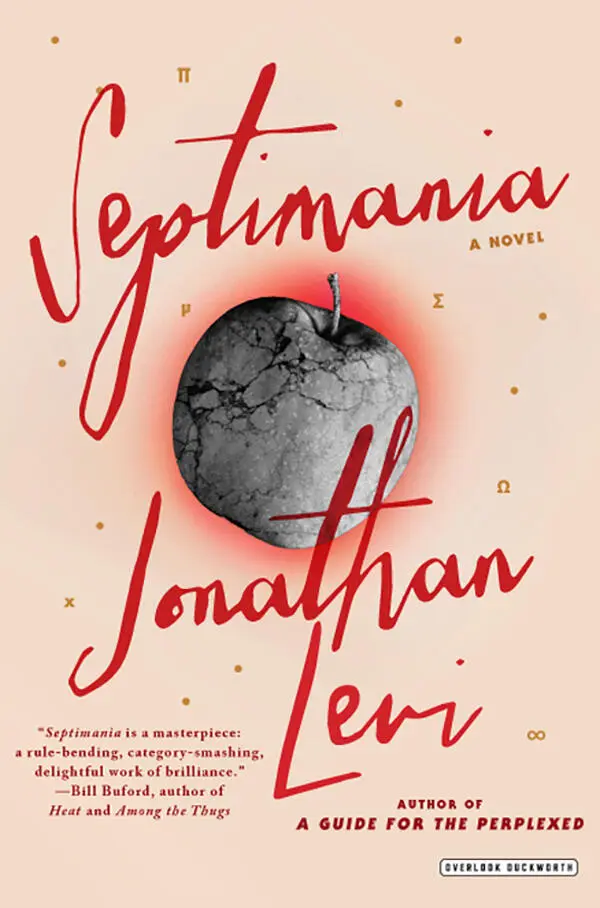
- Название:Septimania
- Автор:
- Издательство:The Overlook Press
- Жанр:
- Год:2016
- ISBN:нет данных
- Рейтинг книги:4 / 5. Голосов: 1
-
Избранное:Добавить в избранное
- Отзывы:
-
Ваша оценка:
Septimania: краткое содержание, описание и аннотация
Предлагаем к чтению аннотацию, описание, краткое содержание или предисловие (зависит от того, что написал сам автор книги «Septimania»). Если вы не нашли необходимую информацию о книге — напишите в комментариях, мы постараемся отыскать её.
Over the next fifty years, Malory’s search for Louiza leads to encounters with Pope John Paul II, a band of lost Romanians, a magical Bernini statue, Haroun al Rashid of Arabian Nights fame, an elephant that changes color, a shadowy U.S. spy agency and one of the 9/11 bombers, an appleseed from the original Tree of Knowledge, and the secret history of Isaac Newton and his discovery of a Grand Unified Theory that explains everything. It is the quest of a Candide for love and knowledge, and the ultimate discovery that they may be unified after all.
Septimania — читать онлайн бесплатно полную книгу (весь текст) целиком
Ниже представлен текст книги, разбитый по страницам. Система сохранения места последней прочитанной страницы, позволяет с удобством читать онлайн бесплатно книгу «Septimania», без необходимости каждый раз заново искать на чём Вы остановились. Поставьте закладку, и сможете в любой момент перейти на страницу, на которой закончили чтение.
Интервал:
Закладка:
“But,” Malory said, “just the other day, the day before yesterday. At TiborTina.”
“He was in the North Tower,” MacPhearson said.
“The World Trade Center?”
“The first one to collapse.”
“He went from TiborTina to the World Trade Center?” Malory asked. “Right after Tibor?”
“He was following Louiza.”
Malory felt ill. Was this what the conversation was about? Had MacPhearson come to tell Malory that Louiza was dead?
“No,” MacPhearson said, in answer to the unasked. “We think Louiza was not in the towers. Maybe Vince was wrong.”
“Vince?”
“Louiza’s husband,” MacPhearson said, and watched Malory’s confusion with interest. “Ah,” he said, “she never told you?”
Malory said nothing.
“There’s no time to weep for poor Vince,” MacPhearson continued, far from tears. “Louiza. We have to find Louiza.”
Now it was Malory’s turn to be discreet. Louiza had married. Louiza had not married Malory. Louiza had married Vince. But Vince was dead.
“ i = u ,” Louiza had told Malory in the beginning. “The implications are potentially dangerous.” Vince was dead, but Malory was alive. Louiza was alive. Malory had a thought. “Mr. MacPhearson,” Malory said, and for the first time stood, “why is Louiza so important to you? What does she know?”
“We don’t know exactly who you are, Mr. Malory. I suspect we will find out, sooner or later. We know you are a physicist. We know that you know that 80 percent of what exists in the universe cannot be seen. But it’s what makes the universe stick. It’s what gives us weight, what gives us gravity. Our search used to be the same as yours — for that dark matter. But now we know that there is another force — a dark energy, an anti-gravity — that is dedicated to sending out its armies of galaxies on an endless jihad to the far corners of space, dedicated to blowing things up, as you saw yesterday, exploding towers, tumbling bodies in a perpetual freefall.
“For 13.8 billion years the universe has been expanding. And in that darkness we have never seen, sits the pitiful dribble of galaxies and stars and planets and mosques and churches and skyscrapers and gabled Victorian piles that we spend 99 percent of our time rebuilding and redecorating. But within that visible matter is one person who has a glimpse into that darkness. We have to find her.”
“Louiza?”
MacPhearson nodded.
“You think that what happened yesterday, the attack against the Twin Towers, the Pentagon, is the fault of dark matter?” Malory’s disbelief had given him a voice. “You think dark energy applies to the motives of people as well as the motions of stars and subatomic particles?”
“Do you think there’s anything else?” MacPhearson asked, and hummed the Goldberg Aria. “Come, Mr. Malory. I know who you are. I know what you’ve been looking for. I need your help.”
“My help?” Malory said. “You have been keeping Louiza away from me for twenty-three years and now you want my help?”
“Yes,” MacPhearson said. “I want your help. We are looking for the same thing.”
“And if I refuse?”
MacPhearson set his hands on his cane and shrugged. “You’re free to go.” He pointed to the far side of the gate. The Driver, Malory’s Driver, was standing at the passenger door of the car that only a few days before had driven him to TiborTina. “Your driver knows how to find me, if you find Louiza.”
Malory walked off the veranda and down the gravel path to the gate. He felt larger, taller than when he’d awakened to the sound of the Goldberg Variations. MacPhearson knew something, but Malory knew more. Without turning back, he sat in the car and waited as the Driver closed the door and returned to the wheel.
“Oh, and Mr. Malory.” MacPhearson hobbled up on his cane and motioned Malory to lower his window. “Mr. Malory,” MacPhearson said, leaning heavily on his stick to bring the remains of his red beard and his coffee-stained teeth to window level with Malory. “If you find that girl, please let us know.”
“Which girl?” Malory said, willing the Driver to back up and leave as soon as possible.
“The girl who left that fourth set of fingerprints on the gun.”
“Yes?” Malory said, thinking of those fingers wrapped around his arm in the innocence of the pasture below the Blue House, her excite ment about the stories of Haroun and Aldana and the remarkable treasure of Judar Son of Omar.
“We ran a quick DNA test on all your prints.”
“I see,” Malory said.
“Of course science requires a little more patience than just a day, but I thought you might like to know.”
“Know what?”
“The girl, you know who I mean,” MacPhearson said. “That girl — well I suspect you suspected.”
“Is my daughter?” Malory asked.
“And Louiza is her mother, yes,” MacPhearson said.
“But a funny thing,” MacPhearson interrupted Malory’s vision, leaning down to the window of the car. “There’s more to the genetic test. It appears that your friend Tibor was her father, too. It all depends on how you look.”
The Driver pulled away from the yellow house with the gables. Malory heard the sound of a guitar, the voice of Dylan, or was it Tibor:
You could almost think that you’re seeing double
On a cold, dark night on the Spanish Stairs.
Two fathers. Malory looked up at the sky. As MacPhearson saw it, there were big things and there were little things. Big things like galaxies, little things like the color-coded quarks that make up the cozy bits of atoms. But that only accounted for a fraction of the stuff that was maybe 5 percent of the universe on a rainy day. The rest was dark matter or dark energy. And Louiza.
3/2
 T WAS A MONTH BEFORE I CAME OUT OF THE WOODS, BEFORE GRAVITY proved stronger than fear and I fell to Earth. My memory of that month includes water — streams, creeks, not all of them the same, a few ponds and September puddles, a lake perhaps. Above all, my memory includes the water that penetrates the forest in the slimmest of trickles, that blackens the bark of maples and birches, and mulches the leaves to an oaken rot that ferments into the colors of nightmares dripping onto softer wounds. My memory includes bugs and beetles, ants and earwigs, small things that wash in acorn cups, things that I followed at night into hollowed trunks, where I folded myself into knotholes, contracted into the shelter of a single leaf to escape the harsher elements and memory herself. Malory believed in One, Tibor in Seven. But the things I saw were beyond number.
I did my best to shut out memory. But at night the music came at me. And it came not just with electric girls in polyethylene thigh-highs and strap-on Fenders, but in a hail of falling leaves, falling branches, falling limbs more present, more horrible than any memory of Tibor’s exploded mind. The unimaginable had happened, although I couldn’t have known it at the time. Unimaginable not just to me and Tibor and Cristina, but to the world outside the forest. And the music of the unimaginable drove a wedge between sleep, thought, and imagination itself.
I don’t know how I coped that month, but cope I did. I swallowed bugs and mushrooms, licked the nighttime moisture from the naked trunks of my fortress. One tree at a time, I began to wander away from my knothole. One dawn, one week — although it could have been two or twelve — after the explosion, I found myself sitting at the edge of my creek, a hundred yards from my cabin, watching the water carry bits of TiborTina to me. I watched as cars came and went, up and down from River Road, policemen, others. And I waited. I don’t know how long I waited — hours, days, with the music louder, if that were possible, than it had been deep in the woods — sitting there on a boulder on the far side of the creek, through the sirens of the day and the Stratocasters of the night. Until one morning …
Читать дальшеИнтервал:
Закладка:
Похожие книги на «Septimania»
Представляем Вашему вниманию похожие книги на «Septimania» списком для выбора. Мы отобрали схожую по названию и смыслу литературу в надежде предоставить читателям больше вариантов отыскать новые, интересные, ещё непрочитанные произведения.








Обсуждение, отзывы о книге «Septimania» и просто собственные мнения читателей. Оставьте ваши комментарии, напишите, что Вы думаете о произведении, его смысле или главных героях. Укажите что конкретно понравилось, а что нет, и почему Вы так считаете.