Jonathan Levi - Septimania
Здесь есть возможность читать онлайн «Jonathan Levi - Septimania» весь текст электронной книги совершенно бесплатно (целиком полную версию без сокращений). В некоторых случаях можно слушать аудио, скачать через торрент в формате fb2 и присутствует краткое содержание. Год выпуска: 2016, Издательство: The Overlook Press, Жанр: Современная проза, на английском языке. Описание произведения, (предисловие) а так же отзывы посетителей доступны на портале библиотеки ЛибКат.
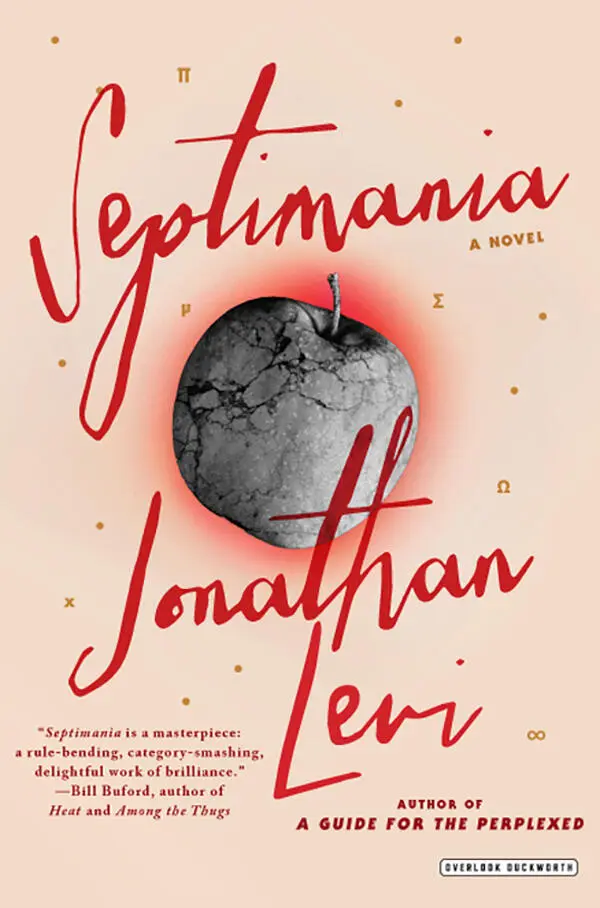
- Название:Septimania
- Автор:
- Издательство:The Overlook Press
- Жанр:
- Год:2016
- ISBN:нет данных
- Рейтинг книги:4 / 5. Голосов: 1
-
Избранное:Добавить в избранное
- Отзывы:
-
Ваша оценка:
Septimania: краткое содержание, описание и аннотация
Предлагаем к чтению аннотацию, описание, краткое содержание или предисловие (зависит от того, что написал сам автор книги «Septimania»). Если вы не нашли необходимую информацию о книге — напишите в комментариях, мы постараемся отыскать её.
Over the next fifty years, Malory’s search for Louiza leads to encounters with Pope John Paul II, a band of lost Romanians, a magical Bernini statue, Haroun al Rashid of Arabian Nights fame, an elephant that changes color, a shadowy U.S. spy agency and one of the 9/11 bombers, an appleseed from the original Tree of Knowledge, and the secret history of Isaac Newton and his discovery of a Grand Unified Theory that explains everything. It is the quest of a Candide for love and knowledge, and the ultimate discovery that they may be unified after all.
Septimania — читать онлайн бесплатно полную книгу (весь текст) целиком
Ниже представлен текст книги, разбитый по страницам. Система сохранения места последней прочитанной страницы, позволяет с удобством читать онлайн бесплатно книгу «Septimania», без необходимости каждый раз заново искать на чём Вы остановились. Поставьте закладку, и сможете в любой момент перейти на страницу, на которой закончили чтение.
Интервал:
Закладка:
I looked up. Or to be more precise, something made me look up, an unfelt hand that lifted my chin, until my eyes saw the spot, the spot on the overhang of the terrace, a single spot that must have missed the high-power hoses.
How many wonders happen as if by magic? I don’t know whether it was gravity or another force — the apple in the leather pouch that had only recently been suspended between the figures of the man and the woman in the Villa Septimania, the attraction of the treasure and the seeker, but a moment later the Pip separated from whatever bit of Tibor had glued it to the overhang and was in my hand. Was it the Pip I had seen Tibor swallow at the edge of the pond? The Pip that had found its way upward out of Tibor’s blasted head to the roof of the overhang of the terrace? The Pip that, as far as I could tell, had waited while I hid unconscious in the forest, until I rewired myself and returned to find it?
But as it fell into my palm, as I closed my fingers around the Pip, I saw something else. I saw what my nightmares in the forest had been telling. I saw the airplanes, I saw the towers, I saw the flames, the ashes of incinerated words, the falling bodies. I saw the man I had seen at the back of the Seven Veils, the man who had wanted to attack Tibor. And I saw other men, other women, hundreds of them. I looked down from the terrace and I saw what Tibor must have seen in his final moment — an entire history, an entire empire. Thousands of people, perhaps more, filling every edge of the TiborTina, ordinary men, ordinary women, children ranked as neatly as convent girls singing backup to the Rolling Stones, standing waist deep in the pond, perched on trees, spreading into the shadows of the forest, nested atop isolated columns above the crumbling ruins of ancient cities like seagulls awaiting the decline and the fall, circle after circle, as many as the fireflies. And in front of me, as an invisible DJ rode his volume pods up to eight, four unimaginably kick-ass girls in thigh-high boots and PVC mini-dresses pounded out the opening chords to a song whose lyrics I didn’t know but in a key I recognized, as unimaginable as that might be.
“So …” the voice said behind me. “You found it.” I reached back without looking, unwilling to see the half-face I was sure would greet me. I grabbed a microphone from his hand and stumbled forward, still unclear, wondering what I was meant to sing. I looked up towards the audience of thousands and saw her. There she was in the front row, the blonde woman from the Farmers’ Market, the woman I had seen talking with Malory by the pond. She smiled at me and the Pip grew warm in my hand. The apple glowed in my leather pouch. Her head swayed, her shoulders rolled softly to the music. She knew the girls in the band and she knew the words. She was my mirror and my teleprompter. Microphone gripped tight, I stepped forward as the spotlight picked me out from an impossible angle on the rising moon and I sang.
3/3
 ALORY STOOD AT THE GATE OF TRINITY AND WONDERED.
It had been twenty-three years since he last walked through Cambridge.
He had walked from the station, the towers of Addenbrooke’s Hospital at his back, dodging bicycles on Parker’s Piece — academics in their daily migration and townies on an early-evening forage for bitter and crisps. He had pulled his suitcase, his worldly belongings, down St. Andrew’s Street, through Lion’s Yard to King’s Parade. Malory had thought very little over the past quarter century of the hours, years he had spent with Chelsea buns and Cumberland sausages in the tea rooms and butcher shops, in the tie-dyed emporia or at the fruitmonger’s buying organic papadums or bruised Prince Williams. Gone, all of them. Gone were the stalls in the market, where E. Power Biggs rubbed vinyl with Billy Preston, and Telemann shared a rack with Telephone Bill and the Smooth Operators. The ghosts of the Taboo Disco Club, the Whim, the Eros had taken up residence in Top-shops and H&Ms. Malory’s own back was scarred from his journey. His feet shuffled down Trinity Street thanks only to the motor of memory, his suitcase trailing like a minor moon.
Malory stood at the gate of Trinity and wondered whether he dared go inside. Henry VIII still guarded the entrance with a stone sword or chair leg or hank of mutton in one hand. The remnants of Newton’s garden sat between the gate and the chapel. Above and to the right, his windows — Newton’s windows, Malory’s windows, inset between the chapel and the bay window that had once been Newton’s loggia — still looked out on Trinity Street, still felt the shade of the anniversary apple tree. For seven winters and seven summers, Malory had sat behind those windows. He had read and he had thought. He had written nothing. Seven autumns of wood fires and moldering leaves, seven springs of thaw. Seven years of paths worn between those rooms and the chapel, the tea room of the University Library, the weekly bicycle ride to Whistler Abbey, and the occasional journey to organs on other greens, in other fens. There had been the High Tables, of course, and pints in the Portland Arms and the Eagle, Sunday lunches at the Spade and Beckett, long afternoons cross-legged on the carpet at Heffers or eating buns in the steamy intimacy of The Whim, and Saturday night Herbie Hancock marathons upstairs on Rose Crescent — the naïve entertainments of a student who might have had a special facility for organs and the history of science, but was otherwise just a normal lad who wanted to fit in, to be coupled to other pipes and sing less solo.
Newton, of course, was a resident of those windows for much longer than Malory — over thirty years, even if one subtracted the months that Trinity closed for the Plague and Newton traveled with his friend, the King, the Queen of Septimania. For the first time Malory wondered — was it mere coincidence that had brought him those two windows in Trinity? Or were all the other tenants, from Newton through the eighteenth, nineteenth, and much of the twentieth centuries also direct descendants of the Great Sir Isaac? Were they all kings of Septimania? Had they all been expelled from Paradise?
It had been seventy-two hours since Malory flew back from New York to Rome. International flights began again on September 15, only four days later than Malory had intended to return to the Villa Septimania. But intention no longer had much connection with what Malory experienced. For three days and three nights, Malory sat in the Good Knight’s Inn, fed, watered, and generally supervised by the Driver. During the days, the image of Louiza’s face from across the pond seemed no farther than the other side of the motel window. Malory felt certain that all he needed do was open the door to the room and she would be on the other side. But every time he turned the deadbolt with the intention of stepping out to find Louiza, to rescue her from whatever terror or loneliness she was facing, a magnetic force, as strong as the one that had pulled him to her that afternoon so long ago in the organ loft of St. George’s, turned on its pole and pushed him back into the room. Don’t, it said. Stay away. And at night, the red-bearded face of MacPhearson would blink with the regularity of the digital alarm clock. I’m watching you, Malory, it said. If you look for her, if you find her, I will take her from you. For three mornings, Malory awoke convinced of an awful truth — as long as he didn’t look, Louiza would stay alive. And Ottavia. Was MacPhearson looking for her too?
On the fourth day, the Driver drove Malory to Newark. He saw him up to Security, handed him his ticket and passport. Private planes were still grounded, but the Driver, on instructions from Settimio presumably, was able to find a seat in Business Class, if only for Malory himself. It was the first flight back to Rome. From his seat in the relative tranquility of the front of the plane, Malory could see lower Manhattan still smoldering below. Tibor was dead. Louiza, Ottavia, and perhaps even Cristina had disappeared. Smoke covered New York, clouds covered the Atlantic, and even gatekeepers like MacPhearson were confused.
Читать дальшеИнтервал:
Закладка:
Похожие книги на «Septimania»
Представляем Вашему вниманию похожие книги на «Septimania» списком для выбора. Мы отобрали схожую по названию и смыслу литературу в надежде предоставить читателям больше вариантов отыскать новые, интересные, ещё непрочитанные произведения.











Обсуждение, отзывы о книге «Septimania» и просто собственные мнения читателей. Оставьте ваши комментарии, напишите, что Вы думаете о произведении, его смысле или главных героях. Укажите что конкретно понравилось, а что нет, и почему Вы так считаете.