Jonathan Levi - Septimania
Здесь есть возможность читать онлайн «Jonathan Levi - Septimania» весь текст электронной книги совершенно бесплатно (целиком полную версию без сокращений). В некоторых случаях можно слушать аудио, скачать через торрент в формате fb2 и присутствует краткое содержание. Год выпуска: 2016, Издательство: The Overlook Press, Жанр: Современная проза, на английском языке. Описание произведения, (предисловие) а так же отзывы посетителей доступны на портале библиотеки ЛибКат.
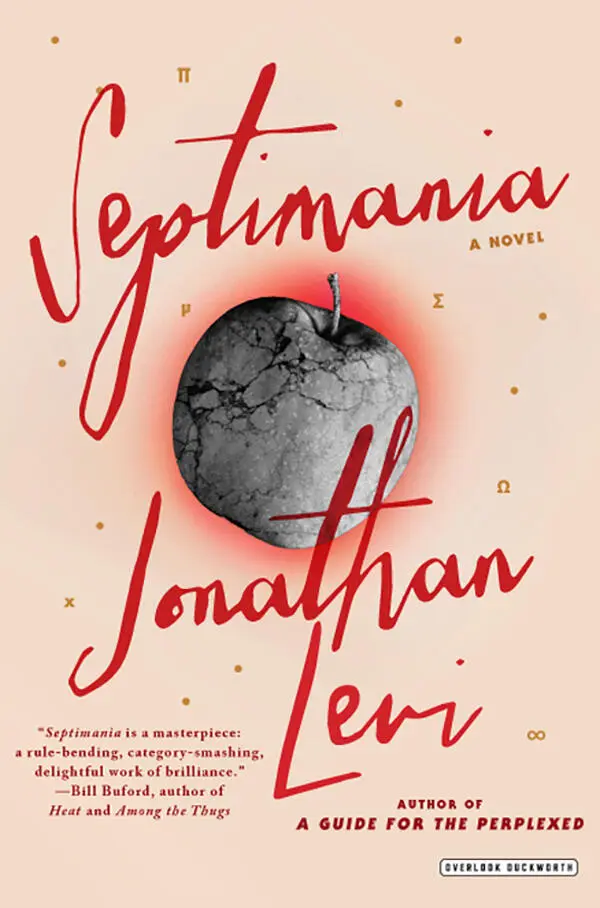
- Название:Septimania
- Автор:
- Издательство:The Overlook Press
- Жанр:
- Год:2016
- ISBN:нет данных
- Рейтинг книги:4 / 5. Голосов: 1
-
Избранное:Добавить в избранное
- Отзывы:
-
Ваша оценка:
Septimania: краткое содержание, описание и аннотация
Предлагаем к чтению аннотацию, описание, краткое содержание или предисловие (зависит от того, что написал сам автор книги «Septimania»). Если вы не нашли необходимую информацию о книге — напишите в комментариях, мы постараемся отыскать её.
Over the next fifty years, Malory’s search for Louiza leads to encounters with Pope John Paul II, a band of lost Romanians, a magical Bernini statue, Haroun al Rashid of Arabian Nights fame, an elephant that changes color, a shadowy U.S. spy agency and one of the 9/11 bombers, an appleseed from the original Tree of Knowledge, and the secret history of Isaac Newton and his discovery of a Grand Unified Theory that explains everything. It is the quest of a Candide for love and knowledge, and the ultimate discovery that they may be unified after all.
Septimania — читать онлайн бесплатно полную книгу (весь текст) целиком
Ниже представлен текст книги, разбитый по страницам. Система сохранения места последней прочитанной страницы, позволяет с удобством читать онлайн бесплатно книгу «Septimania», без необходимости каждый раз заново искать на чём Вы остановились. Поставьте закладку, и сможете в любой момент перейти на страницу, на которой закончили чтение.
Интервал:
Закладка:
“Father always said that he missed the sound of your playing. ‘There was none like Malory,’ he said. He waited twenty years, you know,” she added, “until he couldn’t wait anymore.” And with a final press of the palms, Sybil left Malory to climb alone and she joined the mourners at the coffin at the altar-end of the chapel.
Now Rix, Malory thought. Dead from waiting for the Toccata and Fugue in D minor —which sat open on the music stand. The hired organist slid aside to make room for Malory. Malory was late again. He was as late as he had been for Settimio, for his grandmother, for his thesis, and above all for Louiza. When had he forgotten how to tell time? When he climbed onto the back of the Driver’s Vespa, or long before, when he invited the pale, fair-haired girl up to the organ loft of St. George’s, Whistler Abbey? Or perhaps even at birth, three months too late to know his father. Fifty years ago, Malory thought. Fifty years ago the other Malory, the elder Malory, had drowned, knocked into the water by his eagerness, by the ferry that was bringing his young bride, the pregnant Sara, to him. In three months I shall turn fifty, Malory thought and remembered Tibor’s last words before he swallowed the Pip — I will not turn fifty. Je refuse.
Over the top of the music stand, Malory looked into the forechapel. There was Newton, walking off his pedestal towards him. It was the short-haired Newton, the fifty-year-old Newton. A Newton backed by a marble plaque memorializing the War Dead, the Trinity fellows who gave their lives for the England of Edward III, for principles as ingrained into their patriotic hearts as the cosmic laws of gravity. A Newton who looked, with his half-open mouth and firm step, as if he were ready to lead them like Edward III to victory over the French or the Nazis and maybe even smother Thomas Aquinas under the banner Sapientia Vincit Malitia— Knowledge Conquers Evil.
But Malory knew better. Malory knew this was the fifty-year-old Newton of 1692. The Newton of that lost year, when he didn’t eat, didn’t talk, didn’t sleep. This was the Newton conquered by a sorrow impervious to the remedies of science, the Newton who wrote to his best friends, John Locke and Samuel Pepys, that if he ever saw them again he would kill them. The Newton of 1692, the last date in the chapbook that Malory’s grandmother, Old Mrs. Emery, had given him; the same Chapbook that was the diary of the Prince, of the Princess of Septimania.
I will not turn fifty— Je refuse. Tibor’s words came at him again. He tried to look at the music, to turn to the Bach. But no turn was possible. Newton fixed him with his marble glare. I shan’t turn fifty, Newton said to him. I shan’t turn fifty, Malory answered. I shan’t turn fifty, Malory knew. Je refuse.
3/4
Master’s Lodge, Trinity College
24 December 1692
 y Dear Pepys,
This evening I abandoned Lady Montague and the children and took myself across Great Court to Newton’s rooms. Christmas Eve, as you well remember, is a muffled holiday at Trinity — the fellows deserting the stairwells for more familial climes. But at noon, the Head Porter informed me that Newton was still in residence, although the man himself had not been sighted in some days. I climbed the stairs and knocked on Newton’s oak to convey not only your but also my best wishes on the eve of the anniversary of the birth of Our Saviour and the eve of Newton’s own fiftieth birthday.
“Go away!” Newton shouted at me.
“My dear Newton,” I said, “I hate to see you suffer so.”
He opened the door with one mad pull. He stood wigless, without a jacket, his boots unlaced, a sheet of foreign paper dangling limply from one hand. “What do you know of how I suffer?” I looked into his rooms. Since he made no effort to block my entrance, I walked in. The disorder was indescribable, the stench even worse.
“I know,” I continued, opening the window onto Trinity Street, “that you have not touched food these four days and that the porters say you have neither ventured forth from your rooms nor extinguished your candle this week. I dare say you are not sleeping.”
“You are correct,” Newton said, in a somewhat more placatory manner. “I have not slept for close on eighteen months.”
I was too astonished to carry on this line of inquiry. Newton continued.
“For these past twenty-five years,” he said, speaking as much to the letter in his hand as to me, “I have been thinking, at various times, on the attraction at a distance between two bodies, and from thence, the attraction between three.”
“And for this reason,” I asked, “you neither eat nor sleep?”
“The force, for example, that the Earth exerts on the Moon and the Moon on the Earth. And then the force that the Sun exerts on the Earth and the Moon and the force those two exert on the Sun.”
“Or the force,” I tried to lighten the conversation, “you exert upon those like myself who are worried about the effects this study is having on your body.”
“Yes,” Newton replied, vaguely. I knew he was not fond of metaphor. But I had a sense that I was not far off by bringing the conversation down to Earth. I doubted that the affairs of the cosmos could produce such a calamitous effect in our most gifted fellow.
“My dear Newton,” I said, gripping his shoulder. “It is fast approaching the dinner hour. Lady Montague and I are entertaining some friends at the Lodge. There will be music, dancing, children. We would be delighted to count you among our guests in, say, an hour’s time? Tonight, after all, is the eve of the birth of Our Saviour.”
“Yes,” Newton replied, just as vague but with the hint of a smile. “And mine.”
“What?” I feigned. “You were born on Christmas Day?” Newton nodded. The smile remained, but his eyes wandered over to a portrait above the mantle. It was a sketch in brown charcoal, a sylvan scene, a man and a woman tossing a ball, the ball suspended between them, the motion caught in flight.
“Septimania,” Newton said.
“Excuse me?” I replied.
“Septimania,” he repeated. “It is the reason, Lord Montague, that I must decline your generous invitation. Please tender my best wishes to your gracious wife.”
“If I cannot persuade you,” I said, “please allow me to send over a tray. You must eat something. And certainly,” I added, “you must celebrate your own birthday with a slice of my wife’s Christmas Pudding.”
“I have made many calculations in my life, Master Montague,” Newton said. “I have read the Holy Scriptures,” he continued, “and I have calculated that the Battle of Armageddon will bring the Universe to a violent end less than four centuries from now.”
“By that time,” I began — and I must confess I was at a momentary loss for a riposte—“you and I shall certainly be long gone. Although my wife’s Christmas Pudding may still be edible. Let us gather our rosebuds, as Old Herrick suggested …”
“I can calculate the motions of heavenly bodies,” Newton went on, “but not the madness of people.”
“I don’t follow you, dear fellow,” I told him, brought up short by that word.
“I shan’t turn fifty,” Newton mumbled, folding the letter carefully and placing it into an envelope on top of his papers. He was smiling so benignly, Pepys, and the disorder of his countenance had realigned itself into something so delicate and determined that it wasn’t until I awoke this morning that the words took on a more terrible meaning. I called on the Porters, however, who told me that Mr. Newton had been in and out of college all day, preoccupied, yes, but as was his wont.
Читать дальшеИнтервал:
Закладка:
Похожие книги на «Septimania»
Представляем Вашему вниманию похожие книги на «Septimania» списком для выбора. Мы отобрали схожую по названию и смыслу литературу в надежде предоставить читателям больше вариантов отыскать новые, интересные, ещё непрочитанные произведения.



Обсуждение, отзывы о книге «Septimania» и просто собственные мнения читателей. Оставьте ваши комментарии, напишите, что Вы думаете о произведении, его смысле или главных героях. Укажите что конкретно понравилось, а что нет, и почему Вы так считаете.