Jonathan Levi - Septimania
Здесь есть возможность читать онлайн «Jonathan Levi - Septimania» весь текст электронной книги совершенно бесплатно (целиком полную версию без сокращений). В некоторых случаях можно слушать аудио, скачать через торрент в формате fb2 и присутствует краткое содержание. Год выпуска: 2016, Издательство: The Overlook Press, Жанр: Современная проза, на английском языке. Описание произведения, (предисловие) а так же отзывы посетителей доступны на портале библиотеки ЛибКат.
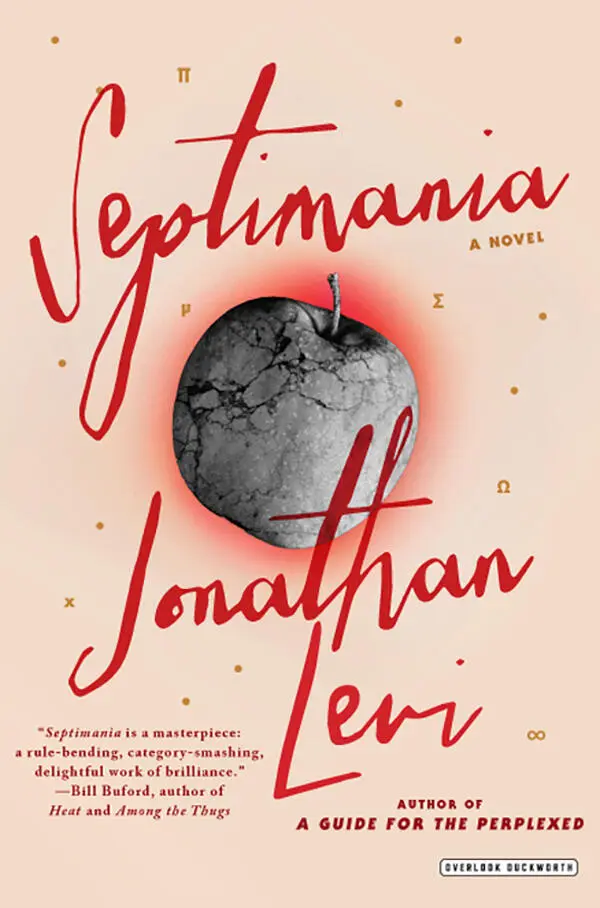
- Название:Septimania
- Автор:
- Издательство:The Overlook Press
- Жанр:
- Год:2016
- ISBN:нет данных
- Рейтинг книги:4 / 5. Голосов: 1
-
Избранное:Добавить в избранное
- Отзывы:
-
Ваша оценка:
Septimania: краткое содержание, описание и аннотация
Предлагаем к чтению аннотацию, описание, краткое содержание или предисловие (зависит от того, что написал сам автор книги «Septimania»). Если вы не нашли необходимую информацию о книге — напишите в комментариях, мы постараемся отыскать её.
Over the next fifty years, Malory’s search for Louiza leads to encounters with Pope John Paul II, a band of lost Romanians, a magical Bernini statue, Haroun al Rashid of Arabian Nights fame, an elephant that changes color, a shadowy U.S. spy agency and one of the 9/11 bombers, an appleseed from the original Tree of Knowledge, and the secret history of Isaac Newton and his discovery of a Grand Unified Theory that explains everything. It is the quest of a Candide for love and knowledge, and the ultimate discovery that they may be unified after all.
Septimania — читать онлайн бесплатно полную книгу (весь текст) целиком
Ниже представлен текст книги, разбитый по страницам. Система сохранения места последней прочитанной страницы, позволяет с удобством читать онлайн бесплатно книгу «Septimania», без необходимости каждый раз заново искать на чём Вы остановились. Поставьте закладку, и сможете в любой момент перейти на страницу, на которой закончили чтение.
Интервал:
Закладка:
The smile, the mouth. A map of ridges and valleys climbing up to a tree line of spiked black hair. The man pushed his way past Louiza, a paper bag of groceries in each arm. Louiza turned towards him and followed down the hall.
“Hey, Lou! Front door! It’s freezing!”
Louiza turned back and shut the door. There was a window — nine panes of glass on the front door — frosted. Beyond, a veranda, snow, trees covered with snow.
Louiza had no idea where she was. She had never seen the man before.
Something was missing.
Through the vague light of the hall, through a door at the far end, Louiza saw the man set the two bags down on a table. The man disappeared. A tap opened, the sound of water in a tea kettle, the pop of a flame. The man reappeared, turned towards Louiza, smiling, blowing on his hands, slipping his arms out of his parka.
“Colder than a Siberian nun!” The man hung the parka on a wooden peg in the hallway. Something dripped onto the floor. “Hey, Lou!” The man was wearing a T-shirt, a white T-shirt. He took Louiza by the shoulders — not roughly but not with delicacy either — and drew her head into his chest.
Louiza had never seen this man. But with her cheek turned against his chest, she could see the figure tattooed into his bicep. It was a figure she recognized — the long s of the integral sign. The formula for the logarithmic constant of e to the power of x.
∫ e x
Mathematics. Maths. Maths she knew.
“How about a cuppa your good ol’ English tea?” The man let her go. He walked down the hall and disappeared to the side across from the dining room. She heard the sound of a zipper, water splashing, a soft moan.
American.
This was not the cottage. This was not Rome. She had no idea where this was.
There was a pine tree inside the house. Something was missing.
Louiza reached up to the wooden peg and took down the dripping parka. She slipped her arms into the sleeves and zipped it shut. She turned the handle of the door. She walked out onto the veranda, yellow boards through the snow, a gable. She breathed. Her eyes opened. Cold climbed from her bare feet to her knees, rung by rung. The Gables. She took another breath.
There had been a plane. There had been a car, a ride through a city, up a river. A pine forest, a mountain, a yellow house, The Gables.
Vince — the man was Vince. American. A soldier. He taught at a place called West Point; he taught soldiers. He taught soldiers maths, he taught soldiers mathematics. He drank beer at a bar down by the river. He brought groceries and beer home in paper sacks and made tuna salad for lunch and steak for dinner. And at night he drank beer and then he came upstairs and slept with her.
Vince. Was Vince her husband?
Something was missing.
And in the morning, Vince cooked oatmeal and left a folder of maths problems on the dining room table. Just like at the cottage.
But she wasn’t at the cottage. She was with Vince, who taught maths to soldiers, who brought her problems and took back the answers and drank beer. She was in America.
Something was missing. She had to go back. She stepped off the verandah into the snow.
“Good morning, Louiza.”
Another man, larger than Vince. In a large parka. Much larger. And under the hood, a red beard. This man she had seen before. This man she remembered.
“Lou, honey!” Louiza turned. It was Vince, out in the cold with his T-shirt. “Where you goin’? I didn’t see her go out,” he explained to the man with the red beard. “Lou, what you doin’ out here in the snow without no shoes?”
Louiza looked down at her feet, snow melting in the heat between her toes.
“Come, come inside, Louiza.” The large man took her arm, took her by her arm in her parka and gently turned her around. His voice was deep; she knew this voice. Louiza’s feet made little angels in the snow.
Louiza was sitting at the dining room table by the papers. Vince was on one side, the red-bearded man on the other. MacPhearson — that was another name, his name. She had met him at the Orchard with her mother and father. MacPhearson. She had seen him before. There was steam. There was tea. No parkas. Her feet were dry and warm in long, gray socks. MacPhearson was speaking.
“Louiza,” MacPhearson said. “How long is it that you’ve been with us?”
With us? With whom? She was in America, now she remembered, somewhere up the Hudson — that was the name of the river. How long had she been with the Hudson? With America?
“Little over two months,” Vince said. “Christmas last week.”
“Thank you, Vince,” the man with the red beard said. Louiza remembered. MacPhearson didn’t like Vince. But Vince couldn’t afford to get angry.
“You remember the cottage, Louiza?” MacPhearson said.
Christmas.
“You did very good work for us back there,” MacPhearson said. “Very good work.”
The pine tree indoors. Christmas.
“But the last two months,” MacPhearson said.
“I’ve been bringing the problems to her,” Vince said. “I’ve been bringing the answers back.”
“But the answers haven’t made sense, unfortunately.” MacPhearson took a sip of his tea. “Cookie?”
The answers. The problems.
“Please,” Louiza said, “I should like to go home.”
“Lou, honey,” Vince said, “you are home.”
“Discretion,” MacPhearson said to Louiza. “Do you know the meaning of the word?”
“Secrecy,” Vince added. MacPhearson held up a hand full of red-haired knuckles and warning. Vince stopped.
“You have a gift, Louiza,” MacPhearson said. “A gift for solving problems in the realm of imaginary numbers that has had very real results. More,” he chuckled, “than you might imagine. And more than many others might imagine. Which is why, for the immediate future, we need to exercise discretion as to your identity and your location.” And then MacPhearson stopped smiling. “But lately, something is missing, Louiza,” MacPhearson said, taking a bite of shortbread. “Something …”
“Yes!” Louiza turned to MacPhearson. He had said what she had been thinking. Something was missing. There were crumbs on his beard. And in between his upper two teeth, a piece of shortbread was stuck, as big as an apple pip.
“What is it, Louiza?” MacPhearson said. “What happened to your solutions, to your imaginary solutions?”
“The baby …” Louiza whispered. And she saw MacPhearson’s face, with its pip-sized crumb of shortbread looking down on her. Not in that house with the pine tree inside. Not in the cottage, not in the Orchard. In Rome. In a room at the prow of a boat. And she was screaming, and he was talking in his low voice. And then she was screaming in the room at the prow of the boat.
Now she was off the boat, in the house with the pine tree inside.
Louiza jumped up. She ran down the hall. She ran into the bathroom, the kitchen, up the back stairs and into the bedroom and then into the guest bedroom, where Vince slept when she curled up into a ball and refused. Where was it? Where was her baby? Where was her baby? And she screamed. And she screamed. Vince ran up the stairs. MacPhearson looked down on her, his beard full of crumbs, his forehead heavy with sweat.
IT WAS DARK WHEN SHE WALKED BACK DOWN THE STAIRS. MACPHEARSON was gone. Vince was gone. The fire was low behind the grate, but the windows cast a light back onto the tree, the sofa, the lace tablecloth, and the folder of problems, the pencil. Louiza sat in her chair. She was wearing a woolen nightgown, a nightgown her mother had packed for her when she went to Cambridge. Her mother. She pulled her feet up and squatted on the chair below her, and buried her face between her knees for warmth, and rocked. The baby, the baby … where was the baby? What had happened to the baby? Baby, baby …
Читать дальшеИнтервал:
Закладка:
Похожие книги на «Septimania»
Представляем Вашему вниманию похожие книги на «Septimania» списком для выбора. Мы отобрали схожую по названию и смыслу литературу в надежде предоставить читателям больше вариантов отыскать новые, интересные, ещё непрочитанные произведения.










Обсуждение, отзывы о книге «Septimania» и просто собственные мнения читателей. Оставьте ваши комментарии, напишите, что Вы думаете о произведении, его смысле или главных героях. Укажите что конкретно понравилось, а что нет, и почему Вы так считаете.