Breyten Breytenbach - All One Horse
Здесь есть возможность читать онлайн «Breyten Breytenbach - All One Horse» весь текст электронной книги совершенно бесплатно (целиком полную версию без сокращений). В некоторых случаях можно слушать аудио, скачать через торрент в формате fb2 и присутствует краткое содержание. Год выпуска: 2008, Издательство: Archipelago Books, Жанр: Современная проза, на английском языке. Описание произведения, (предисловие) а так же отзывы посетителей доступны на портале библиотеки ЛибКат.
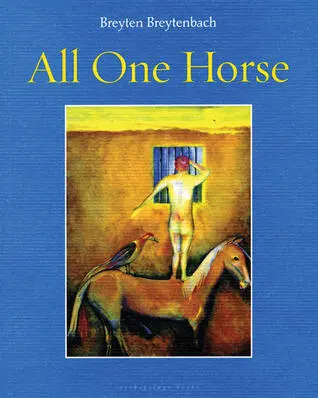
- Название:All One Horse
- Автор:
- Издательство:Archipelago Books
- Жанр:
- Год:2008
- ISBN:нет данных
- Рейтинг книги:4 / 5. Голосов: 1
-
Избранное:Добавить в избранное
- Отзывы:
-
Ваша оценка:
All One Horse: краткое содержание, описание и аннотация
Предлагаем к чтению аннотацию, описание, краткое содержание или предисловие (зависит от того, что написал сам автор книги «All One Horse»). Если вы не нашли необходимую информацию о книге — напишите в комментариях, мы постараемся отыскать её.
“Obviously the greatest Afrikaner poet of this generation. . No one elevated the Boer language to such pure beauty and no one wielded it so devastatingly against the apartheid regime as its exiled poet Breyten Breytenbach.”— All One Horse An outspoken human rights activist,
is a poet, novelist, memoirist, essayist, and painter (his paintings and drawings have been exhibited around the world). After years of exile in France, in 1975 he was apprehended during a clandestine trip to South Africa, accused of terrorism for his anti-apartheid activities, and spent seven years in prison. He received the Alan Paton Non-Fiction Award for
in 1994 and the Hertzog Prize for poetry in 1999 and 2007.
All One Horse — читать онлайн бесплатно полную книгу (весь текст) целиком
Ниже представлен текст книги, разбитый по страницам. Система сохранения места последней прочитанной страницы, позволяет с удобством читать онлайн бесплатно книгу «All One Horse», без необходимости каждый раз заново искать на чём Вы остановились. Поставьте закладку, и сможете в любой момент перейти на страницу, на которой закончили чтение.
Интервал:
Закладка:
In Bombay it is difficult to find an unfrequented votive sanctuary. There is much poverty there — people resting their aching bones for the night in lane and entrepôt, other people under the veil of darkness scrounging in refuse bags for sustenance. Animals too, having to outwit the humans. Animals imitating the sounds of human intercourse. ‘Don’t go shitting there,’ we tell the man, ‘you will find the turd filched from your underpants. And be on the lookout for where you laugh!’ In Bombay there are also grey-vested crows with impertinent stares and evil claws and beaks which they use for tearing apart the human corpses put out for the gods on the Towers of Silence. Gods seldom laugh. That is what distinguishes the man from the gods.
The man has no choice. Man cannot smile without having laughter in reserve. The one abbreviates the other. The one is the flag of the other’s manoeuvres and surrenders. Only politicians can ply a smile with their lips without having anything up the sleeve to back it up with. If man can no longer smile, reflecting the lack and the decadence, bile accumulates in the lower hollows, draining him to bitter despondency, slackening all self-respect. His coffee will have the taste of a fat female thigh. No, man is hooked on the absolute of cackling. How else is he to dog and to dig his death?
We all know how the man, Nascimento Watsenaam, goes erring through the streets until in desperation, sick to his stomach with the need to let his laugh out soon before it becomes a cyst or a cestode or a festering cesspool for small cetaceans, he clambers over a wall into the park on Mulabar Hall where the Towers of Silence try to entice heaven with their fruit of a counter-order. The art is to move away from the sad stench of decomposition and the rigorously patterned flitter of skeletons in moonlight, and yet to find an eddy of obscurity.
He finds it. Or thinks so. There must have been other animals also feeding on the night. Hardly does the laugh protrude when he hears a furtive coming or going. And deeply imbued by etiquette the man gets the fright of his life. Had he but coughed, grabbed the wet laugh and ran! A flash. Too late!
We all see him perish in a figure of speech: glum and deflated, the face gaunt, sunken eyes, not even the most minute uplift of mouth-corners to suggest a whiff of redemption. The man disappears from our knowledge, cursed maybe for ever to move from joke to joke in search of lost levity or levitation. But jokes are placebos for those bitten by the dog of death. We all see him no more.
We all know the thin old cat with the bloated stomach who sometimes burps, licks its whiskers, and cannot repress a sly grin. In exactly this same way does Gautama transmit the essence of his teaching.
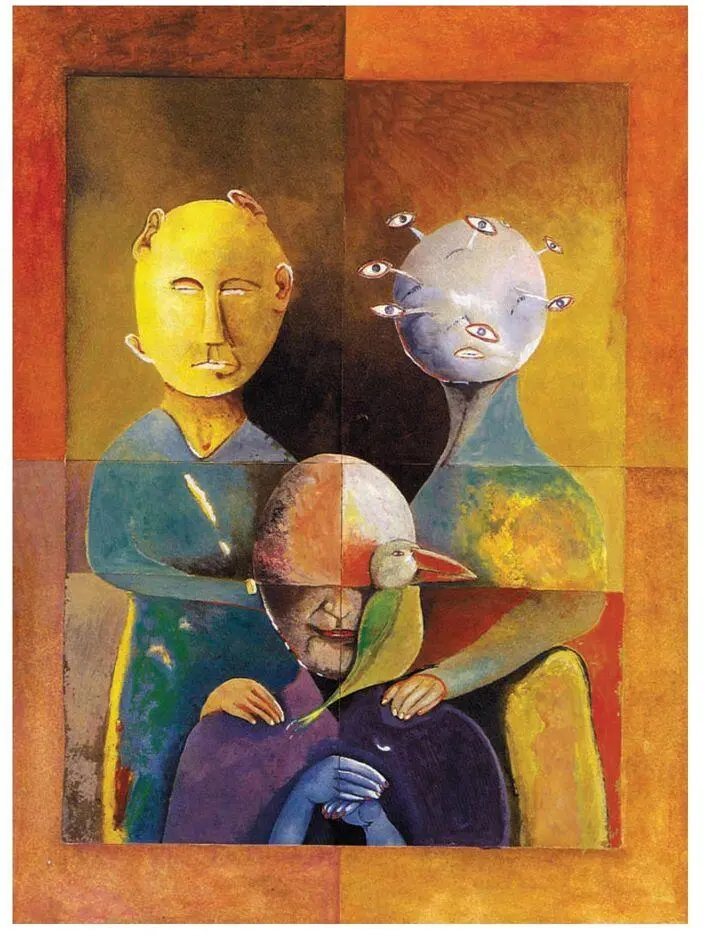
bathed in tears

My mother has been dead for a long time. When she returns her eyesight is not what it used to be and her memory has become erratic. There are loopholes now, and mushy areas of approximation. She returns because she wants to visit with my brother. She has lost her teeth. She has also lost all contact, she says, and she feels it incumbent on her to pick up the threads. She has become finicky, querulous, hard of hearing.
I go to fetch her at the airport. She brings her earthly belongings packed in a cardboard box tied up with rough twine. One becomes very poor in death. It is slightly embarrassing.
I go to fetch her at the airport to take her to my brother’s. I had lost sight of him. It is funny how you can go on living in the same town and yet the world shifts. Youth recedes and no longer bothers you, your pate is polished, you stop visiting certain areas or frequenting the prostitutes and the politicians. They become so dim in the mind’s eye that you end up believing you invented them. You end up forgetting that this is a seaside town with abrupt hills, with dead zones, with botanical gardens, with statues for unknown statesmen, with a wind. You become attached to your attaché-case.
When we arrive at my brother’s place my mother has already forgotten why she came in the first place. It does not really matter. We ride up in the lift. ‘Where are you taking me?’ she asks in an irritated voice. ‘Shall I sing for you? Why can’t you let me be?’ But she doesn’t hear my answer and this angers her so that she decides not to pay any attention.
On the last floor the partitions between the many cubicles, as also the outside walls, are made of glass. My brother resides in a small glass cage. Out there one can see the moon riding stately like a ship coming into harbour after having discovered an unknown continent. ‘Each to his own,’ my brother says. ‘I must have a view on the moon. See how she bobs.’
‘Leave me alone,’ my mother grumbles. She unties her cardboard box, takes out her odds and ends, makes a nest for herself in one corner of the cage. My brother sits stiffly behind his table, his hands rigid like those of some emblematic figure, a pork-pie hat perched on his head. He is thin to the point of emaciation, the dark skin stretched taut over the bones of his face, the ears smaller and more intricate than sea-shells.
We live like this for a long time. My mother spends her days asleep on her pile of rags in the corner. At night, by the light of the moon, I sometimes wake at the feel of her eyes on me, angry like those of an unhappy child. ‘ Who are you?’ she hisses. ‘Keep away from me!’
Day after day I become more fed up. Why should I be subjected to these uncertainties? Why is it so imperative to remember ? To remain integrated with oneself must surely imply to become stultified beyond recognition. In our family we all have blue eyes and smooth cheeks. We have linen-white ears. I look at the mummy at the table. True, we have travelled a long history, but this cannot be my brother !
I look at him from all angles. It is not he. True again, I have been absent for a long sequence of arguments, but could that possibly account for the depredation? I approach him and start shaking him by the arm. ‘Impostor!’ I shout. ‘ Where is my brother? What have you done to B? Who are you?’
I am very upset. I knock his hat off and see his tightly curled hair. I pick up the hat, return it to his head, ram it down over his eyes. ‘You should not obliterate the moon,’ he whispers. I interrogate him. (Where did I learn about interrogation?) ‘Where? When? Why? What? With whom?’ He is implacable. ‘I am your brother,’ he assures me. I find a knife among the old manuscripts over which the mice have pissed in my mother’s box, and try to strip the skin off his hands. Blood stains the table-top. ‘But I am your brother,’ the bewildered man insists. And in a thin voice my mother suddenly starts to wail: ‘Help! Help! They’re killing me!’
I run out. At the end of the corridor in a glassed-in compartment of his own sits a fat man with grey hair. He’s wearing a broad colourful tie. I grab him by the tie. ‘Charley,’ I implore, ‘please, you must help me. You have known the family for a long time. What happened to B? Where is my brother?’
‘Oh dear, oh dear,’ he sighs. ‘No, you couldn’t have known, could you? Where were you during all this book? We tried to keep it hidden so as not to besmirch the family’s name. He went mad, the poor fellow. Was taken to That Place on the hill — you remember?’ Yes, I do remember. Memory is imagination.
Blood on the table, blood on the moon. I pull my mother to her feet. She has wetted her old overcoat. I stuff her belongings back in the cardboard box and down we go in the lift. Down there we shall take the tram going up the hill. ‘Don’t you dare touch me!’ my mother shouts. ‘Rapist!’
Читать дальшеИнтервал:
Закладка:
Похожие книги на «All One Horse»
Представляем Вашему вниманию похожие книги на «All One Horse» списком для выбора. Мы отобрали схожую по названию и смыслу литературу в надежде предоставить читателям больше вариантов отыскать новые, интересные, ещё непрочитанные произведения.






Обсуждение, отзывы о книге «All One Horse» и просто собственные мнения читателей. Оставьте ваши комментарии, напишите, что Вы думаете о произведении, его смысле или главных героях. Укажите что конкретно понравилось, а что нет, и почему Вы так считаете.